
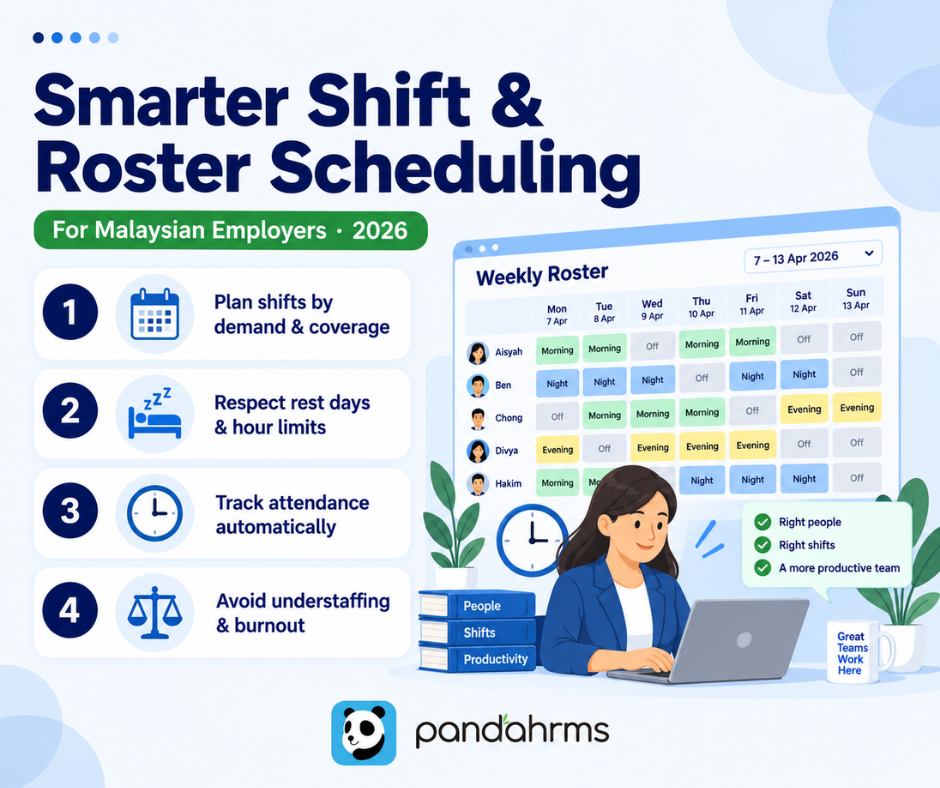
For any business that runs on shifts — retail, F&B, manufacturing, healthcare, security, logistics — the roster is where everything can go right or wrong. Get it right and operations run smoothly. Get it wrong and you’re facing understaffed shifts, runaway overtime, burnt-out staff, and last-minute scrambles. Here’s a practical guide to shift and roster scheduling for Malaysian employers.
What Is Shift & Roster Scheduling?
Shift scheduling is the process of assigning employees to work periods so that the business has the right people, in the right numbers, at the right times — while staying fair to staff and compliant with the law. A good roster balances three things: business demand, employee wellbeing, and legal limits.
The Real Challenges
- Understaffing — too few people on a busy shift hurts service and overloads staff.
- Over-reliance on overtime — patching gaps with OT is expensive and unsustainable.
- Last-minute changes — no-shows and swaps throw the whole roster off.
- Fairness — the same people always getting the bad shifts breeds resentment.
- Compliance — breaching rest-day or working-hour rules creates legal risk.
The Legal Guardrails You Can’t Ignore
Scheduling isn’t just an operational choice — the Employment Act 1955 sets limits you must respect:
- Working hours (Section 60A) — normal working hours are capped (generally not more than 45 hours a week), with limits on daily hours and overtime.
- Rest day (Section 59) — employees are entitled to at least one rest day per week.
- Overtime & holiday pay — work beyond normal hours, on rest days, or on public holidays attracts higher pay rates.
A roster that quietly breaches these — back-to-back shifts with no rest day, or routine excessive hours — is a compliance problem waiting to surface.
Best Practices for Effective Scheduling
Step 1: Schedule to demand, not habit
Staff each shift to actual expected workload (peak hours, busy days), not a flat headcount that leaves you over- or under-staffed.
Step 2: Respect rest days and hour limits
Build the weekly rest day and working-hour caps into the roster from the start — don’t discover a breach after the fact.
Step 3: Be fair and rotate
Rotate less-popular shifts fairly so the load is shared. Fairness is one of the biggest drivers of retention in shift work.
Step 4: Publish early and communicate changes
Give staff their roster with enough notice to plan their lives, and have a clear process for swaps and last-minute changes.
Step 5: Track attendance against the roster
Match who was scheduled to who actually clocked in — so overtime, absences, and coverage gaps are visible and accurate for payroll.
Common Scheduling Mistakes
- Rostering on gut feel instead of actual demand.
- Ignoring rest-day and working-hour limits until it becomes a dispute.
- Relying on overtime to cover chronic understaffing.
- Last-minute rosters that leave staff unable to plan.
- Manual spreadsheets that don’t connect to attendance or payroll.
Chronic understaffing and excessive hours also drive the exact burnout and turnover that make scheduling even harder — see our guide on attendance and time tracking.
Where Pandahrms Helps
Rosters fall apart when they live in a spreadsheet disconnected from reality. With Pandahrms, you can build shift schedules, assign staff by role and location, and have attendance track automatically against the roster — with verified clock-in and geo-fencing so you know exactly who worked when. Rest-day and working-hour visibility helps you stay compliant, and the hours flow straight into payroll for accurate overtime and holiday pay. No more spreadsheet guesswork.
Plan the roster and track it in one place, and scheduling stops being a weekly fire-drill.
Final Thoughts
Good shift scheduling isn’t about squeezing the most out of the fewest people — it’s about matching staffing to demand, respecting rest days and working-hour limits, keeping it fair, and tracking what actually happens. Do that consistently, and you protect service, compliance, and your team all at once.
Frequently Asked Questions (FAQs)
- How many hours can an employee work in Malaysia?
Under Section 60A of the Employment Act 1955, normal working hours are capped (generally no more than 45 hours a week), with limits on daily hours and overtime. Rosters must stay within these limits. - Are employees entitled to a rest day?
Yes. Under Section 59, employees are entitled to at least one rest day per week. Your roster should build this in, and work on a rest day attracts higher pay. - How do I avoid over-relying on overtime?
Schedule to actual demand, plan coverage in advance, and track attendance so gaps are visible early — rather than patching chronic understaffing with expensive, unsustainable overtime. - How much notice should I give for a roster?
There’s no single legal figure, but publishing the roster with reasonable advance notice lets staff plan their lives, reduces no-shows, and improves fairness and retention. - How can a system help with scheduling?
A scheduling and attendance system lets you build rosters, assign staff by role/location, track who actually clocked in against the plan, flag rest-day/hour issues, and feed accurate hours into payroll — removing manual spreadsheet errors.



