When an employee commits misconduct, most employers’ first instinct is to warn — or worse, to sack. But in Malaysia, skipping straight to punishment is one of the fastest ways to lose an unfair dismissal case. The correct first step is almost always a show cause letter. Get it right and you protect the business; get it wrong and even a genuine dismissal can be overturned. Here’s exactly what a show cause letter is, how to write one (with a sample you can copy), and how employees should reply.
What Is a Show Cause Letter?
A show cause letter is a formal letter asking an employee to explain, in writing, why disciplinary action should not be taken against them for an alleged act of misconduct or poor performance. It is not a punishment and not a warning — it’s a request for the employee’s side of the story before any decision is made.
In short: it gives the employee a fair chance to respond, and it gives the employer a documented, defensible record that due process was followed.
Why It Matters: Due Process & Natural Justice
Malaysian employment law is built on the principle of natural justice — the right to be heard before being punished. Under the Industrial Relations Act 1967, reinforced by the Code of Conduct for Industrial Harmony 1975 and decades of Industrial Court decisions, an employer must generally investigate, issue a show cause letter, and allow the employee to respond before taking disciplinary action or dismissing them.
Skip this step and, even where the misconduct was real, the dismissal can be ruled procedurally unfair — exposing the company to reinstatement or compensation orders. The show cause letter is the paper trail that proves you did it properly.
When Should You Issue a Show Cause Letter?
Typically when there’s an allegation of misconduct or a performance issue, such as:
- Attendance issues — repeated lateness, unexplained absence, or abandoning work.
- Insubordination — refusing a lawful, reasonable instruction.
- Breach of company policy — misuse of company property, safety breaches.
- Dishonesty — falsifying records, theft, fraud.
- Poor performance — persistent failure to meet clear, communicated standards.
What a Proper Show Cause Letter Must Contain
A vague letter is a weak letter. To hold up, it should clearly state:
- The specific allegation — what happened, with the date, time, and place.
- The rule or standard breached — reference the policy or expectation.
- A request for a written explanation — why disciplinary action should not be taken.
- A reasonable deadline to reply (commonly 24–72 hours, depending on seriousness and company policy).
- The possible consequences — that disciplinary action, including a domestic inquiry, may follow.
- A neutral, factual tone — no prejudging the outcome.
Sample Show Cause Letter (Template)
|
[Company Letterhead]
Date: [DD/MM/YYYY] To: [Employee Name], [Position] Employee No.: [ID] RE: SHOW CAUSE LETTER Dear [Employee Name], It has come to the Company’s attention that on [date] at approximately [time], at [place], you allegedly [describe the specific alleged misconduct clearly and factually]. This conduct is a possible breach of [the relevant company policy / rule / standard]. You are hereby required to explain in writing why disciplinary action should not be taken against you in respect of the above allegation. Your written explanation must reach [name / HR] within [e.g. two (2) working days] from the date of this letter. Please note that should you fail to respond within the stipulated time, or should your explanation be found unsatisfactory, the Company may proceed with disciplinary action, which may include a domestic inquiry. This letter is issued to give you a fair opportunity to be heard. Yours faithfully, ______________________ Acknowledged received by: ______________ (Employee) Date: __________ |
Always adapt the template to the actual facts — a copy-paste letter with vague allegations is exactly what gets employers into trouble.
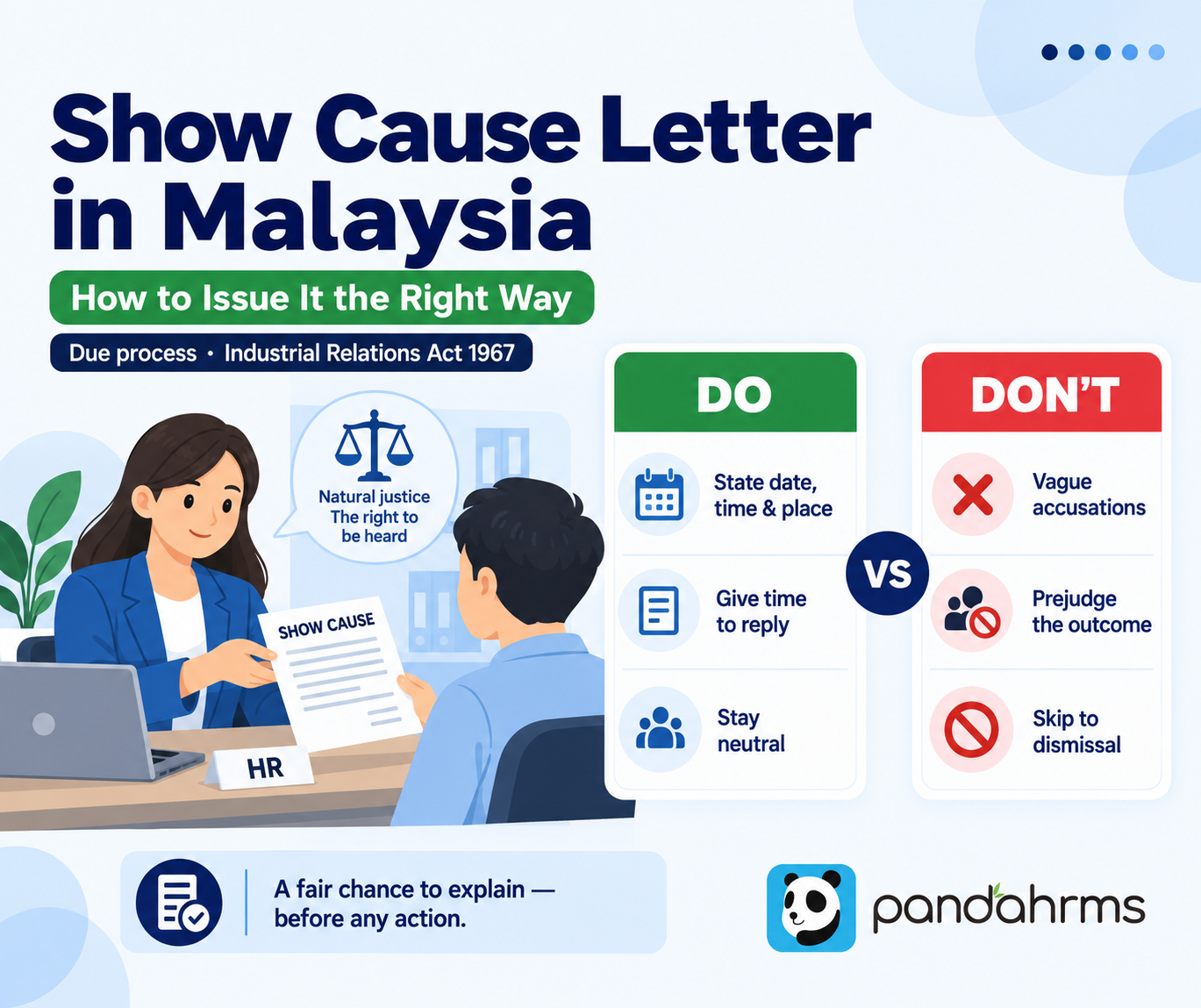
The Do’s and Don’ts
| ✅ Do | ❌ Don’t |
|---|---|
| State the specific allegation with date, time & place | Use vague accusations (“you have a bad attitude”) |
| Give a reasonable, clear deadline to reply | Demand an answer “immediately” or give no time |
| Stay neutral and open-minded | Prejudge — treat the outcome as already decided |
| Genuinely consider the reply before deciding | Issue it as a threat or a formality |
| Keep a signed, dated copy on record | Jump straight to a warning or dismissal |
What Happens After the Employee Replies?
Once the explanation is in, assess it fairly:
- If the explanation is satisfactory — no disciplinary action should be taken. The matter ends there.
- If it’s unsatisfactory (or there’s no reply) — you may proceed with disciplinary action, such as a warning letter for a minor issue, or a domestic inquiry (DI) for serious misconduct.
- Only after due process — including a DI where warranted — should any decision on dismissal be made.
For the next step, see our guide on how to handle a domestic inquiry (DI), and for related situations, managing underperforming employees.
How Should an Employee Reply to a Show Cause Letter?
If you receive one, don’t ignore it — a non-reply is often treated as accepting the allegation. Respond in writing within the deadline, address the specific allegation directly, stick to facts, attach any supporting evidence (messages, records, witnesses), and stay professional. A calm, well-supported explanation can stop the matter from escalating.
Where Pandahrms Helps
A show cause process is only as strong as your records. With Pandahrms, the evidence you need is already there: verified attendance and clock-in data for lateness or absence cases, a complete employee record with prior warnings and documents, and a clear, time-stamped trail for every action. When an allegation is about attendance or absenteeism, you’re not relying on memory or messy spreadsheets — you have the exact records to state the allegation precisely and defend your process. Fair, documented, and audit-ready.
Final Thoughts
A show cause letter isn’t red tape — it’s the step that keeps your disciplinary process fair and legally sound. State the allegation clearly, give a reasonable chance to respond, weigh the reply honestly, and document everything. Do that consistently, and you protect both your employees’ right to be heard and your company’s position if the matter ever reaches the Industrial Court.
Frequently Asked Questions (FAQs)
- Is a show cause letter a punishment?
No. It’s a request for the employee’s written explanation before any decision is made. It gives the employee a fair chance to be heard and is not itself a warning or penalty. - Is issuing a show cause letter legally required in Malaysia?
It’s not a single statutory form, but it’s a core part of due process and natural justice under the Industrial Relations Act 1967 and the Code of Conduct for Industrial Harmony 1975. Skipping it can make a dismissal procedurally unfair. - How long should you give an employee to reply?
Commonly 24 to 72 hours, depending on the seriousness of the allegation and company policy. The key is that the time given is reasonable. - What happens if the employee doesn’t respond?
A failure to respond within the deadline may be treated as the employee having no explanation, and the company can then proceed with disciplinary action or a domestic inquiry — provided due process is still followed. - Can an employer dismiss an employee straight after a show cause letter?
Generally no. If the explanation is unsatisfactory and the misconduct is serious, the proper next step is usually a domestic inquiry before any decision on dismissal — not immediate termination.