
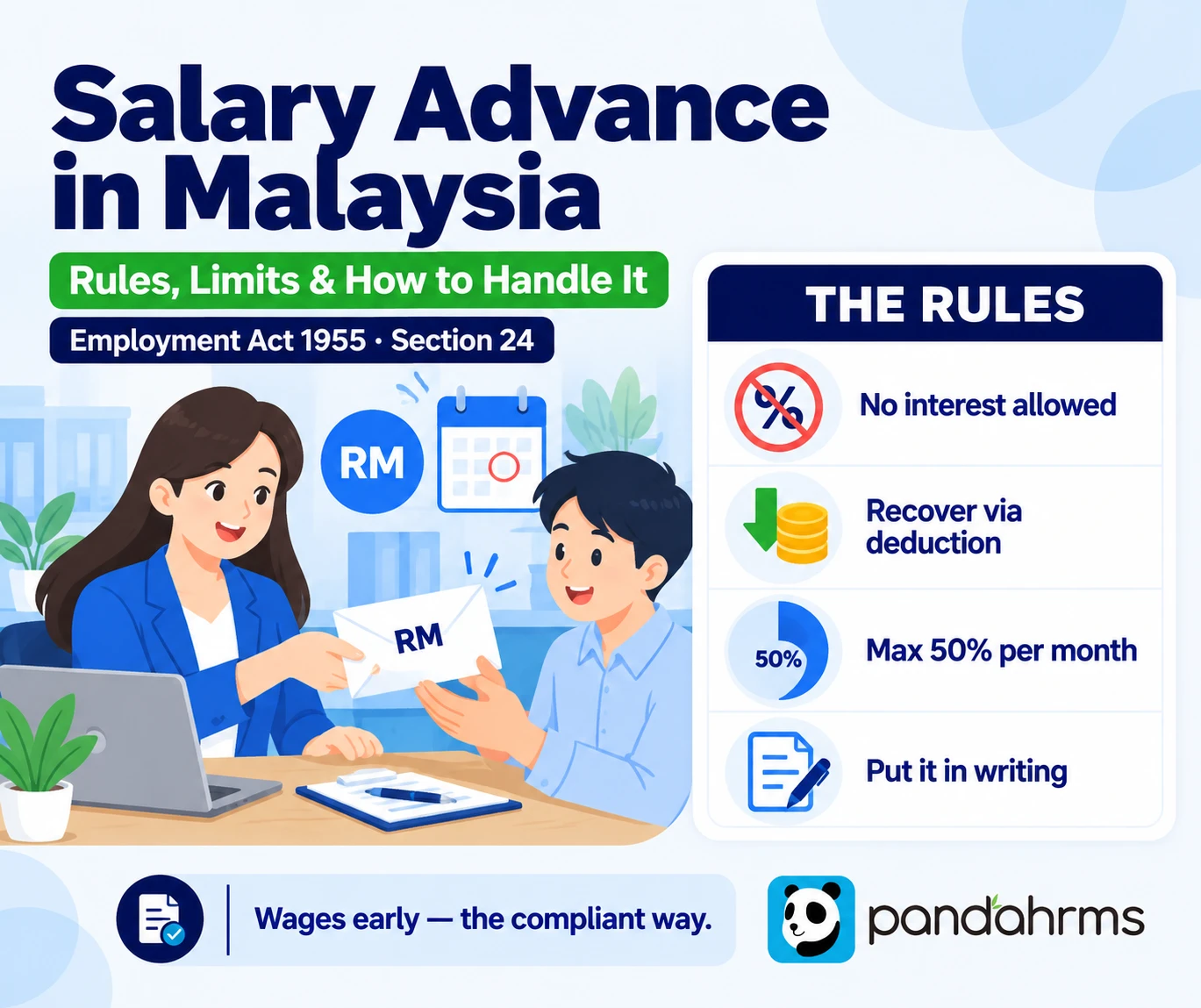
Sooner or later, an employee will ask: “Boss, can I get an advance on my salary?” A medical bill, a car repair, a family emergency — it happens. Handled well, a salary advance builds loyalty and costs you nothing. Handled carelessly, it can breach the Employment Act. Here’s how salary advances work in Malaysia, the legal limits, and how to handle them properly.
What Is a Salary Advance?
A salary advance is when an employer pays an employee part of their wages before the normal payday, to be recovered from a later paycheque. It is not a loan in the ordinary sense — it’s the employee’s own wages, paid early. That distinction matters, because the law treats the two very differently.
Is a Salary Advance Legal? What the Employment Act Says
Yes — salary advances are allowed, but they’re regulated by the Employment Act 1955. Three rules matter most:
- No interest. An employer cannot charge interest on an advance of wages. It’s an advance, not a money-lending arrangement.
- Recovery is a regulated deduction. You recover the advance by deducting it from future wages under Section 24 — the same section that governs all lawful salary deductions. (See our guide on what an employer can legally deduct under Section 24.)
- The 50% cap. Total deductions in any one month generally must not exceed 50% of the employee’s wages for that month (the cap is relaxed only on final payment when someone leaves). So an advance must be recovered in instalments that respect this limit.
The Act (Section 22) also frames advances as being for genuine needs rather than open-ended lending, so keep them reasonable and purpose-driven.
How to Handle a Salary Advance Properly
- Put it in writing. A short signed agreement stating the amount, the reason, and the repayment schedule protects both sides.
- Set a sensible cap. Many employers limit advances to what the employee has already earned that month, or a fixed ceiling.
- Charge no interest. Recover exactly what you advanced — nothing more.
- Stay within 50%. Schedule the repayment deductions so total monthly deductions never breach the Section 24 limit.
- Show it on the payslip. The advance and each recovery instalment should appear clearly on the payslip.
- Have a clear policy. Decide in advance who qualifies, how often, and the limits — and apply it consistently.
Salary Advance vs Loan
| Salary advance | Loan |
|---|---|
| The employee’s own future wages, paid early | Money lent on top of wages |
| No interest allowed | May involve interest (and licensing rules) |
| Recovered via Section 24 deduction, within 50% | Repaid per a separate loan agreement |
Common Mistakes Employers Make
- Charging interest or a “processing fee” on an advance — not allowed.
- Recovering the whole advance in one month and breaching the 50% deduction cap.
- No written agreement, so the terms are disputed later.
- Advancing more than the employee can realistically repay.
- Handing out advances inconsistently, with no policy — inviting claims of unfair treatment.
Where Pandahrms Helps
Salary advances are easy to lose track of once repayment stretches over several months. With Pandahrms, you can record an advance, set the repayment schedule, and let the system deduct each instalment automatically in payroll — while keeping total deductions within the legal 50% limit. The outstanding balance is tracked, and every advance and recovery shows clearly on the payslip. No manual tracking, no accidental over-deduction, no interest slipping in.
Final Thoughts
A salary advance is one of the simplest ways to support an employee through a tough month — as long as you follow the rules. Keep it interest-free, put it in writing, recover it in instalments that respect the 50% cap, and show it on the payslip. Do that, and a small act of goodwill stays fully compliant.
Frequently Asked Questions (FAQs)
- Can an employer charge interest on a salary advance?
No. Under the Employment Act 1955, no interest may be charged on an advance of wages — you recover only what you advanced. - How much can be deducted to recover an advance?
Total deductions in any one month generally cannot exceed 50% of the employee’s wages (Section 24), so an advance is recovered in instalments within that limit. The cap is relaxed only on final payment when employment ends. - Is a salary advance the same as a loan?
No. An advance is the employee’s own wages paid early and carries no interest; a loan is money lent on top of wages and may involve interest and separate rules. - Do I need a written agreement for a salary advance?
It’s strongly recommended. A short signed note stating the amount, reason, and repayment schedule protects both employer and employee and avoids disputes. - Should the advance appear on the payslip?
Yes. Both the advance and each recovery instalment should be shown clearly on the payslip for transparency and record-keeping.



