Late to work? Damaged a company laptop? Took a salary advance? Many Malaysian employers reach straight for the payroll system and deduct it from the next paycheck. But here’s the catch: under the Employment Act 1955, an employer cannot deduct from an employee’s wages unless the law specifically allows it. Get it wrong and you’re facing an unlawful deduction claim. Here’s exactly what you can — and can’t — deduct.
The Golden Rule: Section 24
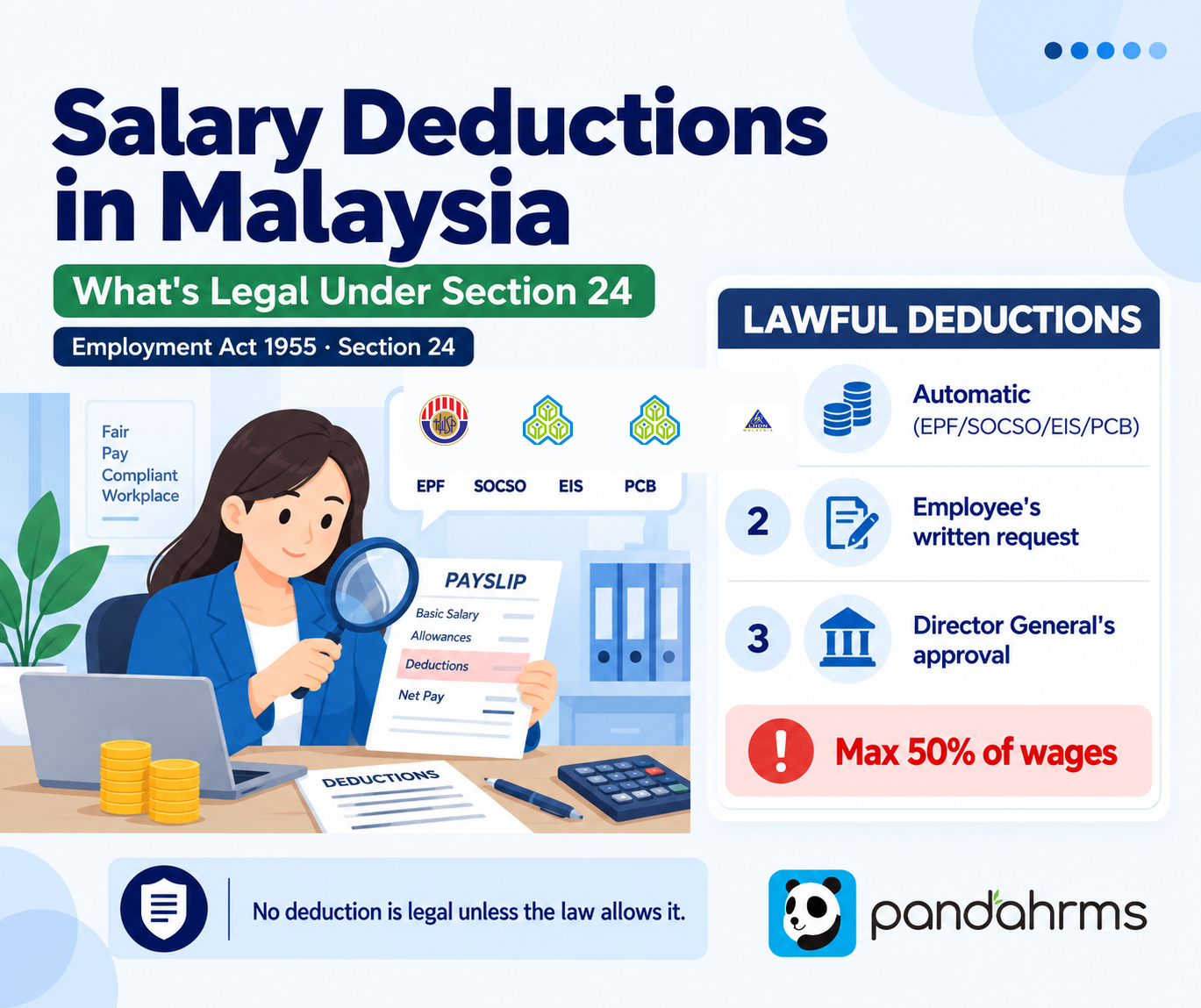
Under Section 24(1) of the Employment Act 1955, no deduction may be made from an employee’s wages except those authorised by the Act. In other words, a salary deduction is unlawful unless it falls into one of the permitted categories below. “It’s company policy” is not a valid basis on its own.
The Three Categories of Lawful Deductions
| Category | Examples |
|---|---|
| 1. Allowed automatically (no consent needed) |
Statutory deductions authorised by law — EPF, SOCSO, EIS, and PCB (income tax); recovery of an overpayment made in error in the preceding 3 months; recovery of a wage advance (with no interest); and indemnity owed for failing to give proper notice. |
| 2. Need the employee’s written request | Deductions the employee asks for in writing — e.g. trade union subscriptions, repayments to a registered cooperative society, or share purchases in the employer’s business. |
| 3. Need written request + Director General’s approval | Deductions for payments to a third party, for goods or services, for contributions to a superannuation, provident, or insurance scheme, or for rent of employer-provided accommodation — these need both the employee’s written request and the Director General of Labour’s approval. |
The 50% Cap
Even where a deduction is lawful, there’s a limit: the total deductions in any one wage period generally must not exceed 50% of the wages earned in that period. Limited exceptions apply — for example, indemnity in lieu of notice, the final wage payment when employment ends, or housing-loan repayments (which may go up to 75% with the Director General’s permission). The point is simple: you can’t wipe out most of someone’s pay in a single month, even for a legitimate reason.
What’s NOT a Lawful Deduction
These common practices are where employers get into trouble:
- Punitive deductions — docking pay as a “fine” or punishment isn’t authorised by the Act.
- Deducting for damage or loss without a proper basis — you can’t simply deduct for a broken laptop or a shortfall; there’s a process to follow. See our guide on deducting salary for damaged or lost company property.
- Over-deducting for lateness — you may not pay for time not worked, but arbitrary lateness “penalties” beyond that are a different matter. See deducting salary for being late.
- Cutting salary unilaterally — reducing an agreed salary isn’t a “deduction” you can just impose; it needs the employee’s agreement. See can an employer cut your salary.
- Breaching the 50% cap — even lawful deductions can’t exceed the limit in one wage period.
Where Pandahrms Helps
Payroll is where deduction mistakes happen — and where they’re most easily avoided. With Pandahrms, statutory deductions (EPF, SOCSO, EIS, PCB) are calculated correctly and automatically every month, authorised deductions like wage advances are tracked against the right employee, and every deduction is itemised on a compliant payslip with a clear record. That means a transparent trail if a deduction is ever questioned — and far less risk of an accidental unlawful deduction.
Final Thoughts
The rule to remember is simple: under Section 24, a deduction is unlawful unless the Employment Act specifically allows it. Stick to the authorised categories, get written consent (and the Director General’s approval) where required, stay within the 50% cap, and document everything. When a situation is genuinely unclear — a large recovery, a disputed loss — check with the Labour Department before you deduct.
Frequently Asked Questions (FAQs)
- Can an employer deduct salary without the employee’s consent?
Only for deductions the Employment Act authorises automatically — statutory contributions (EPF, SOCSO, EIS, PCB), recovery of an overpayment made in error in the preceding 3 months, recovery of a wage advance, or indemnity for insufficient notice. Most other deductions need the employee’s written request, and some also need the Director General’s approval. - Is there a limit on how much can be deducted?
Yes. Total deductions in any one wage period generally cannot exceed 50% of the wages earned that period, with limited exceptions such as the final payment on termination. - Can an employer deduct salary for a damaged or lost item?
Not automatically. Deducting for damage or loss isn’t a straightforward authorised deduction — there’s a proper process, and doing it arbitrarily risks being an unlawful deduction. Check the specific rules before acting. - Can an employer deduct pay as a punishment or fine?
No. Punitive salary deductions or “fines” are not authorised under Section 24 and are unlawful. - Are EPF, SOCSO, and PCB deductions covered by these rules?
Yes — they’re deductions authorised by written law, so they’re permitted automatically without needing the employee’s separate consent. They must still be calculated correctly and remitted on time.