
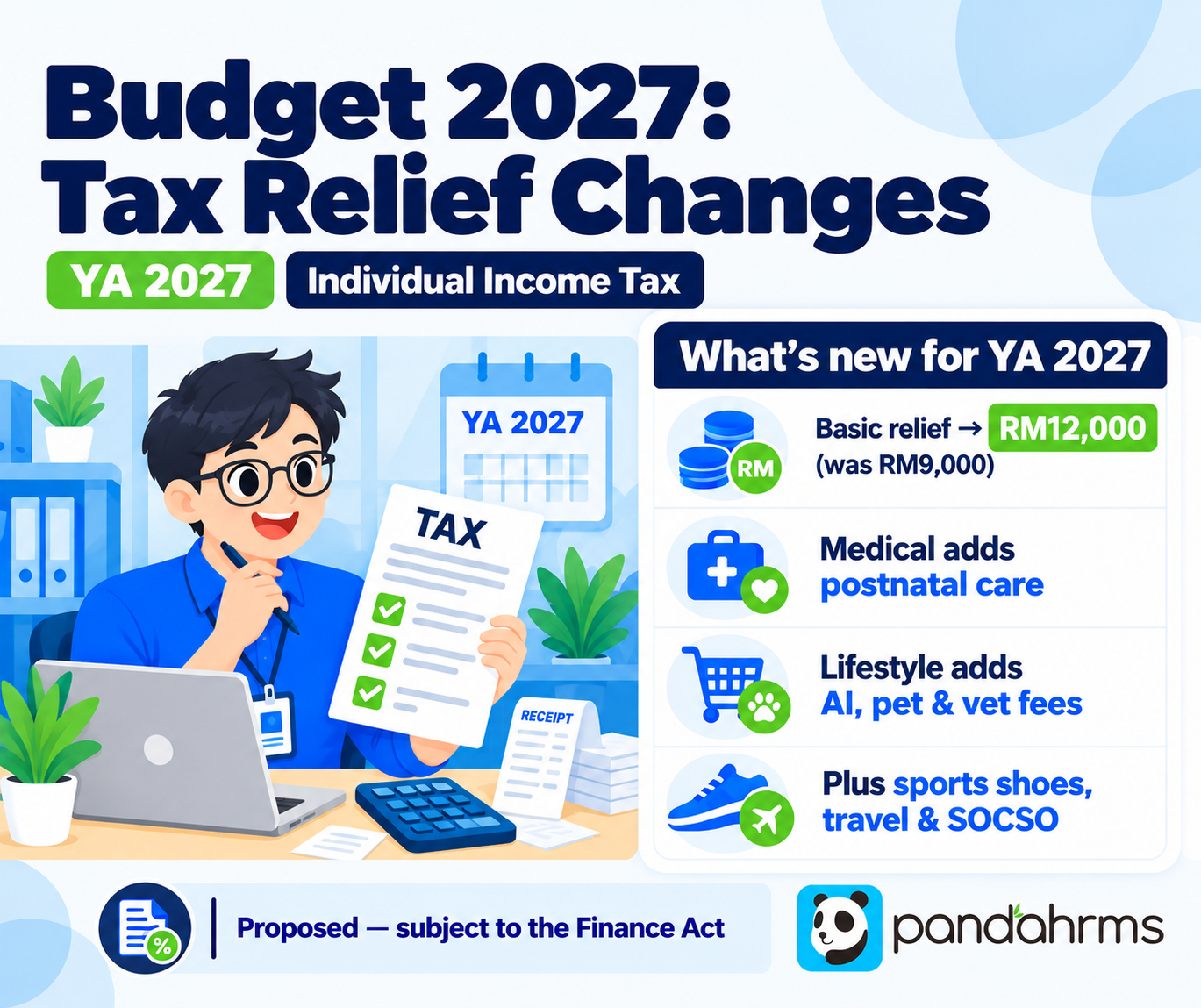
Budget 2027 proposes the biggest refresh to Malaysia’s individual income tax reliefs in years — headlined by the first increase to the basic individual relief since 2010, from RM9,000 to RM12,000, plus changes across seven more relief categories. Here’s every proposed change for Year of Assessment 2027 (the taxes you’ll file in 2028), checked against the Budget 2027 announcement. (These are proposals — the final rules come with the Finance Act and LHDN guidance.)
The Headline: Basic Relief Jumps to RM12,000
Every resident individual gets the basic self relief. Budget 2027 raises it from RM9,000 to RM12,000 — a RM3,000 increase, and the first change since 2010. On its own, that’s RM3,000 more of your income shielded from tax.
The 8 Individual Tax Relief Changes for YA 2027
| Relief | What’s proposed for YA 2027 |
|---|---|
| 1. Individual & dependents | Basic individual relief raised from RM9,000 to RM12,000. |
| 2. Parents & grandparents care | Expanded to cover all care expenses — not just medical treatment, special needs and carer costs. |
| 3. Medical & health | Now includes postnatal care, up to RM3,000 within the overall RM10,000 medical limit. |
| 4. Education & skills | Covers all fields of study (RM7,000 limit stays); your children’s tuition in STEM, arts, languages or religion counts up to RM2,000. |
| 5. Lifestyle | Now also includes AI subscriptions, adopting a pet from a registered shelter, and vet fees for vaccination, spaying or neutering. |
| 6. Sports | Sports equipment relief now includes sports shoes, up to RM300 within the RM1,000 sports limit. |
| 7. Travel | The RM1,000 domestic tourism relief (entry to attractions & cultural programmes) is extended to YA 2027, in line with Visit Malaysia. |
| 8. SOCSO contributions | Now covers mandatory Lindung Kendiri contributions; voluntary Lindung 24 Jam or Lindung Kendiri contributions add up to RM150 more. (See our guide to LINDUNG Pekerja PERKESO.) |
Lower Tax Rates, Too
On top of the reliefs, Budget 2027 trims personal income tax rates for the middle band — the RM70,000–RM100,000 band drops to 18% and the RM100,000–RM150,000 band to 24% — while the top 30% rate now kicks in at RM1 million (down from RM2 million). Together with the higher reliefs, the government says this gives up to RM1,600 in extra disposable income to around five million taxpayers. (For the wider Budget picture, see our Budget 2027 highlights for employers; for why tax deducted differs between people, see same salary, different PCB.)
What This Means for You
More reliefs and lower rates mean a smaller tax bill — but only if you claim what you’re entitled to. A few practical notes:
- These apply to YA 2027 — the income you earn in 2027, filed in 2028. They don’t change your YA 2026 return.
- Keep your receipts for the new items (postnatal care, sports shoes, pet adoption/vet fees, AI subscriptions, parents’ care, domestic travel) so you can claim them.
- They’re proposals until the Finance Act is passed and LHDN publishes the YA 2027 relief list — so confirm the final figures before you rely on them.
What It Means for HR & Payroll
These are personal reliefs, but they land on the HR desk too. Employees will ask about them, and higher reliefs plus lower rates can nudge monthly PCB (MTD) down once LHDN updates the schedule — which flows straight into take-home pay. HR’s job is to make sure the payroll figures and year-end documents are right so employees can claim correctly. (See how the numbers flow in our guide to take-home pay, and the e-Filing guide.)
Where Pandahrms Helps
When tax rules change, the payroll side has to keep up. Pandahrms calculates PCB on the current schedule, keeps EPF, SOCSO and EIS correct, and generates accurate EA Forms — so when employees sit down to file and claim their reliefs, the figures from payroll are already right. When LHDN updates the YA 2027 schedule, the system moves with it, so HR doesn’t have to rework the maths by hand.
Final Thoughts
Budget 2027’s tax-relief refresh is genuinely good news for individuals — a bigger basic relief, broader medical, education and parents’ care, and some modern additions like AI subscriptions and pet care. The smart move now is simple: note which new items apply to you, keep the receipts through 2027, and claim them when you file in 2028 — after confirming the final rules in the Finance Act and LHDN’s guidance.
Frequently Asked Questions (FAQs)
- What is the new individual tax relief amount in Budget 2027?
The basic individual relief is proposed to rise from RM9,000 to RM12,000 for YA 2027 — the first increase since 2010. - When do these tax relief changes take effect?
They apply to Year of Assessment 2027 — income earned in 2027 and filed in 2028. They don’t affect your YA 2026 return. - What new items can I claim under lifestyle relief?
Budget 2027 proposes adding AI subscriptions, adopting a pet from a registered shelter, and vet fees for vaccination, spaying or neutering to the lifestyle relief. - Did medical and sports reliefs change?
Yes — medical relief now includes postnatal care (up to RM3,000 within the RM10,000 limit), and sports equipment relief now includes sports shoes (up to RM300 within the RM1,000 limit). - Are these changes final?
No — they are Budget 2027 proposals. The final reliefs and amounts take effect only once the Finance Act is passed and LHDN publishes the YA 2027 guidance.
Source: Budget 2027 (Belanjawan 2027) announcement, tabled on 9 October 2026, as reported by national media and professional tax summaries (e.g. RinggitPlus, EY, PwC). These are proposals for Year of Assessment 2027; the final reliefs, amounts and scope take effect only once gazetted in the Finance Act and published in LHDN’s guidance. This article is general information, not tax advice.



