
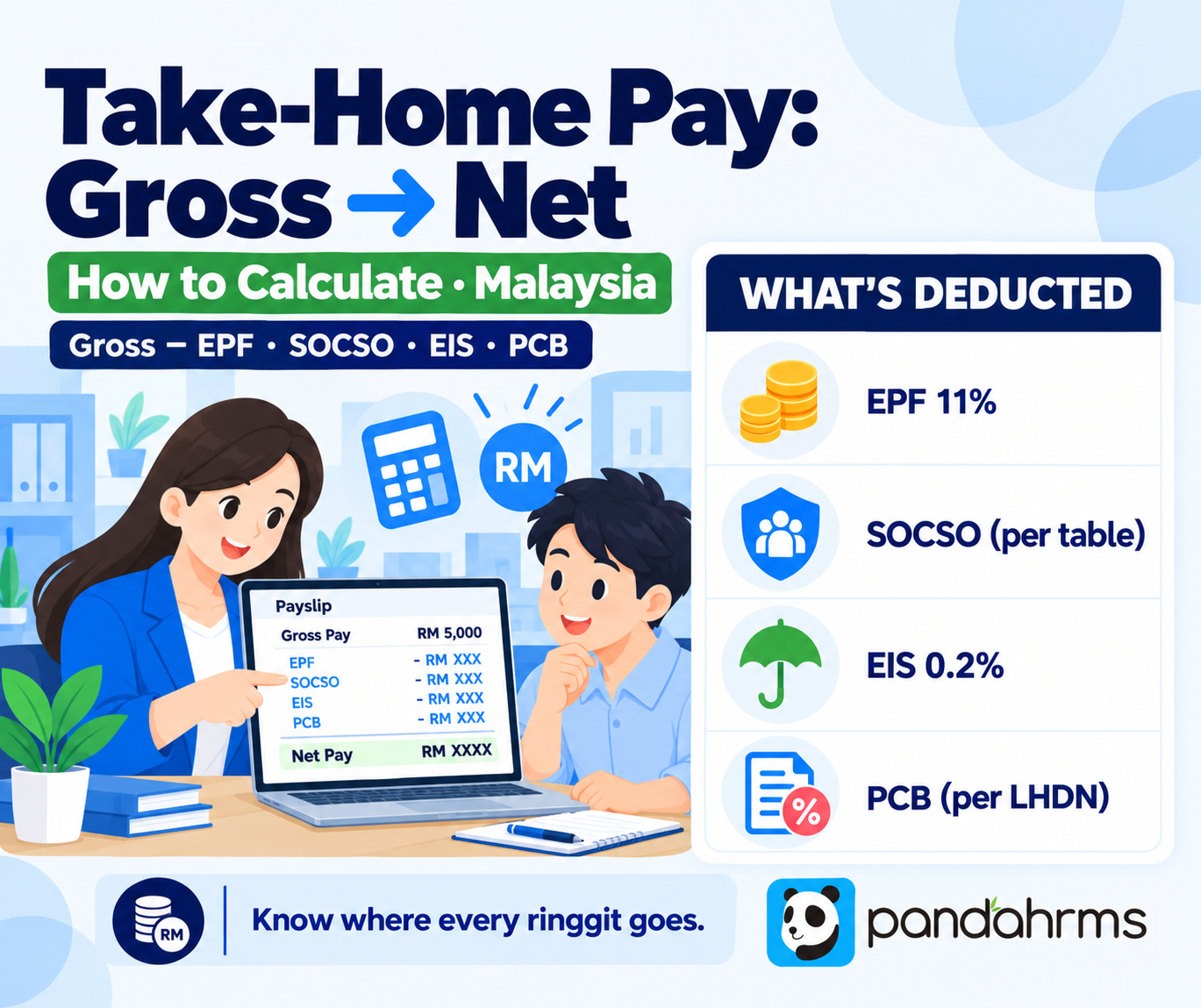
“My salary is RM4,000 — so why did only RM3,4xx land in my account?” It’s one of the most common questions new employees ask, and one every employer should be able to answer. The gap between gross pay and take-home pay is made up of statutory deductions. Here’s exactly how to work it out, step by step.
Gross Pay vs Net (Take-Home) Pay
Gross pay is the full amount an employee earns before any deductions — basic salary plus allowances, overtime, and any bonus. Net pay (take-home) is what’s left after the statutory deductions are taken out. The difference isn’t the employer “keeping” money — it’s contributions and tax paid on the employee’s behalf.
What Gets Deducted From Gross Pay
For a typical Malaysian employee, four items come out of the employee’s side:
| Deduction | Employee’s share |
|---|---|
| EPF (KWSP) | 11% of wages (standard employee rate) |
| SOCSO (PERKESO) | ~0.5% of wages (per the SOCSO table, wage ceiling RM6,000) |
| EIS (PERKESO) | 0.2% of wages (per the EIS table, ceiling RM6,000) |
| PCB / MTD (LHDN) | Monthly tax deduction — varies by income, reliefs & marital status |
Step by Step: From Gross to Take-Home
Let’s work a simple example for an employee with a gross salary of RM4,000:
| Gross salary | RM4,000.00 |
| Less: EPF (11%) | – RM440.00 |
| Less: SOCSO (per table) | – RM19.75 |
| Less: EIS (per table) | – RM7.90 |
| Less: PCB (per LHDN schedule) | – (varies) |
| Take-home pay | ≈ RM3,532 – PCB |
So before tax, this employee takes home about RM3,532; the final figure depends on their PCB. SOCSO and EIS aren’t flat percentages — they come from PERKESO’s contribution tables in fixed wage bands — so always use the current tables (or let payroll do it) rather than eyeballing a percentage.
Why Two People With the Same Gross Get Different Take-Home
The variable is almost always PCB. Monthly tax deduction depends on the employee’s chargeable income, marital status, number of children, and tax reliefs — so two colleagues on the same RM4,000 can have very different net pay. (We explain this in detail here: same salary but different PCB?)
Watch Out: Not Every Deduction Is Allowed
Beyond statutory items, an employer can only make lawful deductions from wages, and total deductions in a month generally can’t exceed 50% of pay. Deducting for damages, shortages, or “penalties” without proper authority is not allowed. See our guide on what an employer can legally deduct under Section 24.
Where Pandahrms Helps
Calculating take-home pay by hand — with EPF, SOCSO and EIS tables plus the PCB schedule — is where mistakes creep in. Pandahrms does the whole gross-to-net calculation automatically: it applies the current EPF rate, pulls the correct SOCSO and EIS amounts from the tables, computes PCB from each employee’s reliefs, and prints a clear breakdown on the payslip. Every employee sees exactly where their money went — and your contributions are always right.
Final Thoughts
Take-home pay is simply gross pay minus EPF, SOCSO, EIS and PCB. Once you know the pieces, the gap between “salary” and “what lands in the bank” stops being a mystery — and being able to explain it clearly builds real trust with your team.
Frequently Asked Questions (FAQs)
- What is the difference between gross and net salary?
Gross salary is total earnings before deductions; net (take-home) salary is what remains after EPF, SOCSO, EIS and PCB are deducted. - How much EPF is deducted from an employee’s salary?
The standard employee EPF contribution is 11% of wages (the employer contributes separately, on top of the salary). - Are SOCSO and EIS a fixed percentage?
Not exactly — they’re taken from PERKESO’s contribution tables in fixed wage bands (roughly 0.5% for SOCSO and 0.2% for EIS on the employee side), subject to the RM6,000 wage ceiling. - Why is my take-home pay different from a colleague with the same salary?
Usually because of PCB — monthly tax depends on your reliefs, marital status and number of children, which differ from person to person. - Can my employer deduct other things from my pay?
Only lawful deductions are allowed, and total monthly deductions generally can’t exceed 50% of wages under Section 24 of the Employment Act.



