“Can I claim SOCSO for my MC?” It’s one of the most common questions employees ask HR — and the answer surprises most people: no, not for an ordinary fever or toothache. PERKESO (SOCSO) does pay an income-replacement benefit when you’re on medical leave, but only when the MC is work-related. Here’s exactly when you can claim, how much it pays, and the step-by-step process — for both employees and the HR teams who help them.
First, the Big Misconception
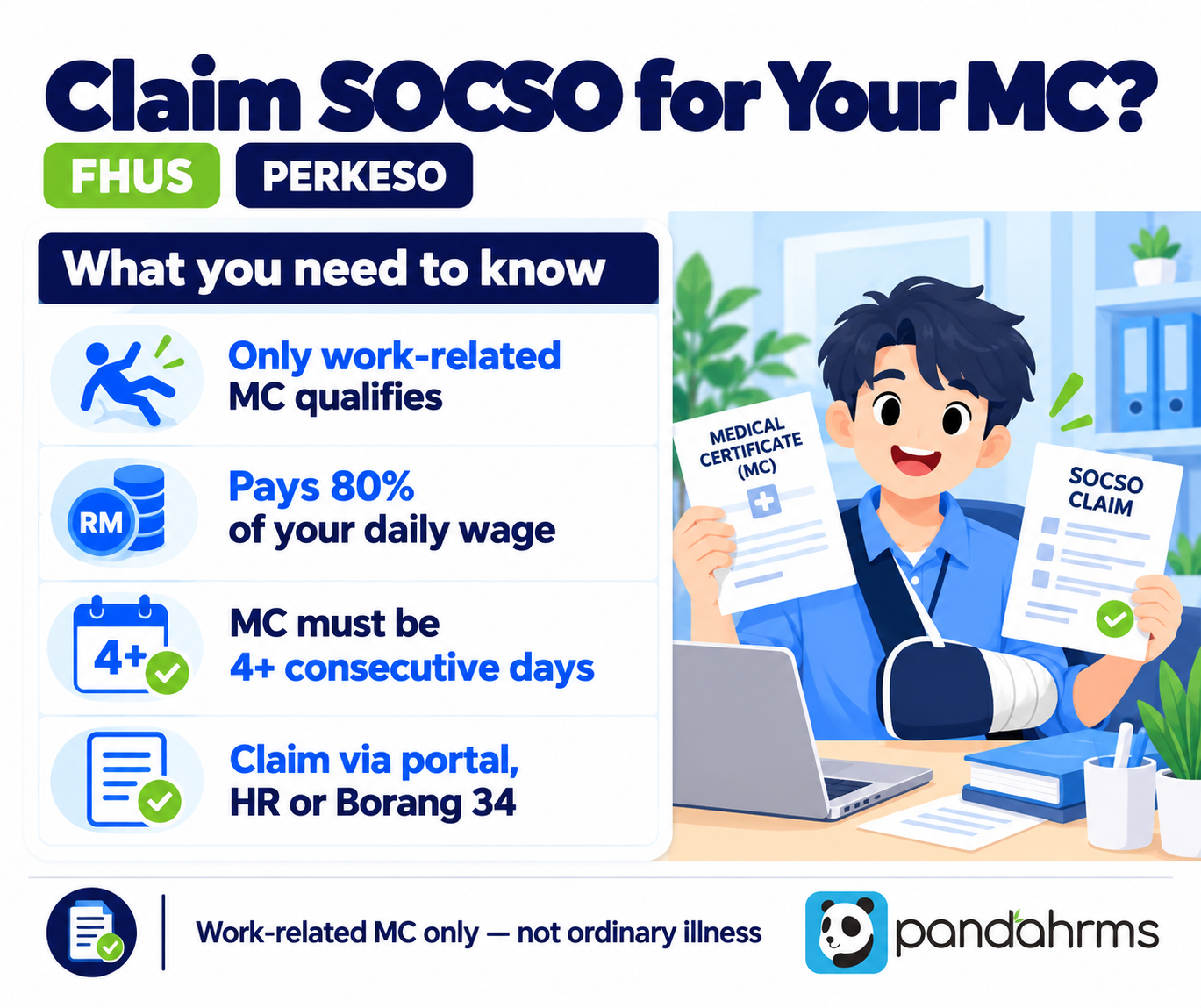
Many employees assume SOCSO covers any sick leave. It doesn’t. The benefit for medical leave — Faedah Hilang Upaya Sementara (FHUS), the Temporary Disablement Benefit — sits under the Employment Injury Scheme (Skim Bencana Pekerjaan). That means it only applies when your MC is caused by a work-related accident, a commuting accident, or an occupational disease. An ordinary illness unrelated to work does not qualify. For normal sick leave, you rely on your paid sick leave entitlement under the Employment Act 1955 instead (see our guide to types of leave in Malaysia).
What Is FHUS (Temporary Disablement Benefit)?
FHUS is an income-replacement benefit paid to an eligible worker who is temporarily unable to work because of a qualifying work injury or occupational disease. It’s paid for the period of medical leave certified by a doctor, subject to PERKESO’s conditions.
How Much Does FHUS Pay?
| Benefit detail | Amount |
|---|---|
| Daily benefit rate | 80% of your average assumed daily wage |
| Minimum daily payment | RM30.00 |
| Maximum daily payment | RM158.67 |
The amount depends on your wage and the number of eligible days of certified leave. Two key rules: your MC must be at least four consecutive days (including the day of the accident), and PERKESO does not pay for days you attend work and receive wages. (Figures are PERKESO’s current rates — confirm the latest with PERKESO.)
When You CAN Claim: Eligibility
To qualify for FHUS, the core conditions are:
- A work-related cause — a workplace accident, a commuting accident (an eligible journey between home and work), or an occupational disease (Penyakit Khidmat) from workplace exposure.
- At least 4 consecutive days’ MC, including the accident day.
- You did not work during the certified leave period.
- Active contributor under the Employment Injury Scheme, generally below age 60.
Whether a specific accident or illness qualifies is assessed by PERKESO. (For the wider list of what SOCSO covers, see our guide to the 10 types of SOCSO claims.)
Documents You Need
For a workplace accident, prepare:
- Identification card (IC) — 1 copy
- Original MC / sijil cuti sakit
- Punch card / attendance record
- Six months of payslips before the accident
- Initial treatment memo from the first clinic or hospital
For a road (commuting) accident, also prepare:
- Police report (Laporan Polis)
- A hand-drawn sketch map (Peta Lakar) on A4 showing the road names, workplace, accident location and home address
PERKESO may ask for additional documents. Always check the current Borang 34 checklist.
How to Claim: 3 Ways
- 1. Portal LINDUNG Faedah (online) — register or log in, select the relevant benefit notice, fill in the details accurately, upload the supporting documents (IC, medical documents), and submit. Keep a copy of your submission.
- 2. Through your HR department — submit your original MC to HR, tell them how many days you’ll be on leave, and ask them to help submit through the employer’s PERKESO system.
- 3. Manually with Borang 34 — download Borang 34 (Butiran Notis dan Tuntutan Faedah), prepare documents per the checklist, complete the relevant sections, and submit at your nearest PERKESO office.
If an employer is slow to act or refuses to help, the worker (or a dependant) can contact PERKESO directly.
What About Ordinary (Non-Work) Sick Leave?
For a normal illness, your protection is your paid sick leave under the Employment Act 1955 — 14 to 22 days a year depending on length of service, or up to 60 days in total where hospitalisation is necessary — paid by your employer, not PERKESO. (See types of leave in Malaysia and your rights around taking MC.)
Where Pandahrms Helps
Notice what an FHUS claim needs: six months of payslips and an attendance / punch-card record. Those come straight from payroll. Pandahrms keeps accurate payslips, attendance and SOCSO contribution records, so when an employee needs to claim, HR can pull the required documents in minutes instead of digging through files — and because SOCSO and EIS contributions are deducted and remitted correctly every month, the employee’s coverage stays intact. (See which wages are subject to SOCSO & EIS.)
Final Thoughts
SOCSO is real protection — but for medical leave, it kicks in only when the injury or illness is work-related. Know the difference: an ordinary MC runs on your Employment Act sick-leave entitlement; a work injury or occupational disease can mean an FHUS claim at 80% of your daily wage. Keep your records straight, submit the right documents, and don’t assume you can draw both a full salary and FHUS for the same days.
Frequently Asked Questions (FAQs)
- Can I claim SOCSO for an ordinary fever or toothache?
Generally no. FHUS under the Employment Injury Scheme only covers work-related accidents, commuting accidents or occupational diseases. An ordinary illness relies on your Employment Act paid sick leave instead. - How many days of MC are needed to claim?
At least four consecutive days, including the day of the accident. - How much does PERKESO pay for MC?
80% of your average assumed daily wage, subject to a minimum of RM30 and a maximum of RM158.67 per day. - Can I claim FHUS if my employer pays my full salary?
Generally no — there is no double claim. FHUS isn’t paid for days you’re already paid in full or attend work. Confirm your case with PERKESO. - How do I claim?
Through Portal LINDUNG Faedah online, via your HR department, or manually using Borang 34 at a PERKESO office.
Source: PERKESO (SOCSO) guidance on the Employment Injury Scheme (Skim Bencana Pekerjaan) and Faedah Hilang Upaya Sementara (FHUS), as reported by national media. Benefit rates (80% of the average assumed daily wage; minimum RM30, maximum RM158.67 per day), eligibility and claim procedures are PERKESO’s — confirm the current rates, conditions and forms with PERKESO (hotline 1-300-22-8000, perkeso.gov.my) for your situation. This article is general information, not legal advice.