Hiring a foreign worker in Malaysia costs far more than the monthly wage. On top of salary, an employer carries the foreign worker levy — an annual charge that many first-time employers underestimate, and that some wrongly try to recover from the worker’s pay. With the minimum wage rising to RM2,000, EPF now extended to foreign workers, and a multi-tier levy on the horizon, the true cost of foreign labour is climbing. This guide breaks down the levy: who pays it, the rates by sector, the rule you cannot break, and what is changing next.
What Is the Foreign Worker Levy?
The foreign worker levy is an annual charge payable to the Malaysian government for employing a foreign worker. It is tied to the worker’s PLKS (Pas Lawatan Kerja Sementara / Temporary Employment Visit Pass) and is paid each year the worker remains employed, typically alongside the permit’s issue or renewal. The rate depends on the sector the worker is employed in and the region (Peninsular Malaysia, Sabah or Sarawak).
Who Pays the Levy — and the Rule You Cannot Break
This is the single most important point for employers:
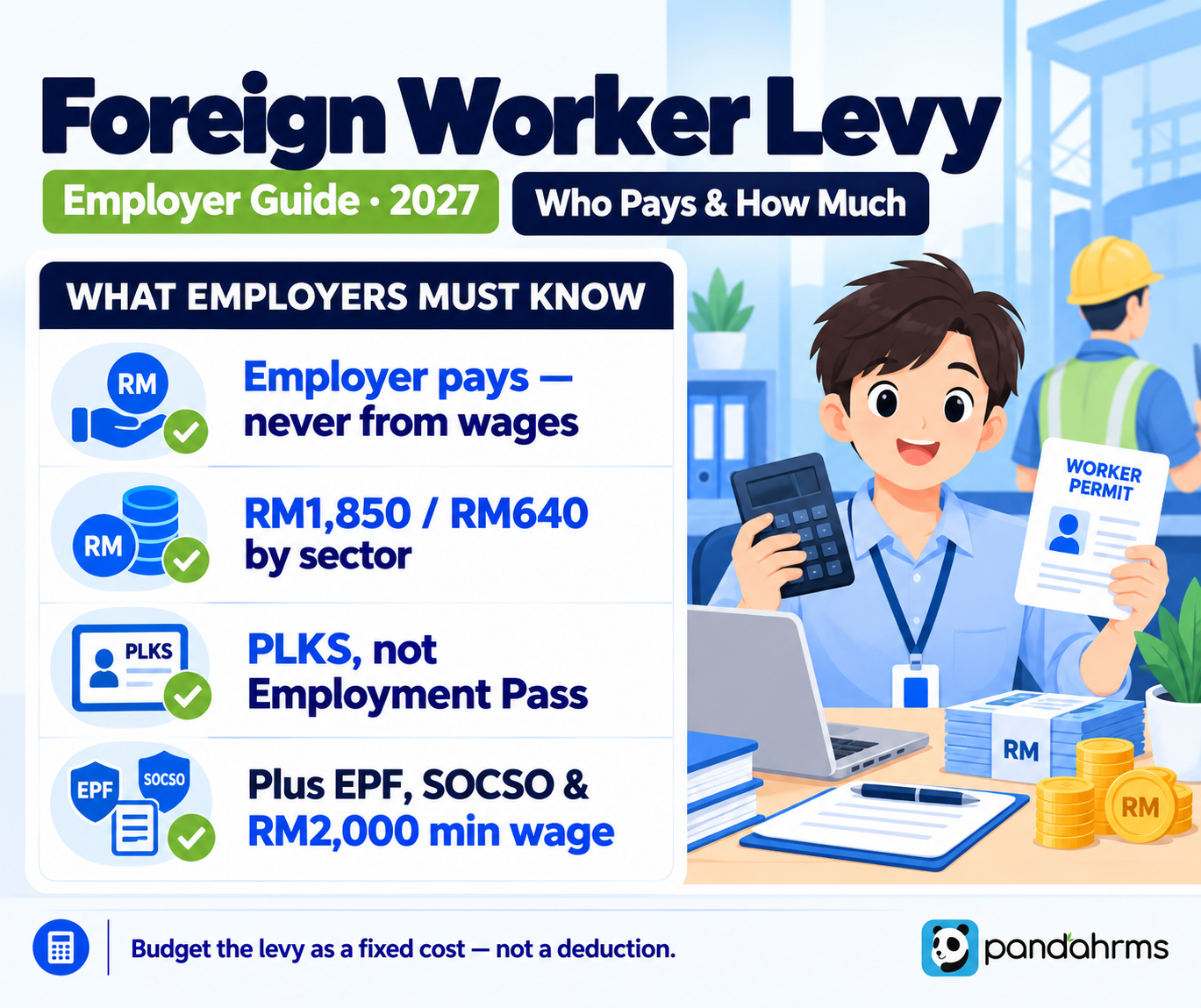
The levy is the employer’s cost. It cannot be deducted from the worker’s wages.
Under the government’s Employer Pays Principle, the employer must bear the levy in full and must not pass it on to the worker through salary deductions. Deducting the levy from wages exposes the employer to enforcement action and to wage claims. Budget for it as a fixed cost of employment, the same way you budget for EPF and SOCSO.
Who the Levy Applies To
The levy applies to foreign workers holding a PLKS (Temporary Employment Pass) in the approved sectors — manufacturing, construction, services, plantation, agriculture and domestic help. It does not apply to Employment Pass holders (expatriates and skilled professionals on higher salary thresholds), who fall under a different immigration category.
Foreign Worker Levy Rates by Sector
The standard annual rates in Peninsular Malaysia are:
| Sector | Annual levy (Peninsular Malaysia) |
|---|---|
| Manufacturing | RM1,850 |
| Construction | RM1,850 |
| Services | RM1,850 |
| Plantation | RM640 |
| Agriculture | RM640 |
Sabah and Sarawak rates are set separately and are generally lower for most sectors (for example, manufacturing and construction are commonly charged at a lower rate than in the Peninsular), though Sarawak applies its own additional surcharge. Domestic helpers are levied at a lower rate than the sectors above. Because levy figures are revised from time to time and vary by region and worker category, always confirm the exact amount with the Immigration Department (Jabatan Imigresen Malaysia) or the one-stop foreign worker system before you budget.
The Levy Is Only Part of the Cost
Employers often plan for the levy and forget the rest. A foreign worker now carries almost the full stack of statutory obligations:
- Minimum wage RM2,000 — the new minimum wage applies to foreign workers too, not just locals. (See: the RM2,000 minimum wage and who’s exempt.)
- EPF — since October 2025, EPF contributions are mandatory for non-Malaysian workers, at 2% from the employer and 2% from the employee (domestic workers excluded). This is new, and it is on top of the levy.
- SOCSO — foreign workers (other than domestic servants) have been covered under SOCSO’s Employment Injury Scheme since 2019, and since July 2024 those under 60 are also brought under the Invalidity Scheme. (See: which wages are subject to SOCSO.)
- Permit, medical (FOMEMA), insurance and recruitment costs on top.
Add it up, and the levy is just one line in a much bigger bill.
What’s Changing: The Multi-Tier Levy
The government has signalled a shift from flat levy rates to a Multi-Tier Levy (MTL) — a system that charges higher rates to businesses that rely most heavily on foreign labour, to push employers toward automation and local hiring. As of now, the multi-tier rates have not been gazetted, so the flat sector rates above still apply. But the direction is clear: Malaysia is targeting a lower share of foreign workers in the workforce over the coming years, and heavy users should expect to pay more once the MTL takes effect. Factor a possible increase into medium-term workforce planning.
Compliance Tips for Employers
- Never deduct the levy from wages — it is your cost under the Employer Pays Principle.
- Budget the levy as an annual, recurring cost, and diarise permit/levy renewal dates so a worker’s pass never lapses.
- Keep levy and permit receipts with each worker’s file for audits and renewals.
- Don’t forget EPF, SOCSO and the RM2,000 minimum wage now apply to foreign workers — update your payroll set-up.
- Review your reliance on foreign labour ahead of the multi-tier levy.
How Pandahrms Helps
Foreign workers add a layer of cost and paperwork — the levy, permit renewals, EPF, SOCSO and the minimum wage all have to line up. Pandahrms stores each worker’s permit and document details with renewal reminders, applies EPF and SOCSO correctly in payroll (including the foreign-worker rates), and keeps the records you’ll need at audit or renewal in one place. For the wider set of obligations after hiring, see our HR & payroll compliance checklist.
Frequently Asked Questions (FAQ)
- Can I deduct the foreign worker levy from my worker’s salary?
No. Under the Employer Pays Principle, the levy is the employer’s cost and must not be deducted from the worker’s wages. Deducting it can lead to enforcement action and wage claims. - How much is the foreign worker levy?
In Peninsular Malaysia the standard annual rate is RM1,850 for manufacturing, construction and services, and RM640 for plantation and agriculture. Sabah, Sarawak and domestic-helper rates differ and are generally lower. Confirm the exact figure with the Immigration Department, as rates are revised periodically. - Does the levy apply to expatriates on an Employment Pass?
No. The levy applies to PLKS (Temporary Employment Pass) holders in the approved sectors. Employment Pass holders fall under a different category and are not subject to this levy. - Do foreign workers get EPF and SOCSO now?
Yes. EPF became mandatory for non-Malaysian workers from October 2025 at 2% employer and 2% employee (domestic workers excluded). Foreign workers have been covered under SOCSO’s Employment Injury Scheme since 2019, and those under 60 under the Invalidity Scheme since July 2024. - Does the RM2,000 minimum wage apply to foreign workers?
Yes. The minimum wage applies to foreign workers in the same way as local employees. - What is the multi-tier levy?
It is a planned system that would charge higher levy rates to businesses most dependent on foreign labour, to encourage automation and local hiring. The rates have not yet been gazetted, so the current flat sector rates still apply.
Source: Immigration Department of Malaysia (Jabatan Imigresen) foreign worker levy framework and the Employer Pays Principle; Employees Provident Fund (EPF/KWSP) on mandatory contributions for non-Malaysian workers from October 2025; Social Security Organisation (PERKESO/SOCSO) on Employment Injury and Invalidity Scheme coverage for foreign workers; and Ministry of Human Resources statements on the multi-tier levy. Levy rates vary by sector, region and worker category and are revised periodically — confirm current figures with the Immigration Department before budgeting. This article is general information, not legal advice.