“My executive worked until 10pm all week — do I have to pay overtime?” It’s one of the most common payroll questions in Malaysia, and the answer surprises many employers. Since the Employment Act now covers all employees, people assume everyone is entitled to overtime pay. But a key wage threshold — RM4,000 a month — decides who is legally entitled to statutory overtime and who isn’t. This guide explains the rule, who it covers, and where managers and executives stand.
First: The Employment Act Now Covers Everyone
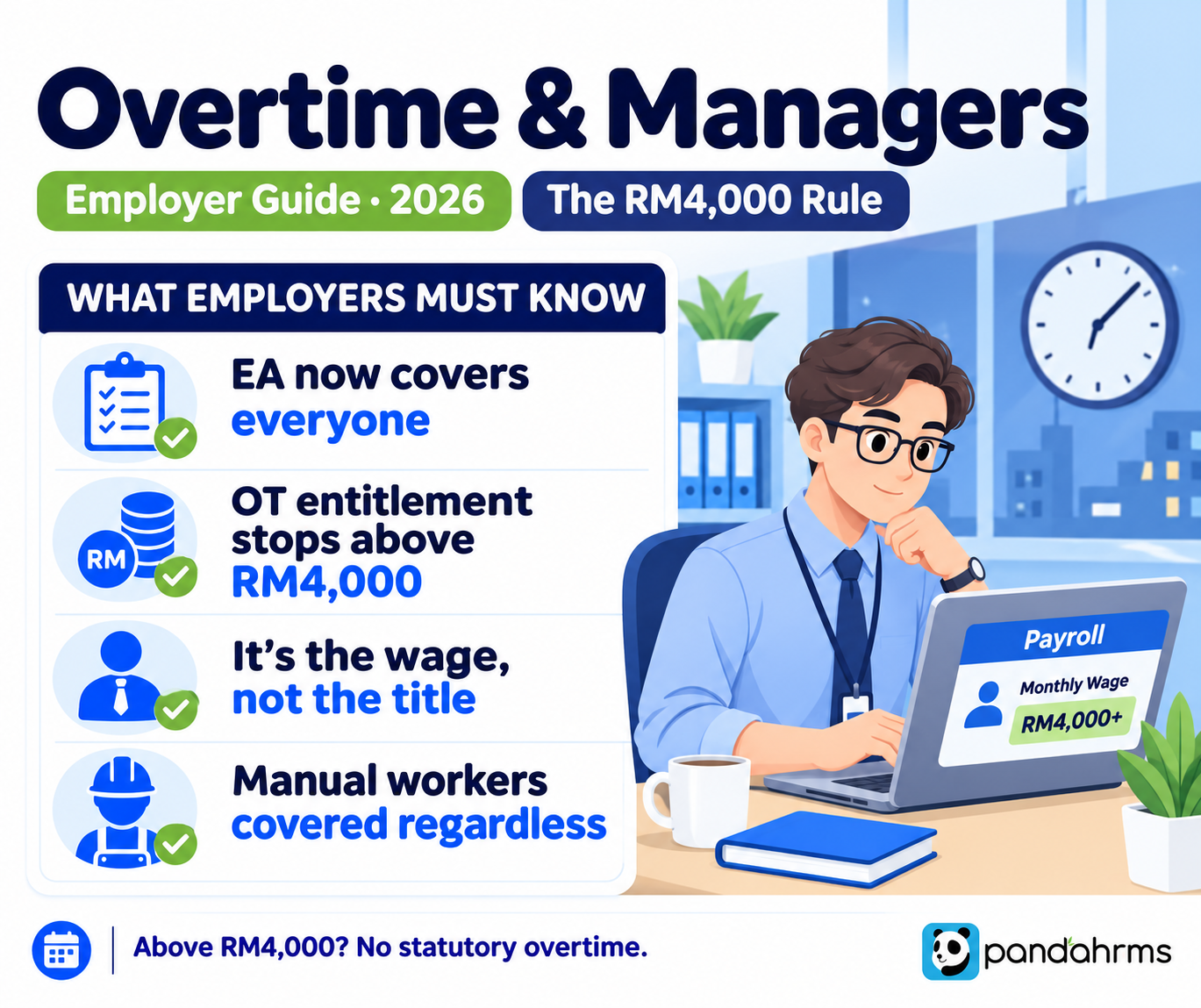
Since 1 January 2023 (under the Employment (Amendment) Act 2022), the Employment Act 1955 applies to all employees, regardless of how much they earn. That was a big change — previously the Act mainly protected lower-wage workers. So yes, your managers and executives are now covered by the Act in general.
But “covered by the Act” does not mean “entitled to every benefit in the Act.” A specific group of provisions is reserved for employees below a wage threshold.
The RM4,000 Threshold
A specific set of provisions in the Act’s First Schedule — overtime pay, rest-day and public-holiday pay, shift allowance, and termination/lay-off benefits — do not apply to employees whose wages exceed RM4,000 a month. (Note: this cap is about those pay entitlements — the general working-hour limits, annual leave, sick leave and other core protections still apply to everyone.) In short:
- Earning RM4,000/month or less → statutorily entitled to overtime pay and the other First Schedule protections.
- Earning more than RM4,000/month → not statutorily entitled to overtime pay (unless the contract provides it).
Because most managers and executives earn above RM4,000, they generally fall outside the statutory overtime requirement.
So, Do Managers & Executives Get Overtime?
Legally, if a manager or executive earns more than RM4,000 a month, the employer is not required by the Employment Act to pay them overtime, work extra hours though they may. Their compensation is taken to reflect the responsibilities of the role, including occasional long hours.
That said, two important caveats:
- Contract and policy can give more. Nothing stops an employer from offering overtime, time-off-in-lieu, or allowances to above-threshold staff. If the employment contract or company policy promises overtime, that promise is binding — honour it.
- It’s the wage that counts, not the job title. Calling someone a “manager” doesn’t remove the entitlement if they actually earn RM4,000 or less. A low-paid employee with “executive” on their business card is still entitled to statutory overtime.
One Group Is Covered Regardless of Pay
There’s an exception that trips up employers: certain manual workers, and employees engaged in or supervising manual work, are covered by these provisions regardless of their wages. So a well-paid supervisor on the factory floor may still be entitled to overtime even above RM4,000. When in doubt about a hands-on or operational role, check the actual nature of the work, not just the salary.
How Overtime Pay Works (for Those Entitled)
For employees who are entitled, overtime on a normal working day is paid at 1.5 times the hourly rate of pay, with higher multipliers on rest days and public holidays. Overtime is also capped — an employee should not work more than 104 hours of overtime in a month. (For the full calculation, see our overtime pay calculation guide and the 45-hour workweek rules.)
What Employers Should Do
- Identify which employees are at or below RM4,000 — they are entitled to statutory overtime; track their hours.
- For above-threshold staff, decide a clear policy (no overtime, time-off-in-lieu, or a discretionary allowance) and put it in the contract so expectations are set.
- Watch the manual-work exception — don’t assume a high salary removes the entitlement for operational roles.
- Keep accurate time records either way — they’re your evidence if a claim arises.
How Pandahrms Helps
Pandahrms flags which employees sit at or below the RM4,000 threshold, captures their working hours and overtime, and applies the correct multipliers automatically on payroll — so entitled staff are paid right, above-threshold staff are handled per your policy, and you have the time records to back it all up. See also which wages count for statutory purposes.
Frequently Asked Questions (FAQ)
- Are managers entitled to overtime pay in Malaysia?
Generally no, if they earn more than RM4,000 a month. Statutory overtime under the Employment Act’s First Schedule applies to employees earning RM4,000 or less. Most managers and executives earn above that, so they aren’t statutorily entitled — unless their contract or company policy provides overtime. - Does the Employment Act cover employees earning above RM4,000?
Yes — since 1 January 2023 the Act covers all employees. But some provisions, including overtime and rest-day/public-holiday pay premiums, apply only to those earning RM4,000 or less. - If I call someone a “manager,” do I avoid paying overtime?
No. It’s the actual wage that matters, not the job title. An employee earning RM4,000 or less is entitled to statutory overtime regardless of their title. - Are any high earners still entitled to overtime?
Yes. Certain manual workers, and those engaged in or supervising manual work, are covered by these provisions regardless of wage. Check the nature of the role for hands-on positions. - How much is overtime pay?
For entitled employees, overtime on a normal working day is 1.5× the hourly rate, with higher rates on rest days and public holidays, capped at 104 overtime hours a month.
Source: Employment Act 1955 as amended by the Employment (Amendment) Act 2022 (in force 1 January 2023) and the Employment (Amendment of First Schedule) Order 2022 — the Act applies to all employees, while certain pay provisions (overtime under s.60A(3), rest-day pay under s.60(3), shift allowance under s.60C, public-holiday pay under s.60D, and termination/lay-off benefits under s.60J) do not apply to employees whose wages exceed RM4,000 a month; certain manual-work categories are covered regardless of wage. Overtime on a normal working day is at least 1.5× the hourly rate, and is capped at 104 hours a month under the Employment (Limitation of Overtime Work) Regulations 1980. The Act applies to Peninsular Malaysia and Labuan, with separate ordinances in Sabah and Sarawak. This article is general information, not legal advice — confirm specific cases with the Labour Department or an employment lawyer.