January is increment season, and HR teams across Malaysia are issuing salary increment letters. There’s no government-prescribed template for one, but the letter still matters: it’s the written record of a change to the employee’s contract of service, and it’s what payroll, EPF, SOCSO and LHDN run off from the effective date. This guide covers what a salary increment letter is, exactly what to put in it, a ready-to-use format, and the one thing to get right so the raise lands correctly on the next payslip.
Is a Salary Increment Letter Required by Law?
No single law says “you must issue an increment letter.” But a pay rise changes a core term of the employment contract, and good practice — and the spirit of the written particulars employers keep under the Employment Act — is to record that change in writing. A clear letter protects both sides: the employee has proof of their new salary, and the employer has a signed record of when it took effect and why.
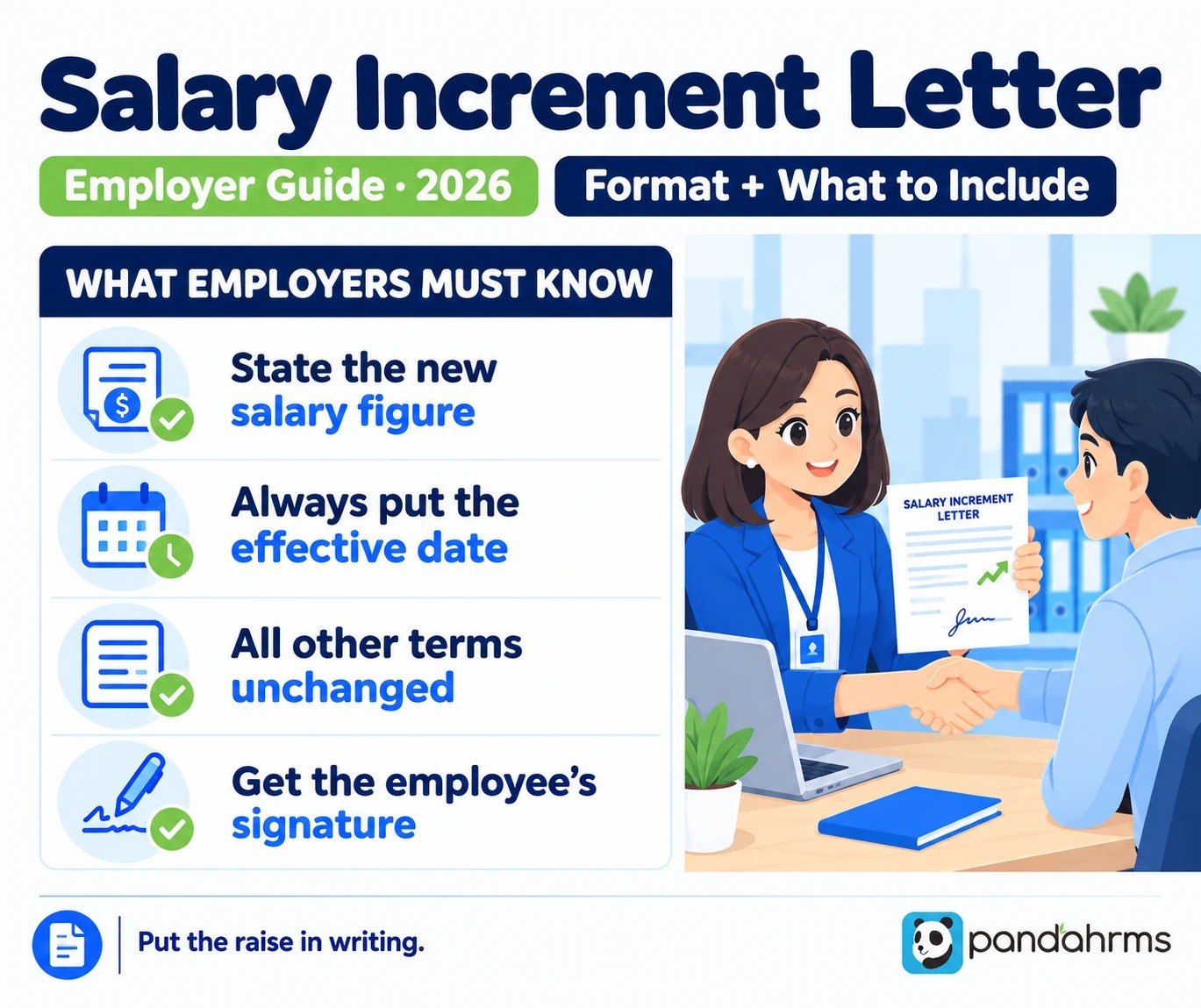
What to Include in a Salary Increment Letter
- Employee details — name, staff/employee number, job title and department.
- Current and new salary — the old basic salary and the new figure (state it as a monthly amount; mention the percentage if your company usually does).
- Effective date — the exact date the new salary starts. This is the single most important line, because payroll uses it.
- Reason — annual/merit increment, promotion, confirmation, or market adjustment.
- What stays the same — a line confirming all other terms of employment are unchanged.
- Signatures — an authorised signatory, and a space for the employee to acknowledge.
A Simple Format You Can Reuse
Keep it to one page:
- Header — company letterhead, date, and “Private & Confidential”.
- Opening — “We are pleased to inform you that your salary has been revised as follows.”
- The details — current salary, new salary, effective date, reason.
- Closing — “All other terms and conditions of your employment remain unchanged,” a thank-you line, and signatures.
- Acknowledgement — “I acknowledge and accept the above,” with the employee’s name, signature and date.
Free Salary Increment Letter Template
Here’s a ready-to-use template — copy it, replace the bracketed fields, and put it on your company letterhead:
[COMPANY LETTERHEAD]
PRIVATE & CONFIDENTIAL
[Date]
[Employee Full Name][Job Title] — [Department]Employee No.: [________]
Dear [Employee Name],
Re: Salary Revision
We are pleased to inform you that, following [your annual review / your promotion / a market adjustment], your salary has been revised as follows:
Current basic salary: RM[________] per month
New basic salary: RM[________] per month
Effective date: [DD Month YYYY]
All other terms and conditions of your employment remain unchanged.
We thank you for your contribution and look forward to your continued commitment.
Yours sincerely,
__________________________
[Name][Designation][Company Name]
Acknowledgement
I acknowledge and accept the salary revision stated above.
__________________________
[Employee Name]Signature: ________________ Date: ____________
⬇️ Download this template: Word (.docx) · PDF
Tip: keep the signed acknowledgement copy on the employee’s file, and make sure the effective date matches your payroll cut-off so the raise lands on the right payslip.
An Increase Is Easier Than a Cut — but Still Put It in Writing
A salary increase is a change in the employee’s favour, so it doesn’t need the kind of consent and consultation a pay cut does — an employee accepts a raise simply by continuing to work. (A reduction is the opposite: cutting pay without agreement is a breach of contract and can amount to constructive dismissal. See our guide on whether an employer can cut your salary.) Even so, documenting the increment in a letter keeps your records clean and avoids disputes later about the amount or the start date.
Getting the Effective Date Right on Payroll
The new salary flows into EPF, SOCSO/EIS and PCB from the effective month. If the increment starts mid-month, the month is usually prorated — part at the old rate, part at the new — and the statutory deductions are calculated on the actual wages paid. Line the letter’s effective date up with the payroll cut-off so nobody is under- or over-paid, and so the raise shows clearly on the payslip.
Common Mistakes to Avoid
- Leaving out the effective date, or using a vague “with effect from this month.”
- Stating only a percentage without the actual new salary figure.
- Forgetting the “all other terms unchanged” line, which can create confusion about allowances or benefits.
- Not keeping a signed, acknowledged copy on the employee’s file.
- Issuing the letter but not updating payroll in time, so the first payslip is still at the old rate.
How Pandahrms Helps
With Pandahrms, a salary change is recorded against the employee with its effective date, and payroll picks it up automatically from that date — prorating the month where needed and recalculating EPF, SOCSO/EIS and PCB on the new figure. The change is kept in the employee’s record for audit, and the increment letter can be generated from the stored details instead of retyping them each cycle. Want to see how a salary revision flows from the letter to the payslip? Contact us for a demo.
Frequently Asked Questions (FAQ)
- Is a salary increment letter required by law in Malaysia?
No law prescribes one, but because a pay rise changes a term of the employment contract, it is good practice to record it in writing so both sides have proof of the new salary and effective date. - What must a salary increment letter include?
Employee details, the current and new salary, the effective date, the reason for the increment, a line that all other terms stay unchanged, and signatures for the employer and the employee’s acknowledgement. - Does an employee have to sign to accept an increment?
An increase takes effect even without a signature because the employee accepts it by continuing to work, but getting a signed acknowledgement keeps your records clean. - When does the new salary affect EPF, SOCSO and PCB?
From the effective date. If it starts mid-month, the month is usually prorated and the statutory deductions are calculated on the actual wages paid. - Is an increment letter the same as a promotion letter?
They overlap but aren’t identical: a promotion letter also changes the job title, grade and responsibilities, while an increment letter may only change the salary. A promotion usually comes with an increment, so the two are often combined.
Source: general principles of the Employment Act 1955 on the contract of service and written particulars of employment, and standard Malaysian HR practice for documenting a change to contractual terms. A salary increase is a beneficial variation accepted by continued employment, whereas an unagreed salary reduction can amount to a breach of contract. This article is general guidance, not legal advice — confirm your specific situation with a qualified adviser.