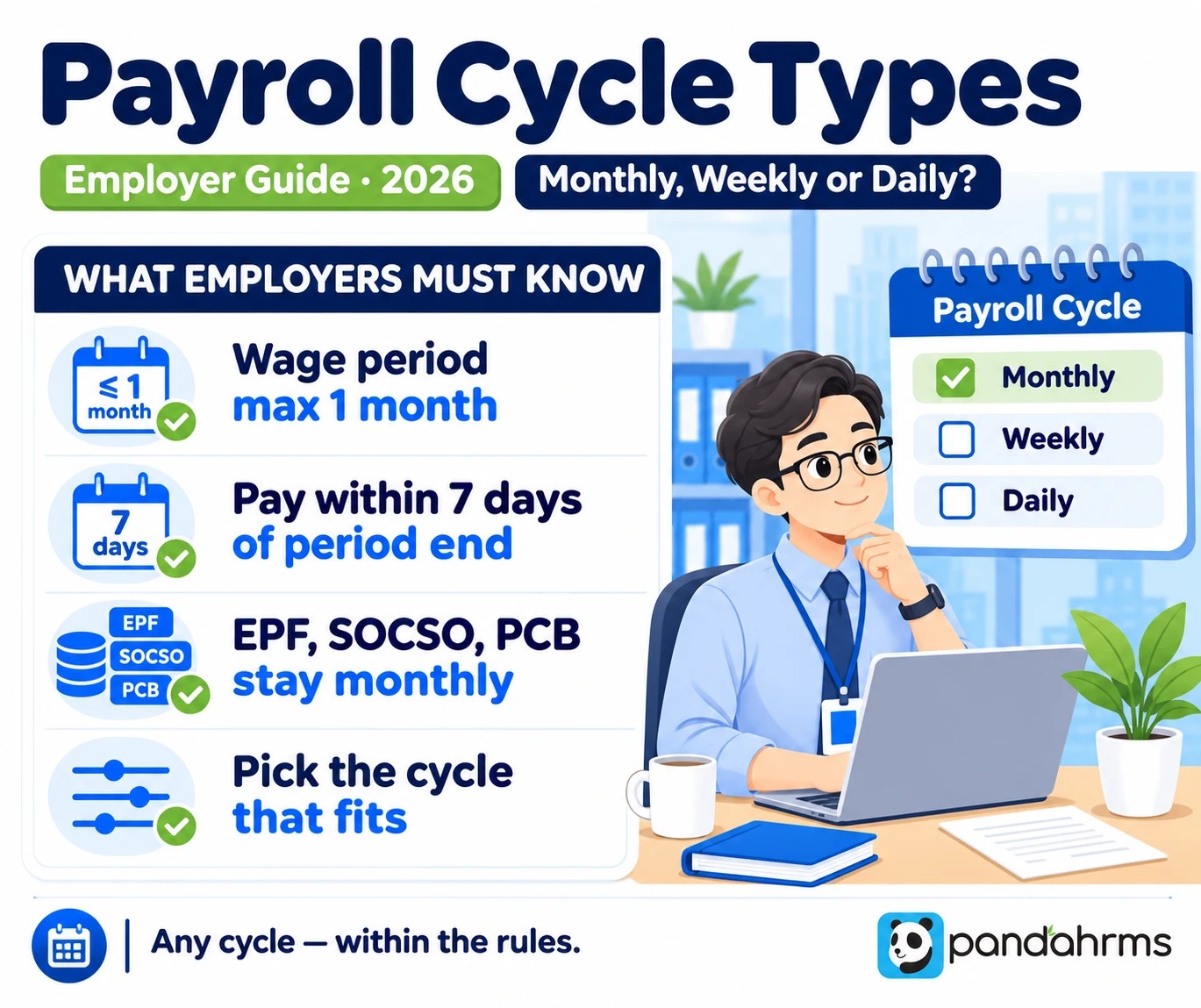
Should you pay staff monthly, twice a month, weekly, or daily? Different businesses run different payroll cycles, and the right one depends on who you employ and how your cash flows. But whatever cycle you pick, Malaysian law sets two hard limits you can’t cross — and the statutory deductions (EPF, SOCSO, PCB) follow their own monthly rhythm regardless. Here’s how the common cycles compare, and the rules that bind all of them.
The Common Payroll Cycles
- Monthly — one payment per month, the standard for salaried staff.
- Semi-monthly — twice a month (for example the 15th and the end of the month), often used to smooth cash flow.
- Weekly — every week, common for shift workers and some operational roles.
- Daily — paid per day worked, used for casual, contract and some plantation or site labour.
The One Legal Limit: a Wage Period Can’t Exceed One Month
Under Section 18 of the Employment Act 1955, a contract of service must specify a wage period that does not exceed one month (and if none is stated, it’s deemed to be one month). In plain terms: you can pay more often than monthly, but you cannot stretch the wage period longer than a month.
The Second Rule: Pay Within 7 Days of the Period Ending
Under Section 19(1), wages for each wage period must be paid within seven days after the end of that period. So a month that closes on the 30th must be paid by the 7th of the next month; a weekly period must be paid within seven days of that week ending. (Overtime, rest-day and certain public-holiday pay get a little more time — under Section 19(2) they may be paid by the last day of the next wage period.) Paying late isn’t just bad form; it’s a breach of the Act. See our guide on late salary payment.
Statutory Deductions Stay Monthly — No Matter the Cycle
This is the part that trips up employers who pay weekly or daily: EPF, SOCSO/EIS and PCB are submitted monthly, by the 15th of the following month, regardless of how often you pay wages. If you run a weekly cycle, you still total each employee’s wages for the calendar month and remit one monthly contribution for each scheme. Your payroll system has to roll the sub-monthly payments up into a correct monthly figure for every statutory deduction.
Which Cycle Fits Your Business?
| Cycle | Best for | Trade-off |
|---|---|---|
| Monthly | Salaried office staff | Simple; one run, one set of statutory files |
| Semi-monthly | Smoothing employee cash flow | Two runs a month; deductions still tallied monthly |
| Weekly | Shift and operational workers | More runs; must roll up to monthly statutory totals |
| Daily | Casual, contract, site labour | Heaviest tracking; attendance must feed pay accurately |
How Pandahrms Helps
Whatever cycle you run, Pandahrms keeps each pay run inside the legal wage period, and — this is the important part — it totals every employee’s wages for the calendar month and produces one correct monthly file for EPF, SOCSO/EIS and PCB, even when you pay weekly or daily. Attendance feeds straight into pay, so daily and shift workers are paid on what they actually worked. (See what must appear on the resulting payslip, or our payroll compliance checklist.) Want to see a weekly cycle roll up into monthly statutory files? Contact us for a demo.
Frequently Asked Questions (FAQ)
- Can I pay my employees once every two months in Malaysia?
No. Under Section 18 of the Employment Act 1955, a wage period cannot exceed one month. You may pay more often than monthly, but not less often. - When must wages be paid?
Under Section 19(1), within seven days after the end of each wage period. Overtime, rest-day and certain public-holiday pay may be paid by the last day of the next wage period under Section 19(2). - If I pay weekly, do I submit EPF and SOCSO weekly?
No. EPF, SOCSO/EIS and PCB are remitted monthly, by the 15th of the following month. You total each employee’s wages for the calendar month and submit one monthly contribution per scheme. - Which payroll cycle is best?
It depends on your workforce: monthly suits salaried staff, weekly or daily suits shift and casual labour, and semi-monthly can ease employee cash flow. All must stay within the one-month wage period and the seven-day payment rule. - Can I change my payroll cycle?
Yes, but tell employees in advance, keep it within the legal limits, and make sure the transition month doesn’t leave anyone paid late or the statutory totals miscounted.
Source: Employment Act 1955 — Section 18 (a wage period must not exceed one month) and Section 19 (wages payable within seven days after the wage period, with overtime, rest-day and certain public-holiday pay payable by the last day of the next wage period). EPF, SOCSO/EIS and PCB (MTD) contributions are remitted monthly, by the 15th of the following month, under the EPF, SOCSO/EIS and Income Tax rules. This article is general guidance, not legal advice — confirm your specific situation with the Labour Department, EPF, PERKESO and LHDN, or a qualified adviser.