Cash is tight this month. A big client hasn’t paid. Payroll is due — but the money isn’t quite there yet. Can you just pay staff a few days late?
It’s a question many Malaysian employers quietly ask, especially small businesses riding out a slow month. The honest answer is uncomfortable: the law does not care about your cash flow. Salaries must be paid on time, and “we’re waiting to get paid ourselves” is not a valid excuse.
Here’s exactly what the Employment Act requires on salary timing, when a delay is (and isn’t) allowed, the penalties for getting it wrong, and how to stay compliant.
The 7-Day Rule: What the Law Requires
The core rule sits in Section 19 of the Employment Act 1955:
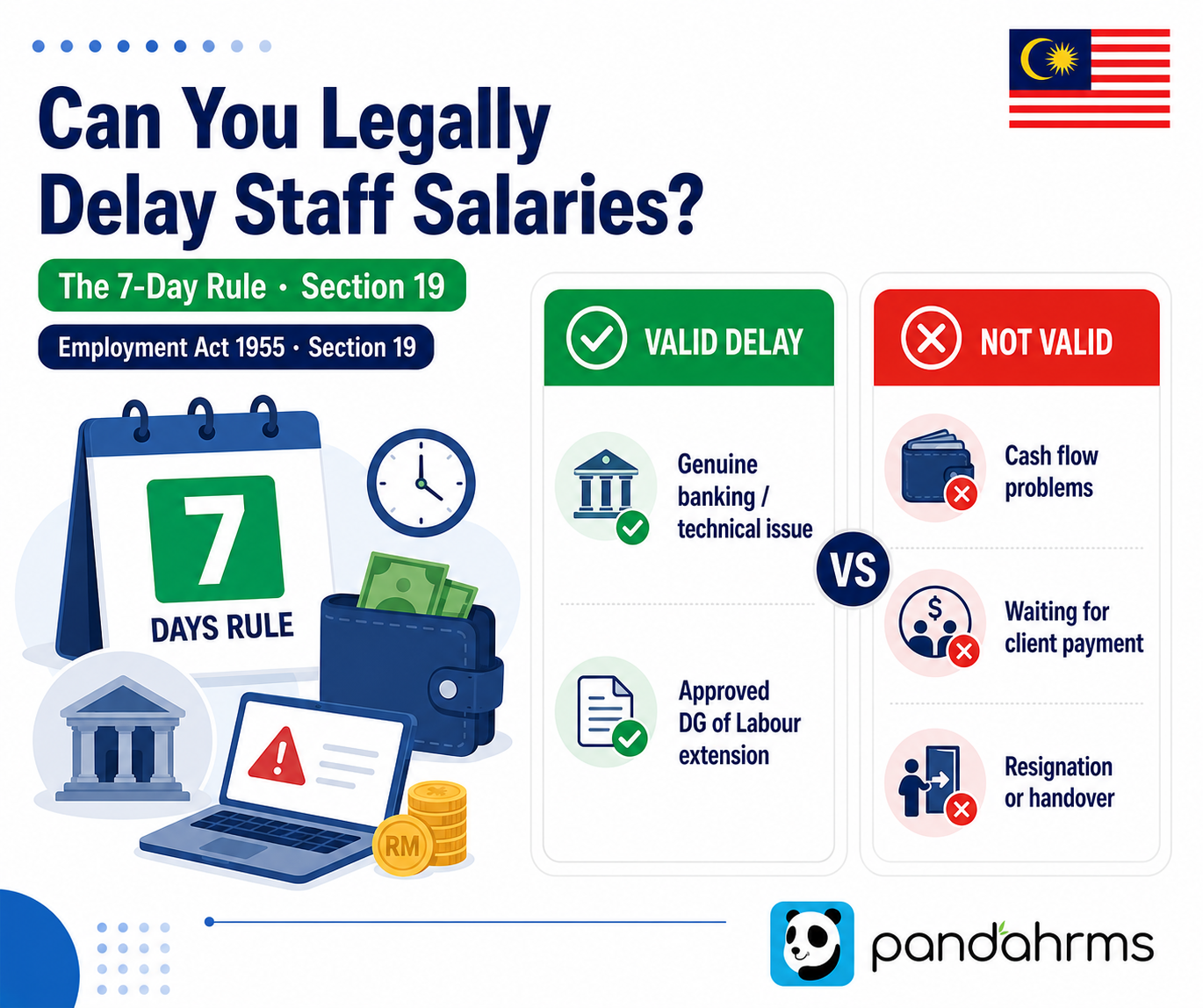
Every employer must pay each employee their wages no later than the 7th day after the end of the wage period.
A “wage period” cannot exceed one month. So for normal monthly salaries, wages for a given month must reach the employee within seven days of that month ending.
Paying on the 7th of the following month is lawful — it’s the latest allowed. Many employers pay earlier (on the last working day of the month), which is perfectly fine. What you cannot do is pay later than that 7-day window.
There’s one built-in flexibility: under Section 19(2), wages for overtime, rest-day, or public-holiday work may be paid by the last day of the next wage period.
Can Employers Delay Salaries? The Invalid Reasons
This is where employers get caught out. The following are NOT valid reasons to pay staff late — the wages are still due on time regardless:
| "Reason" for Delay | Valid Excuse? |
|---|---|
| Cash flow problems / financial difficulty | No |
| Still waiting for a customer to pay you | No |
| The employee has resigned | No — final wages still apply |
| Incomplete handover | No |
| Employee hasn’t returned company property | No |
The principle is firm: your business circumstances do not transfer the risk onto your employees’ salaries. Once wages are earned, they must be paid on schedule.
The Limited Valid Exceptions
There are only narrow situations where a short delay may be defensible:
- Genuine technical issues — a banking outage, system maintenance, or a payroll processing error. Even then, you should notify affected employees immediately and pay as soon as possible.
- A Director General extension — an employer may apply to the Director General of Labour for permission to extend the payment period where timely payment is “not reasonably practicable.” Approval is discretionary, not automatic — you cannot assume it.
Notice what’s missing from this list: cash flow. A slow month simply doesn’t qualify.
The Penalties and Real-World Consequences
Paying wages late isn’t just poor practice — it’s a breach of the Employment Act. The consequences include:
- An offence under the Employment Act, which can attract a fine on conviction.
- Labour Department complaints and investigation — employees can lodge a complaint with the nearest labour office (JTKSM), triggering scrutiny of your payroll practices.
- Claims for unpaid wages through the Labour Court.
- Constructive dismissal risk — persistent or serious failure to pay wages on time can be treated as a fundamental breach of contract, potentially allowing an employee to claim constructive dismissal.
And beyond the legal exposure, there’s the human cost: late pay erodes trust, damages morale, and drives good people to leave — the last thing any business under financial pressure can afford.
How to Stay Compliant
Paying on time is mostly a matter of process. A few habits keep you on the right side of Section 19:
Step 1: Run payroll early
Don’t leave it to the last day. Start the process with enough buffer to catch errors and clear bank processing time.
Step 2: Verify calculations before payday
Check salaries, overtime, deductions, and statutory contributions in advance so nothing derails the run at the last minute.
Step 3: Ensure funds are ready
Confirm the payroll account is funded ahead of the pay date — don’t rely on incoming receivables landing “just in time.”
Step 4: Allow for bank processing
Factor in the time it takes for transfers to actually reach employees, especially around weekends and public holidays.
Step 5: Communicate immediately if something goes wrong
If a genuine technical issue delays payment, tell employees at once, explain the cause, and pay as fast as possible.
Key principle: Salary timing is a legal obligation, not a cash-flow buffer. Plan payroll as a fixed, non-negotiable deadline — because that’s exactly what the law treats it as.
Where the Right HR System Helps
Most late-payment problems come down to a payroll process that’s rushed, manual, or error-prone. That’s precisely what a proper payroll system prevents.
With an HR and payroll system like Pandahrms, salaries, overtime, and statutory deductions are calculated accurately and ahead of time, payroll runs follow a consistent schedule, and everything is documented — so paying within the 7-day window becomes routine rather than a monthly scramble. When payroll is organised and predictable, on-time payment takes care of itself.
Pay on time, stay compliant, and let your system keep payday on track.
Final Thoughts
Can employers delay salaries in Malaysia? For almost every reason a business might have — cash flow, unpaid invoices, a departing employee — the answer is no. Section 19 sets a hard 7-day deadline, and only narrow technical exceptions or a discretionary Director General extension can move it.
Treat payday as the fixed legal deadline it is: run payroll early, keep funds ready, and communicate immediately if a genuine problem arises. Do that, and you protect your employees, your compliance record, and the trust that keeps your team together.
Frequently Asked Questions (FAQs)
When must salaries be paid in Malaysia?
Under Section 19 of the Employment Act 1955, wages must be paid no later than the 7th day after the end of the wage period. For monthly salaries, that means within seven days of the month ending.
Can an employer delay salary due to cash flow problems?
No. Cash flow difficulties, waiting for customer payments, or other business circumstances are not valid reasons to delay wages. Salaries must still be paid within the legal timeframe.
Is paying salary on the 7th of the month legal?
Yes. Paying by the 7th day after the wage period ends is the latest lawful date. Paying earlier is fine; paying later breaches Section 19.
What can employees do if their salary is paid late?
Employees can lodge a complaint with the Labour Department (JTKSM), claim unpaid wages through the Labour Court, and in serious or repeated cases may have grounds for a constructive dismissal claim.
Are there any valid reasons to pay wages late?
Only narrow ones — a genuine technical or banking issue (with immediate notice and prompt payment), or an approved extension from the Director General of Labour, which is discretionary. Overtime and holiday-work pay may also fall due by the end of the next wage period under Section 19(2).
Disclaimer
This article is intended for general informational purposes only and should not be regarded as legal advice. Wage payment obligations depend on the specific facts, the employment contract, the applicable laws, and individual circumstances. Employers are encouraged to refer to the latest guidance from the Department of Labour (JTKSM) or consult a qualified employment adviser before acting.
Sources
- Employment Act 1955 (Act 265), Malaysia — Sections 18 and 19
- Employment (Amendment) Act 2022, Malaysia
- Department of Labour Peninsular Malaysia (JTKSM) guidance on payment of wages