A long-serving employee retires after 15 years and asks about their gratuity. A contract employee finishes and expects a “thank you” payment. Both raise the same questions for an employer: do I actually have to pay this, how much, and is it taxed? Gratuity is widely misunderstood in Malaysia — partly because it is not what most people assume.
Here’s how gratuity and long-service payments work: when they’re owed, how to calculate them, and the tax treatment that catches employers out.
Is gratuity mandatory?
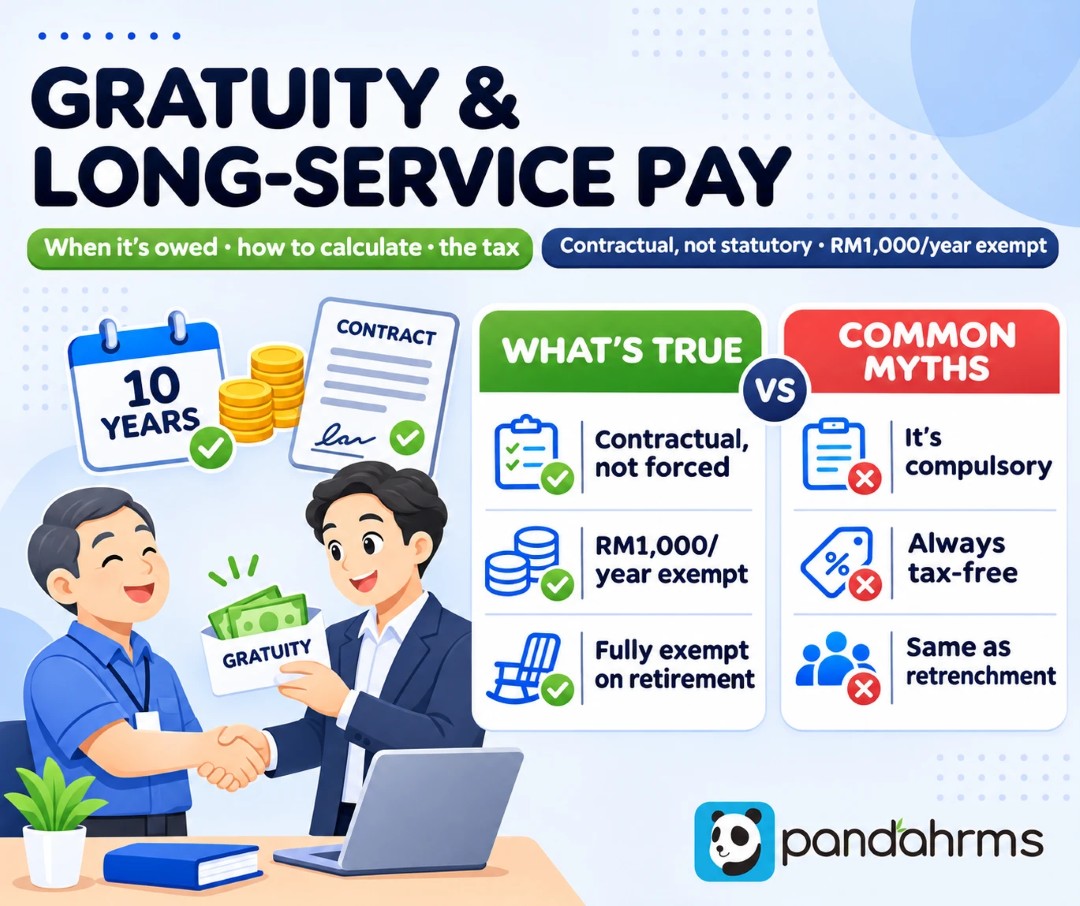
No — this is the key point. Gratuity is not a statutory entitlement under the Employment Act 1955. It is a contractual or discretionary payment: an employer owes it only if it is promised in the employment contract, the staff handbook, a collective agreement, or an established company practice.
That makes gratuity different from the statutory termination and lay-off benefits that apply when an employee is retrenched — those are set by law and calculated on a fixed scale. If you’re dealing with a retrenchment rather than a retirement or long-service payment, read retrenchment and termination benefits instead; this guide is about the contractual gratuity.
Rule of thumb: if no contract, handbook or consistent past practice promises a gratuity, there is no legal obligation to pay one. If any of them does, it becomes enforceable — so say what you mean in writing.
When is a gratuity usually paid?
In practice, employers pay gratuity in a few situations:
- Retirement — a lump sum recognising a full career, often on reaching the retirement age.
- Long service — a reward for completing a set number of years (for example, after 10 or 15 years).
- End of a fixed-term contract — some contracts promise a gratuity on successful completion.
How to calculate it
Because gratuity is contractual, the formula is whatever the contract says — there is no statutory rate. The most common approach is a number of days’ or weeks’ pay for each completed year of service. For example:
Gratuity = (days of pay per year) × (years of service) × (daily rate)
So an employee on RM3,000 a month (about RM100 a day) promised 15 days’ pay per year of service who completes 10 years would receive roughly 15 × 10 × RM100 = RM15,000. Whatever formula you use, write it clearly into the contract so there’s no dispute at the end.
The tax treatment
Gratuity is employment income, but it enjoys a tax exemption — and the size of it depends on why the employee is leaving:
| Situation | Tax treatment |
|---|---|
| Retirement due to ill health | Fully exempt (if the Director General is satisfied) |
| Retirement at age 55 or the contractual retirement age, with 10+ years continuous service with the same employer or group | Fully exempt |
| Any other gratuity | Partially exempt — RM1,000 for each completed year of service |
So if an employee who doesn’t meet the full-exemption conditions receives a RM30,000 gratuity after 10 completed years, RM1,000 × 10 = RM10,000 is exempt and the remaining RM20,000 is taxable. Report it correctly in payroll so the right amount of PCB is applied — see our guide to PCB.
One thing to keep separate: gratuity is not the same as compensation for loss of employment (which has its own exemption), nor the same as leave encashment for unused annual leave. Each is taxed under its own rule.
Does EPF or SOCSO apply?
A genuine retirement or end-of-service gratuity is generally not “wages” for EPF and SOCSO purposes — it’s a one-off payment on leaving, not remuneration for work done. If a payment labelled “gratuity” is really a disguised bonus or regular pay, though, it can be treated as wages. When in doubt, check what the payment is really for against our guides on what counts as wages for EPF.
Where Pandahrms helps
Pandahrms lets you add a gratuity or long-service payment to an employee’s final payroll, apply the right tax exemption, and keep a clean record of the payout and the years of service it was based on. Book a free Pandahrms demo to see how final-pay and gratuity are handled.
FAQ
- Is gratuity compulsory in Malaysia?
No. Gratuity is not a statutory entitlement under the Employment Act. It is owed only if promised in the contract, handbook, collective agreement or established company practice. Statutory retrenchment benefits are a separate, mandatory matter. - How is gratuity calculated?
By whatever formula the contract sets — commonly a number of days’ or weeks’ pay for each completed year of service. There is no fixed statutory rate, so the calculation follows the agreement. - Is gratuity taxable?
It’s employment income, but it’s exempt in part or in full. Retirement gratuity is fully exempt for ill-health retirement, or for retirement at 55 (or the contractual retirement age) with at least 10 years’ service with the same employer or group. Otherwise RM1,000 per completed year of service is exempt and the rest is taxable. - Is gratuity the same as retrenchment benefits?
No. Retrenchment (termination and lay-off) benefits are set by law and calculated on a fixed scale. Gratuity is a contractual payment for long service or retirement. Different rules, different calculations. - Do EPF and SOCSO apply to gratuity?
A genuine retirement or end-of-service gratuity is generally not treated as wages for EPF and SOCSO, because it’s a one-off leaving payment rather than pay for work done. A payment that’s really a bonus in disguise can be treated as wages.