When an employer or an employee wants to end the job immediately — without serving out the notice period — the Employment Act lets them pay for it instead. That payment is called payment in lieu of notice, often shortened to PILON. It can run in either direction, and because many employers get its payroll treatment wrong, it is worth understanding properly.
This guide covers what PILON is, how long the notice period is, how to calculate the amount, and — the part that trips people up — how to treat it for EPF, SOCSO, EIS and tax. (If your question is whether you can dismiss someone in the first place, see our guide on terminating an employee without notice.)
What is payment in lieu of notice?
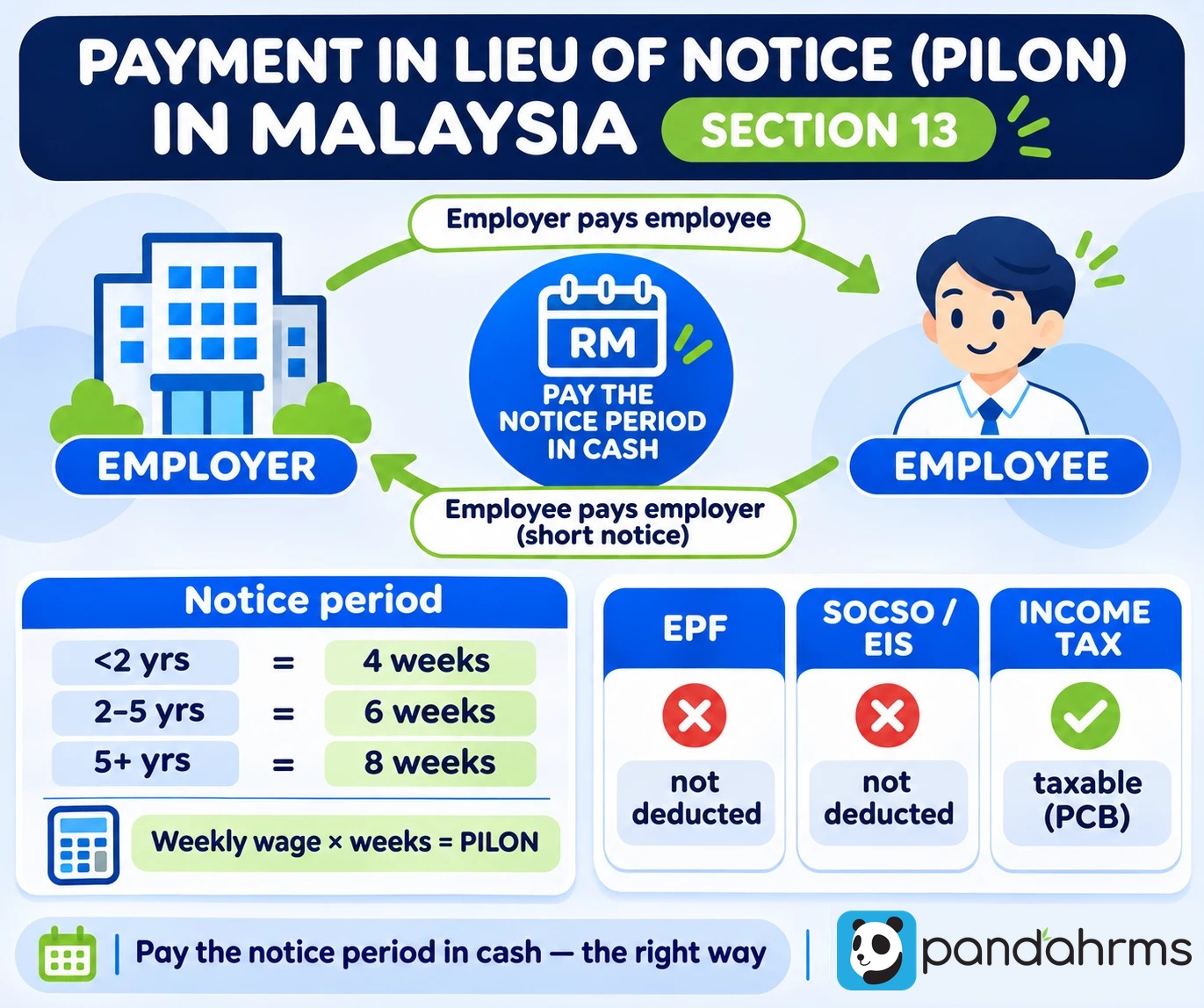
Under Section 13 of the Employment Act 1955, either party may end the contract without notice by paying the other an indemnity — a sum equal to the wages the employee would have earned during the notice period. In plain terms:
- Employer pays the employee when it ends the employment immediately (for example, when you want them to stop work and leave straight away instead of working out their notice).
- Employee pays the employer when they resign and leave without serving the required notice (short notice).
PILON is not the same as a termination or retrenchment benefit. It simply replaces the notice period with its cash equivalent.
How long is the notice period?
First, check the employment contract — the notice period stated there applies, as long as it is not shorter than the statutory minimum. Where the contract is silent, Section 12(2) sets the minimum based on length of service:
| Length of service | Minimum notice |
|---|---|
| Less than 2 years | 4 weeks |
| 2 years to less than 5 years | 6 weeks |
| 5 years or more | 8 weeks |
Where the statutory notice applies, both sides are bound by the same period, so the amount of PILON is the same whichever direction it flows (unless the contract sets a different notice period for each side).
How to calculate payment in lieu of notice
The indemnity equals the wages the employee would have earned for the part of the notice period not served, based on their last-drawn wages. A practical way to work it out:
- Weekly wage = monthly salary × 12 ÷ 52
- PILON = weekly wage × number of weeks not served
Worked example. An employee on RM3,900/month has served 3 years, so the statutory notice (if the contract is silent) is 6 weeks. The employer ends the job with immediate effect:
- Weekly wage = RM3,900 × 12 ÷ 52 = RM900
- PILON = RM900 × 6 weeks = RM5,400
If only part of the notice is unserved — say the employee works 2 of the 6 weeks — you pay only for the remaining 4 weeks. (Some employers instead use a daily rate of monthly ÷ 26 × working days; follow what the contract and your last-drawn-wage basis support.)
The part everyone gets wrong: EPF, SOCSO and tax
This is where PILON differs from normal salary, and where payroll mistakes happen:
- EPF — not contributable. KWSP lists payment in lieu of notice of termination among “non-wages”, so no EPF is deducted or contributed on it.
- SOCSO & EIS — not contributable. Payment in lieu of notice is likewise outside the wages used for SOCSO and EIS.
- Income tax — yes, it is taxable. Under the Income Tax Act 1967, Section 13(1)(e), wages paid in lieu of notice are treated as gains from employment, so PCB (MTD) applies to the taxable portion.
One nuance on tax: where the payment forms part of compensation for loss of employment, an exemption can apply — RM10,000 for each completed year of service with the same employer (or group), and a full exemption if the loss of employment is due to ill health. Because the line between “pay in lieu” and “compensation for loss of employment” can be fact-specific, confirm the exempt portion with LHDN for anything beyond a straightforward case.
When the employee owes you (short notice)
PILON works the other way too. If an employee resigns and walks out without serving notice, Section 13 entitles the employer to the same indemnity from them. In practice you would set this off against their final pay — but remember that deductions from wages are governed by Section 24, so handle it correctly rather than simply withholding. For the full offboarding steps, see our guide on an employee who resigned without notice.
Getting PILON right in payroll
The trap with PILON is treating it like ordinary salary — deducting EPF and SOCSO on it by default, or forgetting PCB because “it’s not really salary”. Both are wrong. A payroll system handles this by letting you add a pay item that is excluded from EPF, SOCSO and EIS but still flows into the PCB calculation, and shows cleanly on the payslip.
Processing a final payout with pay in lieu? Book a free Pandahrms demo and we’ll show you how it’s set up so the statutory treatment is right every time.
Frequently Asked Questions
- Is payment in lieu of notice compulsory?
It is the lawful alternative to serving notice. If either party ends the contract without giving the required notice, Section 13 entitles the other party to the indemnity. - How is PILON calculated?
It equals the wages for the unserved notice period, based on last-drawn wages — e.g. weekly wage (monthly × 12 ÷ 52) multiplied by the number of weeks not served. - Do I deduct EPF and SOCSO from payment in lieu of notice?
No. KWSP and PERKESO treat payment in lieu of notice as non-contributable, so EPF, SOCSO and EIS are not applied to it. - Is payment in lieu of notice taxable?
Yes. It is taxable employment income under Section 13(1)(e) of the Income Tax Act 1967, so PCB applies — though part may be exempt if it forms compensation for loss of employment. - Can an employer claim PILON from an employee who leaves without notice?
Yes. The indemnity runs both ways. Any set-off against final pay must still follow Section 24 of the Employment Act on lawful deductions.