Unpaid leave — cuti tanpa gaji — looks straightforward: no work, no pay. But two things trip employers up: whether they even have to grant it, and how to deduct the pay correctly. Get the divisor wrong and every unpaid day is miscalculated.
This guide covers when unpaid leave applies, how to calculate the deduction the right way under the Employment Act, and what happens to EPF, SOCSO and EIS for that month.
Is unpaid leave a right?
No. Unpaid leave is not a statutory entitlement in Malaysia. Paid leave — annual leave, sick leave, public holidays — is set by the Employment Act, but unpaid leave is granted at the employer’s discretion, by mutual agreement or under your own company policy. That means you can approve it, set conditions, or decline it — as long as you apply your policy consistently.
Typical situations where unpaid leave comes up:
- An employee has used up their annual leave but needs more time off
- Extended personal, family or medical reasons beyond paid entitlements
- Study leave or a personal sabbatical your policy allows
Note the difference between approved unpaid leave and unauthorised absence. If an employee simply doesn’t turn up, that is absence without leave — a conduct issue you handle through your disciplinary process, not the same as granting cuti tanpa gaji.
How to calculate the unpaid leave deduction
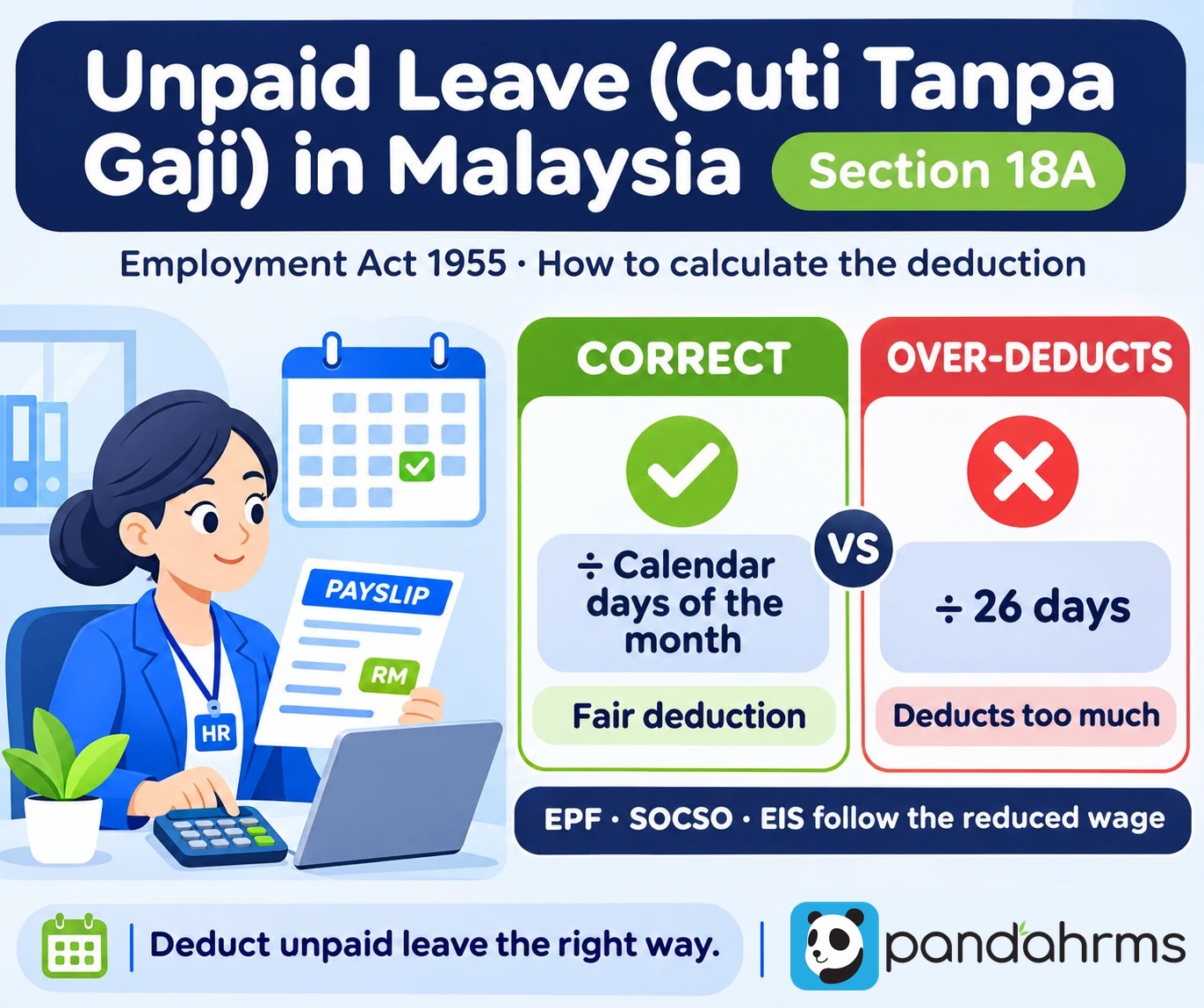
This is where most mistakes happen. For an employee covered by the Employment Act, the deduction for days not worked follows the incomplete-month formula in Section 18A:
Daily rate = Monthly wage ÷ number of days in that wage period (the calendar month)
Deduction = Daily rate × number of unpaid days
Worked example. An employee earns RM3,000/month and takes 2 days of unpaid leave in November (30 days):
- Daily rate = RM3,000 ÷ 30 = RM100
- Deduction = RM100 × 2 = RM200
- Pay for the month = RM3,000 − RM200 = RM2,800
Do not automatically divide by 26. The ÷26 figure is the ordinary rate of pay used for overtime and rest-day/public-holiday pay (Section 60I) — it is not the divisor for an ordinary unpaid-leave deduction. Using ÷26 here over-deducts: RM3,000 ÷ 26 × 2 = RM230.77 instead of RM200. For the full explanation of when each divisor applies, see our guide on ÷26 vs incomplete-month wages (Section 60I & 18A). (If the employee is not covered by the Employment Act, follow the method stated in their contract.)
What happens to EPF, SOCSO and EIS?
Unpaid leave lowers the month’s wages, and the statutory contributions simply follow the actual wage paid:
- A few unpaid days: EPF, SOCSO and EIS are calculated on the reduced monthly wage (RM2,800 in the example above), not the full salary.
- A full month of unpaid leave (zero wages): with no wages paid, there is no EPF, SOCSO or EIS for that month. Flag this to the employee — a month with no SOCSO contribution is a gap in their contribution record, which can matter for certain benefit eligibility.
Getting unpaid leave right in payroll
The safe way to handle unpaid leave is to (1) record it as its own leave type, (2) let the system apply the correct Section 18A daily rate instead of a hard-coded ÷26, and (3) let EPF, SOCSO, EIS and PCB recalculate on the reduced wage automatically. Done manually, the two easy mistakes are using the wrong divisor and forgetting that the statutory deductions should drop with the lower pay.
Want unpaid leave to flow straight into the right deduction and contributions? Book a free Pandahrms demo and we’ll show you how it’s set up.
Frequently Asked Questions
- Do I have to approve unpaid leave?
No. Unpaid leave is not a statutory right. It is granted at the employer’s discretion or by agreement, usually under your company policy — apply that policy consistently. - How do I calculate the deduction for unpaid leave?
For an Employment Act employee, use the Section 18A incomplete-month formula: monthly wage ÷ number of days in that calendar month × the number of unpaid days. - Should I divide the monthly salary by 26 for unpaid leave?
No. ÷26 is the ordinary rate of pay for overtime and rest-day/holiday pay. Using it for unpaid leave over-deducts; use the Section 18A calendar-day divisor instead. - Is EPF and SOCSO still deducted during unpaid leave?
They are calculated on the actual wage paid. A few unpaid days means contributions on the reduced wage; a full month of no pay means no EPF, SOCSO or EIS for that month. - Is unauthorised absence the same as unpaid leave?
No. Absence without approval is a conduct matter for your disciplinary process, not the same as approved cuti tanpa gaji.