Fixed-term contracts look like the perfect flexibility tool: hire someone for six months or a year, and when the contract ends, the relationship simply ends — no termination, no dispute. But in Malaysia, that assumption is exactly where employers get burned. Used wrongly, a “fixed-term” contract can be ruled a permanent one by the Industrial Court — turning a simple non-renewal into an unfair dismissal claim. Here’s how fixed-term contracts really work, and how to use them safely.
What Is a Fixed-Term Contract?
A fixed-term contract is an employment contract with a defined end date (or tied to the completion of a specific project). Unlike permanent employment, it’s meant to last only for a set period — common for seasonal work, one-off projects, or covering a temporary need. When a genuine fixed-term contract reaches its end date, it expires on its own — there’s no termination and no dismissal.
Are Fixed-Term Contracts Legal in Malaysia?
Yes. There’s nothing unlawful about hiring on a fixed-term basis. The problem is never the contract label — it’s whether the arrangement is genuinely fixed-term, or a permanent job dressed up in temporary clothing to sidestep an employer’s obligations.
Genuine vs “Sham” Fixed-Term Contracts
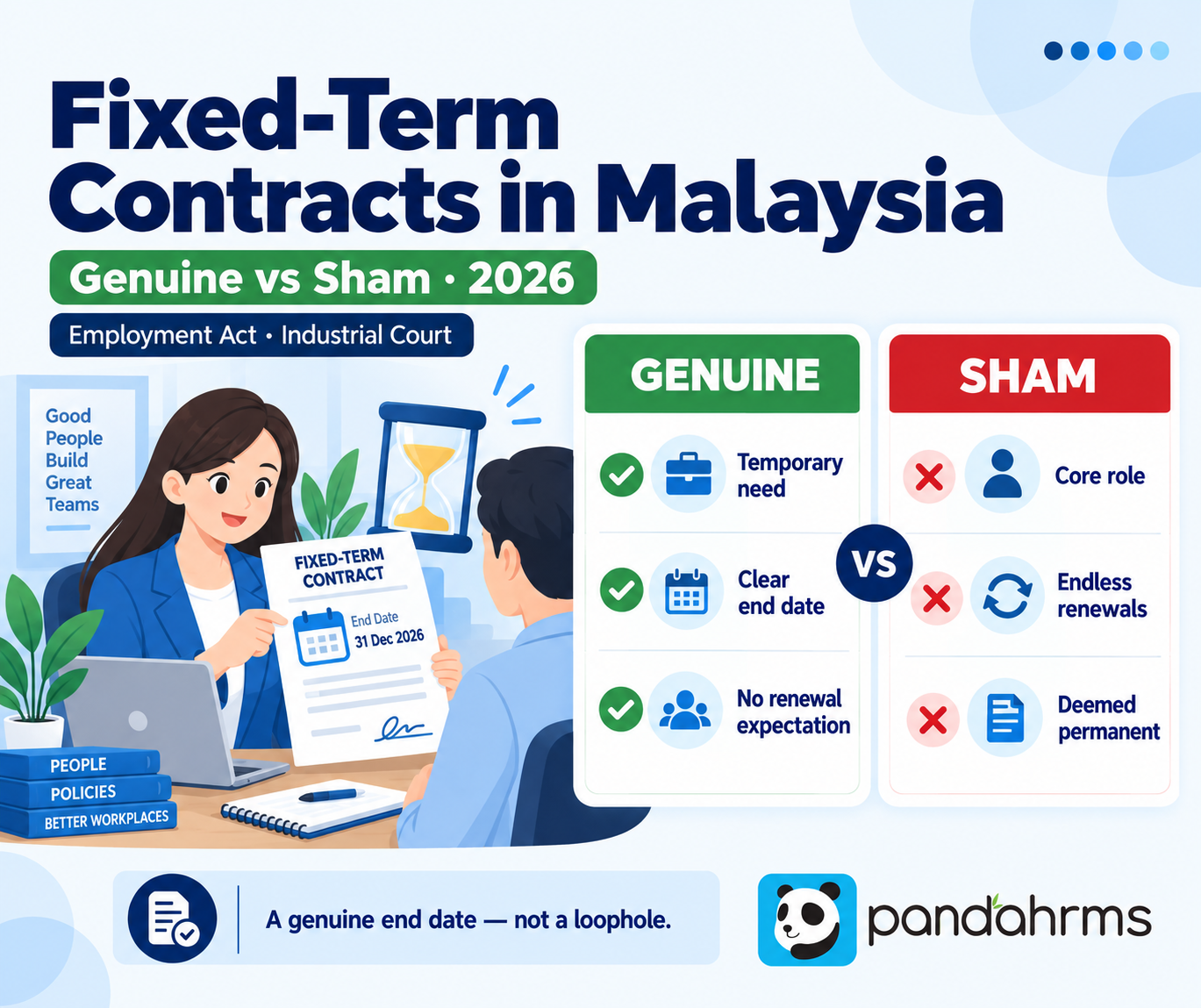
This is the heart of the matter. The Industrial Court looks past the wording of the contract to the reality of the relationship. A genuine fixed-term contract usually involves:
- A real, temporary need — seasonal work, a specific project, or a defined assignment.
- A clear understanding by both parties that there is no expectation of renewal.
- A genuine business reason for the fixed duration.
A “sham” fixed-term contract, on the other hand, is a permanent role dressed up as a series of short contracts — typically to avoid paying benefits or to make it easy to let someone go. Courts see through this.
When a Fixed-Term Contract Becomes “Permanent”
A fixed-term contract that is repeatedly and automatically renewed over a long period can create a legitimate expectation of permanent employment — and be deemed permanent. In the landmark case Ahmad Zahri bin Mirza Abdul Hamid v AIMS Cyberjaya Sdn Bhd (2020), the Federal Court held that a contract renewed successively, without any break between terms and without the employee having to re-apply, was in reality a permanent employment relationship.
To decide whether it’s a genuine fixed-term or “permanent employment in disguise”, the courts weigh three factors:
| Factor | What the court looks at |
|---|---|
| Intention of the parties | Did both sides genuinely intend a temporary, non-renewable arrangement? |
| Employer’s conduct | How the contract was handled — automatic renewals, no breaks, no re-application. |
| Nature of the business & work | Is the work genuinely temporary, or a core, ongoing function of the business? |
Non-Renewal: Is It a Dismissal?
It depends entirely on whether the contract was genuine:
- Genuine fixed-term — when it expires, there is no dismissal. The employer has no further obligation, and non-renewal cannot be challenged as unfair dismissal.
- Sham fixed-term — if the Industrial Court decides the employee was really permanent, then non-renewal is treated as a dismissal. If it’s found to be without just cause or excuse, the employer can face reinstatement or compensation of up to 24 months’ salary.
Best Practices for Employers
- Use fixed-term only for genuinely temporary needs — projects, seasonal peaks, or specific cover, not core permanent roles.
- Put it in writing, with a clear start and end date and the reason for the fixed term.
- Avoid endless automatic renewals for the same person doing ongoing work — that’s the fastest route to a “deemed permanent” finding.
- Be consistent — if the role is really permanent, hire on a permanent contract (with probation) instead. For the essentials of a proper contract, see our guide on the employment offer letter & contract.
Where Pandahrms Helps
Fixed-term problems often start with poor record-keeping — contracts that quietly roll over, or end dates no one is tracking. With Pandahrms, every employee’s contract type and end date is recorded, so you get clear visibility of who is on a fixed term and when it expires. You can plan renewals or exits deliberately — instead of letting contracts auto-repeat until they’re legally permanent — and keep a clean documented history of each agreement. Good records are your first line of defence.
Final Thoughts
Fixed-term contracts are a legitimate tool — but only when they’re genuine. Use them for real temporary needs, document them clearly, and don’t lean on rolling renewals to keep a permanent employee “flexible”. Treat the label as a legal commitment, not a loophole, and you get the flexibility without the unfair-dismissal risk.
Frequently Asked Questions (FAQs)
- Are fixed-term contracts legal in Malaysia?
Yes. Hiring on a fixed-term basis is lawful, provided the arrangement is genuinely temporary. The risk arises only when a fixed-term contract is used to disguise what is really permanent employment. - Can a fixed-term contract become permanent?
Yes. If it is repeatedly and automatically renewed without breaks, the courts may find a legitimate expectation of permanent employment and deem the employee permanent — as the Federal Court held in the AIMS Cyberjaya case. - Is not renewing a fixed-term contract considered dismissal?
For a genuine fixed-term contract, expiry is not a dismissal. But if the contract is found to be a sham and the employee is really permanent, non-renewal can be treated as an unfair dismissal. - What happens if a fixed-term contract is ruled unfair dismissal?
The employer can be ordered to reinstate the employee or pay compensation — potentially up to 24 months’ salary — so the cost of getting it wrong is significant. - How can employers use fixed-term contracts safely?
Use them only for genuinely temporary work, state a clear end date and reason in writing, avoid endless renewals for ongoing roles, and hire permanent staff on permanent contracts.