
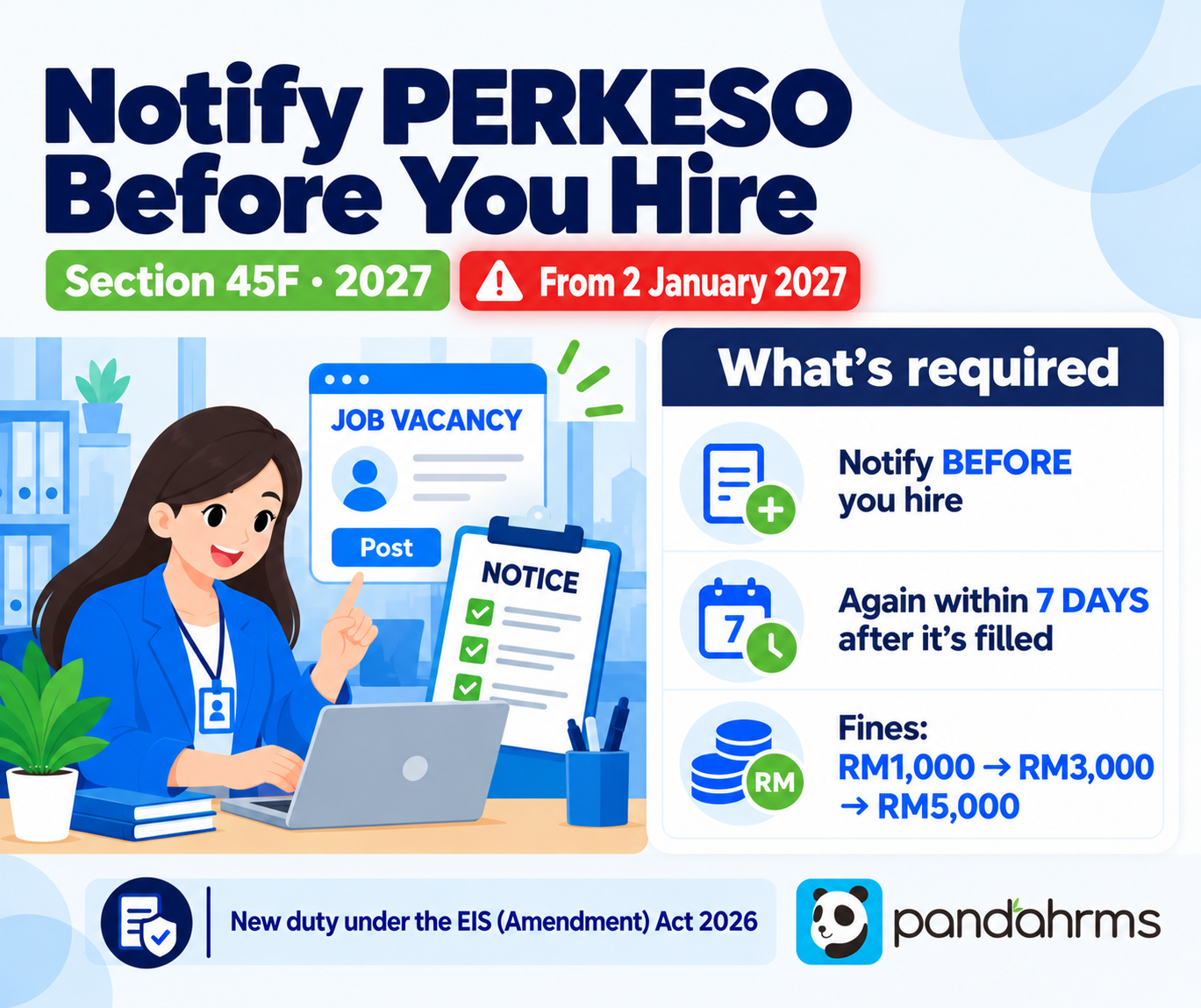
From 2 January 2027, telling PERKESO about a job vacancy is no longer good practice — it’s the law. The Employment Insurance System (Amendment) Act 2026 adds a new Section 45F that requires every employer to notify PERKESO before hiring to fill a vacancy, and again within 7 days after it’s filled — with fines of up to RM5,000 for non-compliance. Here’s exactly what the law says, verified against the gazetted Act, and what you need to do.
What’s New: Section 45F Is Now Law
The Employment Insurance System (Amendment) Act 2026 (Act A1796) inserts a set of new provisions (Sections 45A–45H) dealing with employment services. One of them, Section 45F, makes it a legal duty for employers to report job vacancies to PERKESO. The vacancy-notification duty comes into operation on 2 January 2027 (appointed by the Minister via gazette notification P.U. (B) 391/2026).
The same amendment also renames the principal Act from the Employment Insurance System Act 2017 to the Employment Insurance System and Employment Services Act 2017 — a signal of how central employment services (matching job seekers to vacancies) now are to PERKESO’s role. This builds on the vacancy-reporting rules we covered when the tiered fines were first proposed (see our guide on the new tiered fines that replaced the RM10,000 penalty).
Two Things Every Employer Must Do
Under Section 45F, there are two separate notifications for each vacancy or newly created position:
| When | What you must do |
|---|---|
| Before hiring (s.45F(1)) | Notify PERKESO in writing about the job vacancy or new position before you hire someone to fill it. |
| After it’s filled (s.45F(3)) | Once the position is filled, notify PERKESO in writing within 7 days. |
In short: tell PERKESO when you open a role, and tell them again when you fill it. The stated purpose is “employment brokerage” — helping PERKESO match job seekers to real vacancies and keep accurate labour-market data.
The Penalties (Section 45F(4))
An employer who fails to give the before-hiring notification (contravening subsection (1)) commits an offence, with fines that rise with repeat offences:
| Offence | Maximum fine |
|---|---|
| First offence | Fine not exceeding RM1,000 |
| Second offence | Fine not exceeding RM3,000 |
| Third or subsequent offence | Fine not exceeding RM5,000 |
These tiered fines replaced an earlier proposed flat maximum of RM10,000, following feedback from employers and SMEs. The Ministry of Human Resources has indicated that enforcement will start with compliance notices — a warning and a chance to put things right — before any compound is imposed. The message is still clear, though: build this into your hiring process now.
How Do You Notify PERKESO?
The Act simply says “in writing.” In practice, employers already report vacancies through PERKESO’s national employment platform, MYFutureJobs. As of now, PERKESO has not published the final form or system flow specific to the new Section 45F duty, so watch for official PERKESO guidance closer to the 2 January 2027 start date — and in the meantime, keep MYFutureJobs reporting as your baseline.
Who and What This Covers
- Which employers? The duty applies to employers generally — plan for it whether you’re an SME or a large organisation.
- Which roles? Any job vacancy or newly created position you’re hiring for.
- What form? A written notification to PERKESO — one before hiring, one within 7 days after the role is filled.
How to Prepare Before 2 January 2027
- Add two steps to your hiring workflow — “notify PERKESO” as a gate before an offer is made, and “notify PERKESO” again within 7 days of the new hire’s start.
- Assign ownership — make clear whether HR or the hiring manager files each notification, so nothing slips through.
- Keep a record — log the vacancy, the notification dates, and the fill date for every role, so you can prove compliance.
- Watch for PERKESO’s guidance on the exact submission channel for Section 45F.
Where Pandahrms Helps
The hard part of Section 45F isn’t the notification itself — it’s never missing it across every open role and every new hire. Pandahrms keeps a clean record of each new position and every hire’s start date, so your team always has the details and dates on hand to notify PERKESO on time, and a clear trail to show you did. Build the two notification steps into your onboarding checklist, and a tidy HR system turns a new legal duty into a routine tick-box instead of a compliance risk.
Final Thoughts
Section 45F doesn’t change who you hire — just that you tell PERKESO before you hire and within 7 days after you fill the role. The fines are modest and enforcement starts with a warning, but the simplest way to stay clear of them is to bake both notifications into your hiring process before 2 January 2027. Get it set up once, and it runs itself.
Frequently Asked Questions (FAQs)
- When does Section 45F take effect?
The job-vacancy notification duty under Section 45F comes into operation on 2 January 2027, appointed by the Minister via gazette notification P.U. (B) 391/2026 under the Employment Insurance System (Amendment) Act 2026. - What exactly must an employer do?
Notify PERKESO in writing about a job vacancy or new position before hiring to fill it (s.45F(1)), and again in writing within 7 days after the position is filled (s.45F(3)). - What are the penalties?
For failing to give the before-hiring notice: a fine not exceeding RM1,000 for a first offence, RM3,000 for a second, and RM5,000 for a third or subsequent offence (s.45F(4)). - How do I submit the notification?
The Act requires written notification to PERKESO. Vacancy reporting is typically done through MYFutureJobs; employers should follow PERKESO’s official guidance on the exact process for Section 45F as the start date approaches. - Does enforcement start with a fine?
The Ministry of Human Resources has indicated that employers will first receive compliance notices to allow corrective action before any compound is imposed — but the duty itself is mandatory from 2 January 2027.
Sources (official): Employment Insurance System (Amendment) Act 2026 (Act A1796), new Section 45F, on the Federal Legislation Portal (AGC) — see sections 45A–45H. The commencement date of 2 January 2027 is appointed by gazette notification P.U. (B) 391/2026 (published 30 September 2026), which is listed on that same Act page. This article is general information, not legal advice.



