
Every year, the same question lands on the employer’s desk: how much of a raise should we give — and when? Give too little and good people start looking elsewhere; give too much and the wage bill runs ahead of the business. A salary increment isn’t guesswork — it’s a decision you can make fairly and consistently. Here’s a practical guide for Malaysian employers heading into 2027.
What Is a Salary Increment?
A salary increment is a permanent increase to an employee’s base salary. It’s different from a one-off bonus (which doesn’t raise the base) and from a promotion increase (which comes with a bigger role). An increment usually rewards continued performance and keeps pay in step with the market.
When Do Malaysian Employers Give Increments?
Most companies review salaries once a year, with the new figure typically taking effect in January, right after the annual performance appraisal cycle. Some employers instead review on each employee’s work anniversary. Either way, the key is a consistent, scheduled cycle — not ad-hoc raises that are hard to justify and easy to dispute.
How Much? The Factors That Decide
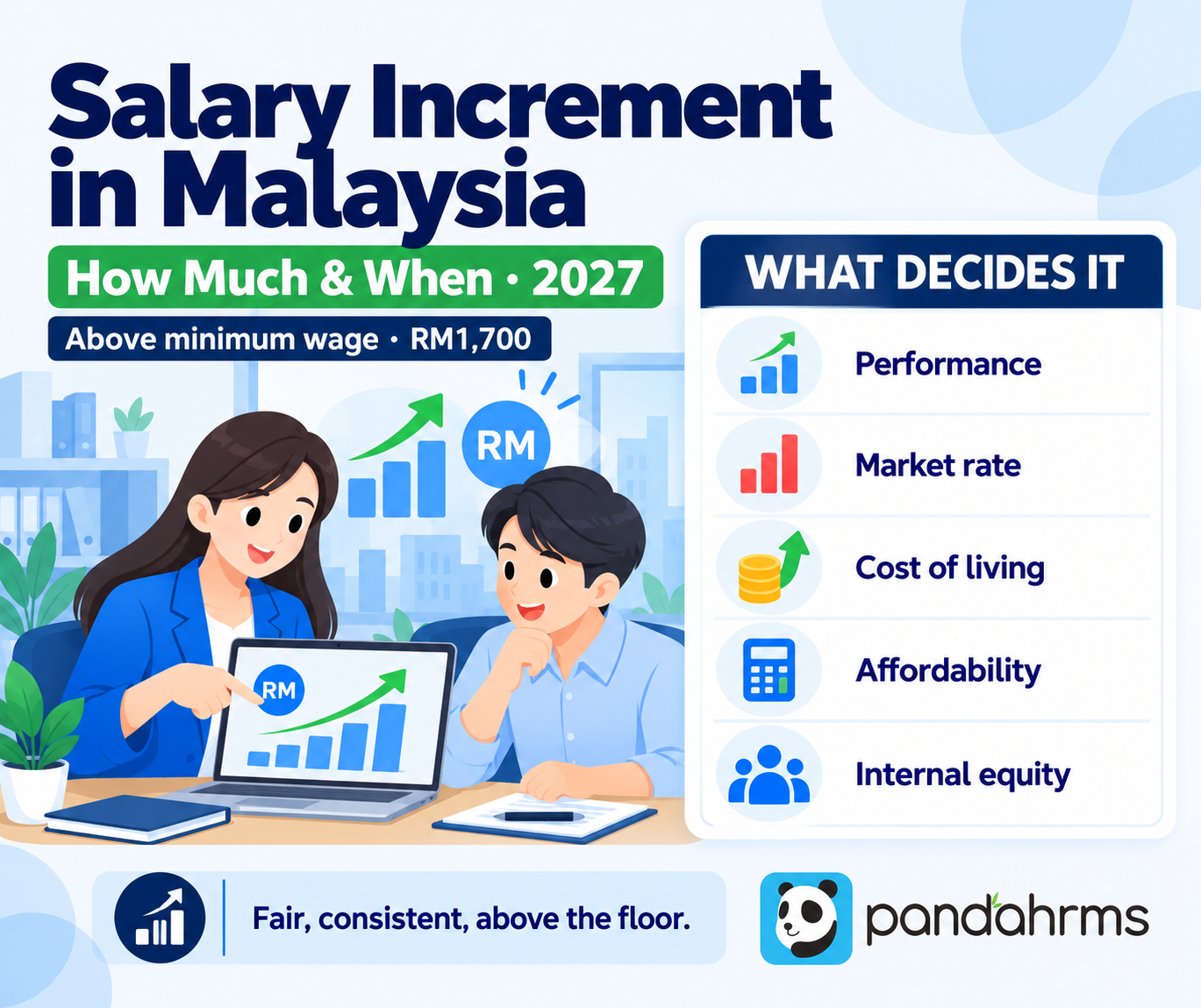
There’s no legally fixed increment rate in Malaysia. In practice, annual increments tend to sit in the mid-single-digit percentage range, but the right number for your business depends on:
- Performance — a top performer should clearly out-earn an average one; a tiered increment matrix (by appraisal rating) keeps this fair.
- Market rate — benchmark against what similar roles pay in your industry, or you’ll lose people to competitors.
- Cost of living / inflation — a raise below inflation is effectively a pay cut in real terms.
- Company affordability — the increment must fit the wage budget and business outlook.
- Internal equity — keep pay consistent between people doing similar work.
Increment vs Adjustment vs Promotion
| Type | What it’s for |
|---|---|
| Annual increment | The regular yearly raise, tied to performance and the market. |
| Salary adjustment | A correction — e.g. bringing pay up to market or to the legal minimum wage. |
| Promotion increase | A larger raise that comes with a new role and bigger responsibilities. |
Don’t Forget Compliance
Whatever you decide, an increment can never take pay below the legal floor. Basic salary must remain at or above the RM1,700 minimum wage, and employers in scope should keep the Progressive Wage Policy in mind. Remember, too, that a higher salary means higher EPF, SOCSO, and EIS contributions — factor the on-costs into the budget.
Where Pandahrms Helps
Increment season is far smoother with the right system. Pandahrms stores each employee’s full salary history, lets you apply an effective-dated increment (so January’s raise starts exactly when it should), and instantly recalculates payroll and every statutory contribution on the new figure. You get a clean audit trail of who was raised, by how much, and when — and payslips that reflect the new salary automatically. No spreadsheets, no missed effective dates.
Final Thoughts
A salary increment is one of the clearest signals of how you value your people. Run it on a consistent cycle, tie it to performance and the market, keep it above the legal minimum, and budget for the statutory on-costs. Do that, and your increment decisions stay fair, affordable, and defensible — year after year.
Frequently Asked Questions (FAQs)
- Is a salary increment compulsory in Malaysia?
No. There is no law requiring an annual increment, unless it is guaranteed in the employment contract or a collective agreement. However, pay must always remain at or above the minimum wage. - How much is a typical salary increment in Malaysia?
There’s no fixed rate; annual increments commonly fall in the mid-single-digit percentage range, but the right figure depends on performance, industry, market rates, and company affordability. - When are increments usually given?
Most Malaysian employers review salaries once a year, with the increase taking effect in January after the annual appraisal, though some use each employee’s work anniversary. - What’s the difference between an increment and a bonus?
An increment permanently raises base salary; a bonus is a one-off payment that does not change the base. - Does a salary increment affect EPF and SOCSO?
Yes. A higher salary means higher EPF, SOCSO, and EIS contributions, so employers should budget for the added on-costs.



