Payday is simple when everyone works under one roof. Add a second outlet, a third branch, a kiosk in another state — and the same payroll run turns into a week of chasing timesheets, reconciling clock-ins you never saw, and working out which branch each ringgit of wages and overtime belongs to.
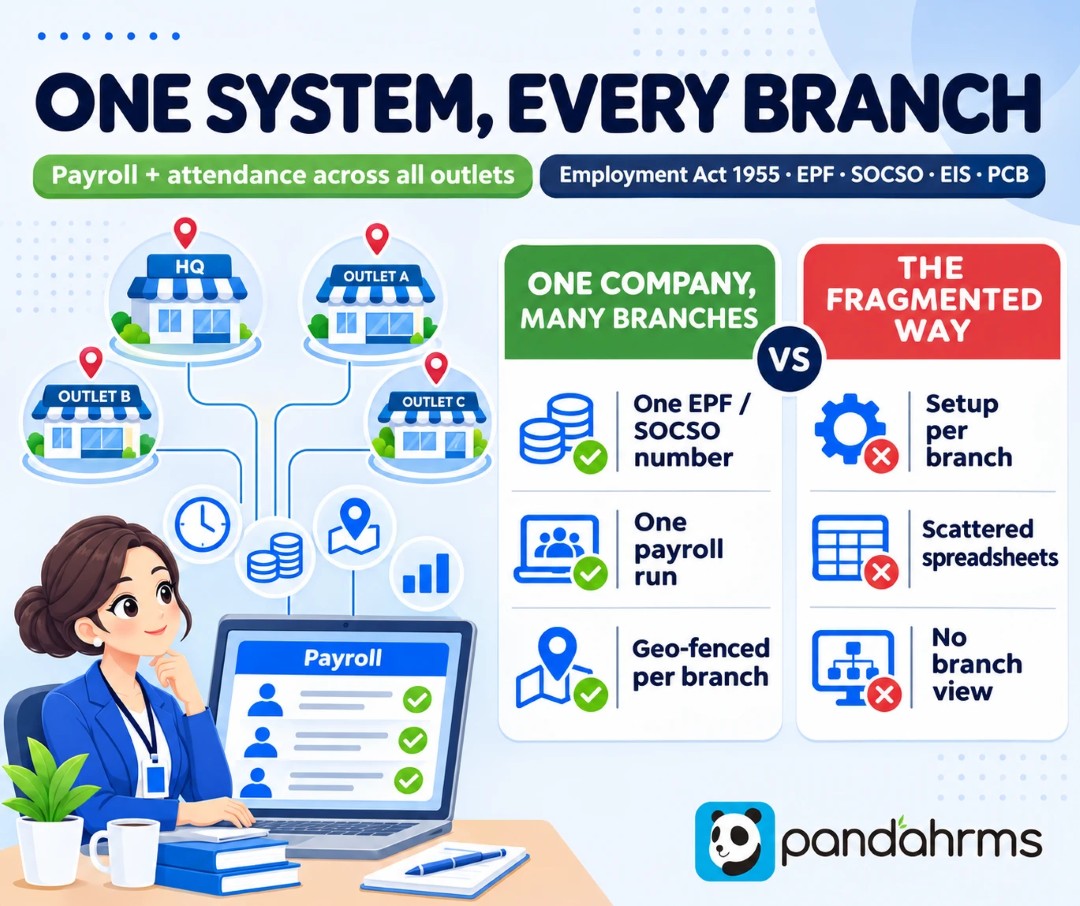
Here’s the reassuring part: running payroll and attendance across multiple branches is not a different set of laws. The Employment Act, EPF, SOCSO, EIS and PCB rules are exactly the same as for a single site. What changes is the operations — getting clean attendance out of every location, paying everyone in one run, and reporting cost branch by branch. This guide shows how to set it up properly.
First, the question that changes everything: one company, or many?
Before you touch any payroll software, settle your legal structure — because it decides how many statutory accounts you file under.
| Same company, many branches | Each outlet a separate Sdn Bhd | |
|---|---|---|
| Legal employer | One employer | A separate employer per company |
| EPF / SOCSO / EIS / PCB | One account each — one consolidated monthly submission | A separate set of accounts and submissions per company |
| Staff moving between sites | An internal transfer — service continues | A resignation from one company and a rehire by another |
| RM2,000 minimum-wage exemption | Measured once for the company | Measured across the whole group, not per company |
Most Malaysian SMEs run many branches under a single Sdn Bhd. If that’s you, you have one EPF number, one SOCSO code and one LHDN employer (E) number — the branches are just locations, not separate employers, so you don’t set each outlet up as its own employer.
If instead each outlet is its own registered company, each one is a separate employer and files its own EPF, SOCSO, EIS and PCB. You can still manage them from one system, but you cannot merge their statutory submissions. One trap to watch: the RM2,000 minimum-wage RM50 million exemption is counted across your whole group of companies — see how the RM50m exemption counts your whole group.
The Employment Act applies the same at every branch
Wherever your people clock in, the core rules don’t move:
- The wage period cannot exceed one month, and wages must be paid within 7 days of the end of the wage period — at every outlet.
- Overtime, rest days and public-holiday pay follow the same Employment Act rules at all branches — but public holidays can differ by state (more on that below).
- When a worker moves from one branch to another under the same company, it’s an internal transfer, not a new hire — their service is continuous. Put it in writing with an employee transfer letter rather than resigning and re-hiring them.
So where’s the real headache? Operations, not the law
Every pay cycle, a multi-branch employer has to do three things a single-site employer barely thinks about:
- Collect accurate attendance from every location — including the ones you never physically visit.
- Run payroll once, not once per branch — without copying data between spreadsheets.
- Report cost by branch — so each outlet’s wages, overtime and headcount are visible.
Get any of these wrong and you either overpay, underpay, or lose track of which branch is quietly bleeding money. Let’s take them in turn.
Attendance: how to trust clock-ins you can’t see
The moment staff clock in at a site you’re not standing in, two questions appear: were they actually there, and were they on time? The fix is to let the phone and the location do the checking:
- Geo-fenced clock-in — staff can only clock in when they are physically inside the outlet’s GPS radius, so an off-site clock-in is rejected. See how geo-fencing improves attendance accuracy.
- A separate zone per outlet — each branch gets its own boundary, so a KL crew member can’t clock in for the Penang shift.
- Selfie or biometric clock-in — stops “buddy punching”, where one person clocks in for another. See how to stop time theft and buddy punching.
Geo-fencing answers “were they there?”. A clear shift and roster schedule answers “were they supposed to be?”. You need both to turn raw clock-ins into trustworthy payroll hours.
Payroll: one run, every branch
Once attendance is clean, the goal is a single payroll run that covers all your outlets:
- Mixed pay cycles are normal. A salaried branch manager runs monthly; daily-rated or part-time crew may run weekly or by the day. A good system handles different payroll cycles in the same place.
- Attendance should feed payroll directly. Hours, overtime and late deductions from every branch flow into the same run — no re-keying, no emailed spreadsheets.
- One statutory file. Because a single company is one employer, EPF, SOCSO, EIS and PCB for all branches are calculated and submitted together.
Branch-level reporting: know which outlet costs what
Running one payroll doesn’t mean losing sight of each branch. The trick is to tag every employee to a branch, cost centre or company entity so the numbers split themselves:
- Payroll and cost reports break down by outlet automatically — wages, overtime and headcount per branch.
- That’s how you spot the one outlet with runaway overtime, or the branch whose labour cost is eating its sales.
- If your outlets are separate companies, each entity still reports on its own books — but you manage and view them from one login.
Branches in different states? Mind the holiday calendars
Public holidays in Malaysia are gazetted state by state. A branch in Johor and a branch in Kedah do not share the same public-holiday list, which changes holiday pay and replacement-day rules for each site. Assign the correct state calendar to each branch — read how to manage multiple public-holiday calendars across Malaysian states.
Where Pandahrms makes multi-branch simple
Pandahrms is built for employers running more than one location:
- Geo-fenced attendance with a separate zone per outlet, plus selfie clock-in to stop buddy punching.
- One payroll run across every branch — mixed pay cycles included — with attendance feeding straight in.
- Branch / company-entity tagging, so every payroll and cost report splits by outlet on its own.
- Consolidated EPF, SOCSO, EIS and PCB for the whole company — or separate sets if your outlets are separate entities.
If payday means chasing timesheets from five different outlets, book a free Pandahrms demo and we’ll show you one run that covers them all. New to structuring pay across sites? Start with our guide to building job grades and pay bands, then line it up against the HR & payroll compliance checklist.
FAQ
- Do I need a separate EPF or SOCSO number for each branch?
No — not if the branches belong to one Sdn Bhd. A single company is one employer with one EPF number, one SOCSO code and one LHDN (E) number; the branches are locations, not separate employers. You only register separately when each outlet is its own registered company. - Can one payroll run cover all my outlets?
Yes. Because it’s one employer, you process every branch in a single run and file one set of statutory contributions — as long as your system can pull attendance from each location and tag employees to their branch. - How do I track attendance at outlets I’m never physically at?
Use geo-fenced mobile clock-in: staff can only clock in inside the outlet’s GPS boundary, and a selfie or biometric check stops one person clocking in for another. Each branch has its own zone. - My branches are in different states — do they use different public holidays?
Yes. Public holidays are gazetted by state, so a branch in one state may get a holiday another doesn’t. Assign the correct state calendar to each branch, or you’ll miscalculate holiday pay and replacement days. - Each outlet is a separate company — can I still manage them together?
Operationally, yes. Each entity keeps its own EPF/SOCSO/EIS/PCB accounts and files on its own, but you can run them all from one system. Just note that the RM2,000 minimum-wage RM50 million exemption is measured across your whole group, not per company. - An employee works across two branches in a month — how do I pay them?
They remain one employee under one employer. Split their hours or cost between the two branches for reporting, but pay them on a single payslip with one set of statutory deductions.