“She’s Still on Probation — We Can Let Her Go Anytime”
That sentence gets said in Malaysian SMEs every week.
It is also how employers end up in the Industrial Court.
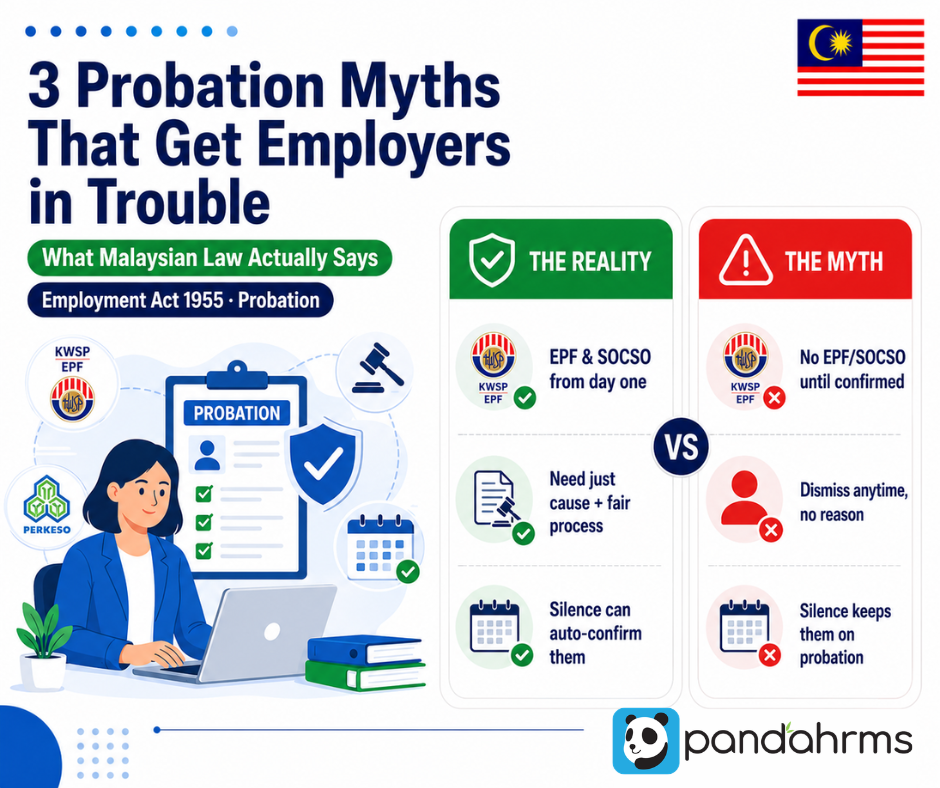
Probation in Malaysia is widely misunderstood — by employers, not just employees. The three most expensive myths: probationers have no EPF yet, can be dismissed freely, and stay “on probation” for as long as nobody says otherwise.
All three are wrong. Here is what the law actually says.
What Probation Is — and What It Is Not
Probation is a trial period at the start of employment, giving the employer time to assess whether the new hire fits the job.
Here is the part many employers miss: probation is a creature of the contract, not the law. The Employment Act 1955 does not define a probation period, does not require one, and does not set its length. Whatever probation terms you want — the length, the extension right, the confirmation process — exist only if your employment contract creates them.
In practice most Malaysian contracts set 3 to 6 months, often with a clause allowing one extension.
Myth 1: “No EPF and SOCSO Until Confirmed”
False — and this one carries statutory penalties.
A probationer is simply a new employee. EPF, SOCSO and EIS contributions are due from the first month of employment — there is no probation exemption anywhere in the EPF Act 1991 or the Employees’ Social Security Act 1969.
The same goes for statutory leave: annual leave and sick leave entitlements accrue from day one of service. Whether the employee can utilise annual leave during probation can be governed by your policy — but the entitlement is accruing regardless.
If you have staff whose contributions started only “after confirmation”, you have back-contributions to settle. Our EPF contribution guide covers the current rates.
Myth 2: “Probationers Can Be Dismissed Anytime, No Reason Needed”
False. This is the myth that produces unfair dismissal claims.
Malaysian Industrial Court jurisprudence has consistently held that a probationer enjoys the same protection against dismissal without just cause or excuse as a confirmed employee. Probation lowers the performance bar the employer must show — it does not remove the need for a reason and a fair process.
What that means practically:
• You need genuine grounds — documented poor performance, misconduct, or unsuitability. “Not a good fit” with an empty file is not a defence.
• You need a fair process — the probationer should know what was expected, know they were falling short, and get a real chance to improve. For misconduct, the normal inquiry process applies.
• You need the paper trail — reviews, feedback notes, warnings. The employer who assessed honestly at month two rarely has a problem; the employer who said nothing until the termination letter usually does.
We cover the termination decision itself in detail in Can You Terminate a Probationary Employee in Malaysia? — read it before acting on this one.
Myth 3: “Say Nothing and They Just Stay on Probation”
Dangerous. Silence at the end of a probation period is a trap of the employer’s own making.
When the probation period expires and the employee simply keeps working — no confirmation letter, no extension letter — the employment status becomes arguable, and arguments about status are exactly what courts are for. Depending on the contract wording and conduct, the employee may be treated as having been confirmed, or as still probationary; either way, you have handed the decision to someone else.
The rule is simple: before the probation period expires, put one of two letters on the table — a confirmation letter, or an extension letter that states the new end date and the specific areas to improve. An extension should be provided for in the contract and communicated before expiry, not discovered after it.
What a Probationer Is Entitled to From Day One
| Item | During probation? |
|---|---|
| EPF, SOCSO, EIS contributions | ✅ Yes — from month one |
| Annual leave accrual (s.60E) | ✅ Yes — accrues from day one of service |
| Sick leave (s.60F) | ✅ Yes |
| Public holidays | ✅ Yes |
| Overtime rates (where applicable) | ✅ Yes |
| Protection from dismissal without just cause | ✅ Yes — the standard applies to probationers |
| Confirmation at a fixed date | ❌ Only what the contract provides |
Running Probation Properly — the Employer Checklist
1. Write it into the contract. Length, the right to extend once (with a stated maximum), and what confirmation depends on. No clause, no probation.
2. Set expectations in week one. A probationer who does not know the target cannot be fairly failed against it.
3. Review at the midpoint, in writing. A 15-minute documented check-in at month 2 of 3 (or month 3 of 6) is the cheapest legal protection you can buy.
4. Decide before expiry. Confirm, extend with reasons, or part ways — but never let the date pass silently.
5. Register statutory contributions from payroll run one. Not from confirmation.
How Pandahrms Helps
Probation failures are usually calendar failures — dates that slipped past unnoticed. Pandahrms closes the gaps:
• Probation end dates tracked per employee, with reminders before expiry — so confirmation or extension happens on time, not after.
• EPF, SOCSO and EIS calculated from the first payroll run automatically — no “start contributions after confirmation” mistake.
• Leave accrual runs from day one, with utilisation rules set by your policy.
• Review notes and letters stored against the employee record — the paper trail, in one place.
Conclusion
Probation is a genuine and useful management tool — but it is a narrower one than most Malaysian employers assume. Statutory rights start on day one, dismissal still needs just cause, and the probation clock only exists if the contract created it and you actively manage the dates.
Treat probation as a structured assessment with a deadline — not as a rights-free zone — and it will do exactly what it was designed to do.
Does a probationer get EPF in Malaysia?
Yes. EPF, SOCSO and EIS contributions are mandatory from the first month of employment. There is no probation exemption in any of the statutes.
How long can probation last in Malaysia?
The law does not set a length — it is contractual. Common practice is 3 to 6 months, with any extension provided for in the contract and communicated before the original period expires.
Can an employer terminate an employee during probation?
Yes, but only with just cause or excuse and a fair process — documented performance grounds or misconduct. Probation is not a licence to dismiss freely.
What happens if probation ends and nothing is said?
The employee’s status becomes arguable, which is a risk the employer created. Always issue a confirmation letter or an extension letter before the period expires.
Does annual leave accrue during probation?
Yes — statutory annual leave under Section 60E accrues from the start of service. Whether it can be taken during probation depends on company policy, but the entitlement itself is accruing.