
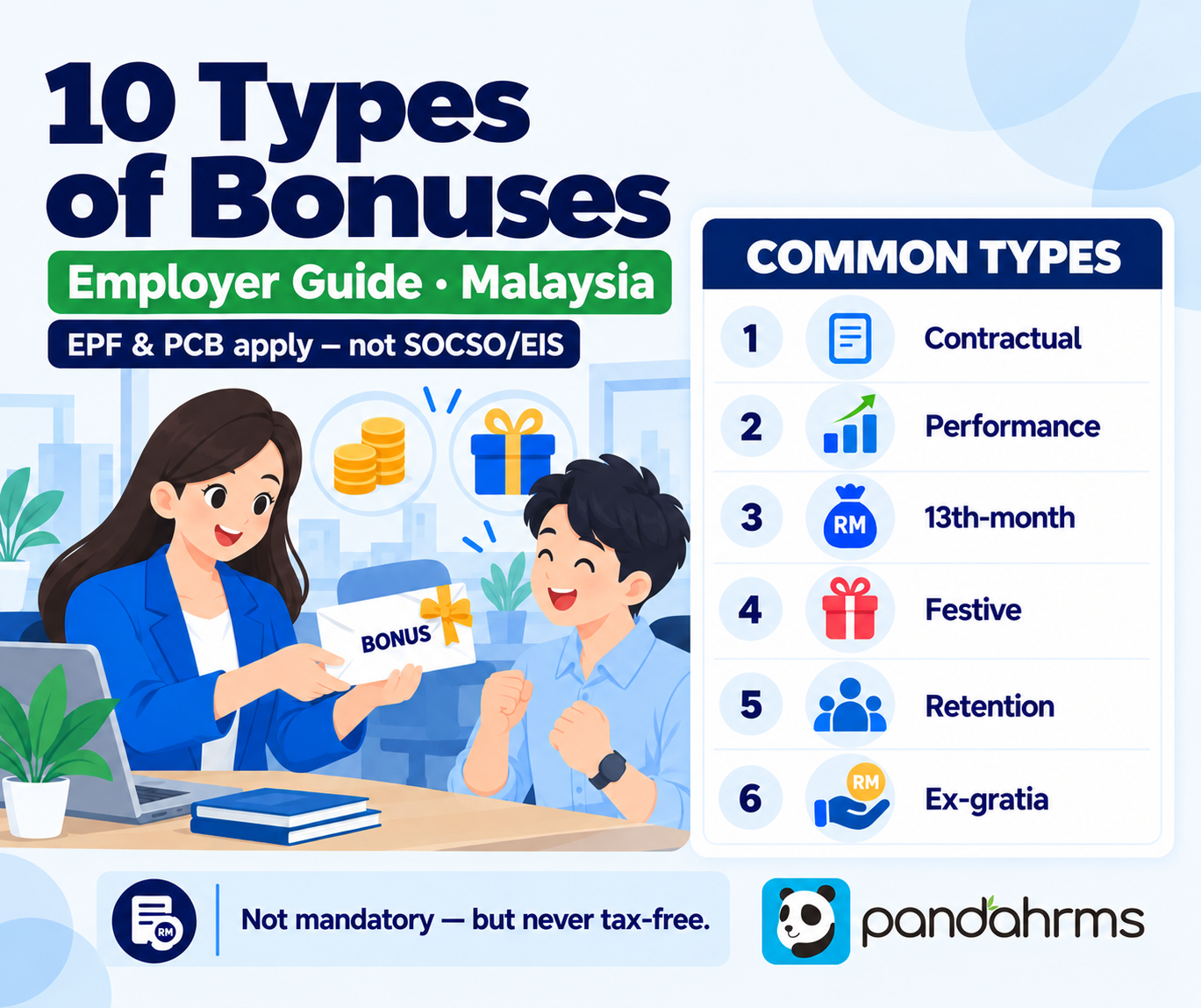
A bonus is one of the simplest ways to reward good work, share the company’s success, and keep good people from leaving. But “bonus” is a broad word — a guaranteed contractual bonus and a one-off festive token are very different things, with different expectations and different costs. Here are 10 types of bonuses Malaysian employers can offer, how each works, and the statutory catch every employer needs to remember.
Is a Bonus Mandatory in Malaysia?
Generally, no. There is no statutory requirement to pay a bonus under the Employment Act 1955 — unless it’s promised in the employment contract, a collective agreement, or established company practice. If you’ve contractually guaranteed it, though, it becomes an enforceable obligation. (See our guide: is a year-end bonus mandatory in Malaysia?)
10 Types of Bonuses Employers Can Offer
| Bonus type | What it is |
|---|---|
| 1. Contractual bonus | Guaranteed in the contract (e.g. a fixed 13th-month) — an enforceable obligation. |
| 2. Performance / discretionary bonus | Paid at the employer’s discretion, based on individual or company performance. |
| 3. 13th-month bonus | One extra month of salary, often paid at year-end. |
| 4. Festive bonus | A goodwill payment before a festival — Raya, CNY, or Deepavali. |
| 5. Signing / joining bonus | A one-off incentive to attract a new hire, sometimes with a clawback period. |
| 6. Retention bonus | Paid to keep a key employee through a critical period (e.g. a project or merger). |
| 7. Referral bonus | Rewards an employee who refers a candidate who is hired and stays. |
| 8. Profit-sharing bonus | A share of company profits distributed to staff. |
| 9. Attendance bonus | Rewards consistent, punctual attendance over a period. |
| 10. Ex-gratia bonus | A voluntary, one-off goodwill payment with no obligation to repeat it. |
The Catch: Bonuses Aren’t “Tax-Free”
Whatever you call it, a bonus still carries statutory obligations — but the rules differ by scheme:
- EPF — yes. A bonus is part of wages for EPF, so EPF contributions apply.
- SOCSO & EIS — no. An annual bonus is specifically excluded from SOCSO/EIS wages, so no SOCSO or EIS is charged on it. (See: which wages are subject to SOCSO & EIS.)
- PCB / MTD — yes. A bonus is taxable income and attracts monthly tax deduction, often at a higher rate in the month it’s paid.
- EA Form — every bonus must be reported in the employee’s annual EA Form. (See our EA Form guide.)
Budget for these on-costs when you decide the bonus figure — the true cost to the company is more than the headline amount.
Tips for Employers
- Be clear: contractual or discretionary? Spell it out in writing. A vaguely “expected” bonus can become a costly dispute.
- Communicate the criteria for performance-based bonuses, so staff know how to earn them.
- Apply it consistently and keep records — inconsistent bonuses invite claims of unfair treatment.
- Remember the statutory on-costs when budgeting.
Where Pandahrms Helps
Whatever bonus you’re paying, the payroll has to be right. With Pandahrms, you can add any bonus type to a pay run and the system automatically applies the right rules — EPF and PCB on the bonus, with SOCSO/EIS correctly excluded — reflects it on the payslip, and carries it into the employee’s EA Form at year-end. No manual recalculation, no misapplied statutory deductions — the reward reaches your staff and your compliance stays intact.
Final Thoughts
Bonuses are a powerful tool — but only when they’re clear, consistent, and correctly processed. Decide which type fits your goal, put the terms in writing, budget for the statutory on-costs, and pay it accurately. Do that, and a bonus does exactly what it should: reward your people and strengthen your team.
Frequently Asked Questions (FAQs)
- Is a bonus compulsory in Malaysia?
No. There’s no statutory requirement to pay a bonus under the Employment Act 1955, unless it is guaranteed in the contract, a collective agreement, or established practice. - Is a bonus subject to EPF, SOCSO, and EIS?
A bonus is subject to EPF and PCB (monthly tax deduction). However, an annual bonus is not subject to SOCSO or EIS — it is specifically excluded from SOCSO/EIS wages. - What is the difference between a contractual and a discretionary bonus?
A contractual bonus is promised in the contract and is enforceable; a discretionary bonus is paid at the employer’s choice and is not guaranteed. - Does a bonus need to appear in the EA Form?
Yes. All bonuses paid during the year must be reported in the employee’s EA Form for their personal tax filing. - Can an employer stop paying a bonus?
A discretionary bonus can be withheld, but a contractual one cannot be removed unilaterally. Long-standing practice can also create an expectation, so communicate any change carefully.



