“How many days of leave is my staff actually entitled to?” It’s one of the most common questions Malaysian employers ask — and getting it wrong causes disputes, payroll errors, and compliance headaches. The tricky part: some leave is required by law, while other types are simply company benefits. This guide breaks down every type of leave in Malaysia — what’s mandatory under the Employment Act 1955, and what’s up to your policy.
Statutory Leave — Required by the Employment Act 1955
These are the statutory time-off entitlements every covered employer must provide. Since the 2022 amendments (effective 1 January 2023), the Employment Act applies to all employees regardless of wage (with limited exceptions on certain provisions).
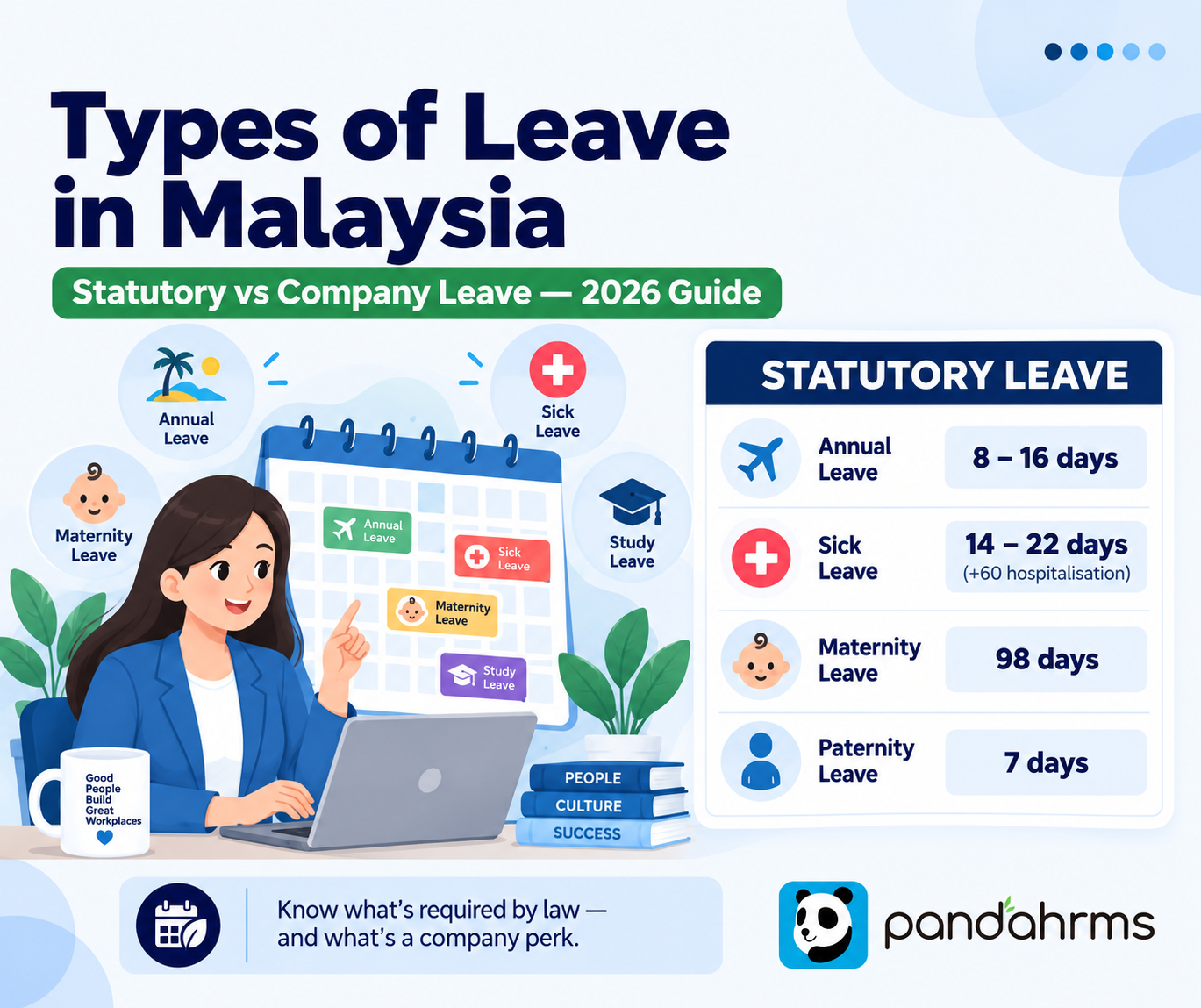
| Leave type | Entitlement |
|---|---|
| Annual leave (s.60E) | 8 days (<2 yrs service) · 12 days (2–5 yrs) · 16 days (>5 yrs) |
| Sick leave (s.60F) | 14 days (<2 yrs) · 18 days (2–5 yrs) · 22 days (>5 yrs) outpatient — plus a separate entitlement of up to 60 days hospitalisation leave |
| Maternity leave (s.37) | 98 consecutive days of paid maternity leave |
| Paternity leave (s.60FA) | 7 consecutive days (married male employee, subject to conditions) |
Annual Leave
Paid time off that scales with length of service (8/12/16 days). Employees apply in advance, and employers manage approvals around business needs. For the rules on approving and refusing it, see our guide on whether employers can reject annual leave.
Sick Leave (MC)
Paid leave when an employee is certified unfit for work by a registered medical practitioner. Outpatient entitlement is 14/18/22 days by service. Separately, where a registered doctor certifies that hospitalisation is necessary, the employee is entitled to up to 60 days of hospitalisation leave — and since the 2022 amendment (effective 1 January 2023) this is a separate entitlement, additional to the outpatient sick-leave days (not a combined 60-day cap). A valid medical certificate is the key requirement — see the rules around MC and sick leave.
Maternity & Paternity Leave
Female employees are entitled to 98 consecutive days of paid maternity leave. Married male employees are entitled to 7 consecutive days of paternity leave, subject to conditions (such as being married to the mother and minimum service). Both were expanded under the 2022 amendments.
A Note on Public Holidays
Strictly speaking, public holidays aren’t “leave” you apply for from a balance — they’re a separate paid-holiday entitlement under Section 60D. Employees are entitled to at least 11 paid gazetted public holidays a year, including 5 compulsory ones (National Day, the Agong’s Birthday, the State Ruler’s birthday / Federal Territory Day, Labour Day, and Malaysia Day). The business closes or the employee is paid for the day — they don’t request it — and work done on a public holiday attracts higher pay. They’re often grouped with leave, which is why they’re worth mentioning here.
Non-Statutory Leave — Company Benefits (Not Required by Law)
These leave types are not mandated by the Employment Act — they exist only if your company chooses to offer them. They’re common benefits that help attract and retain staff:
- Emergency leave — for unexpected crises; usually discretionary, often drawn from annual leave. See our full guide on emergency leave in Malaysia.
- Compassionate / bereavement leave — for the death of an immediate family member.
- Marriage leave — a few days for an employee’s own wedding.
- Unpaid leave — by mutual agreement, once paid entitlements are used up.
- Replacement leave (off-in-lieu) — time off in exchange for working on a rest day or holiday, per policy.
- Study / examination leave — for employees pursuing further qualifications.
Because these aren’t fixed by law, the golden rule is to define each one in a written policy — how many days, paid or unpaid, and how to apply — so there’s no confusion when the situation arises.
Key Rules Employers Often Get Wrong
- Pro-rating: annual leave is pro-rated for employees who haven’t completed a full 12 months of service (Section 60E). Sick leave is not pro-rated — the entitlement follows the service-length bracket.
- Carry-forward & encashment: how unused annual leave is carried over or paid out should be set in your policy and contract.
- MC needs a certificate: sick leave must be supported by a certificate from a registered medical practitioner.
- Statutory is the floor, not the ceiling: you can always offer more than the legal minimum — but never less.
How Pandahrms Helps
Juggling this many leave types in spreadsheets is where mistakes creep in. With Pandahrms, you set up every leave type once — statutory and company-specific — with its own rules (entitlement days, paid or unpaid, pro-rating, carry-forward). Employees apply from their phone, approvals route automatically, and balances update in real time with a shared leave calendar so managers can plan around absences. Statutory entitlements are tracked correctly, and approved leave flows straight into payroll. No more manual counting, no more disputes over “how many days do I have left”.
Final Thoughts
Malaysia’s leave landscape is really two layers: the statutory minimums you must provide under the Employment Act 1955 — annual, sick, public holidays, maternity, and paternity — and the company benefits you choose to add on top, like emergency and compassionate leave. Know which is which, put your policies in writing, track balances accurately, and leave management stops being a monthly headache.
Frequently Asked Questions (FAQs)
- What types of leave are required by law in Malaysia?
Under the Employment Act 1955, employers must provide annual leave, sick leave, paid public holidays, maternity leave, and paternity leave. Other types like emergency, compassionate, and unpaid leave are company benefits, not legal requirements. - How many days of annual leave is an employee entitled to?
Under Section 60E: 8 days a year for less than 2 years of service, 12 days for 2–5 years, and 16 days for more than 5 years. Employers can offer more, but not less. - How much sick leave is an employee entitled to?
Under Section 60F: 14, 18, or 22 outpatient days depending on service length, plus a separate entitlement of up to 60 days of hospitalisation leave where hospitalisation is necessary (treated as additional to the outpatient days since the 2022 amendment). A medical certificate from a registered practitioner is required. - How long is maternity and paternity leave in Malaysia?
Maternity leave is 98 consecutive days for female employees. Paternity leave is 7 consecutive days for eligible married male employees, subject to conditions. - Is emergency leave a legal entitlement?
No. Emergency leave is not in the Employment Act — it’s a discretionary company benefit, often drawn from annual leave. It should be defined clearly in your company policy.