Many business owners read “minimum wage RM2,000, but MSMEs with sales under RM50 million are exempt” and relax — “my company only does RM20 million, so I’m safe.” A recent clarification from the Human Resources Minister says: not so fast. The RM50 million threshold is assessed on your whole group, not a single company — and the minimum wage covers foreign workers too. Here’s what that means for employers.
Quick Recap: RM2,000 from June 2027
Under Budget 2027, Malaysia’s minimum wage rises from RM1,700 to RM2,000 a month from June 2027. To ease the transition, MSMEs with annual sales below RM50 million are exempted for now and may continue paying RM1,700. (For the full breakdown, see our minimum wage RM2,000 guide.)
That exemption is where the confusion starts — and where the new clarification matters.
The Catch: The RM50 Million Is Your WHOLE Group
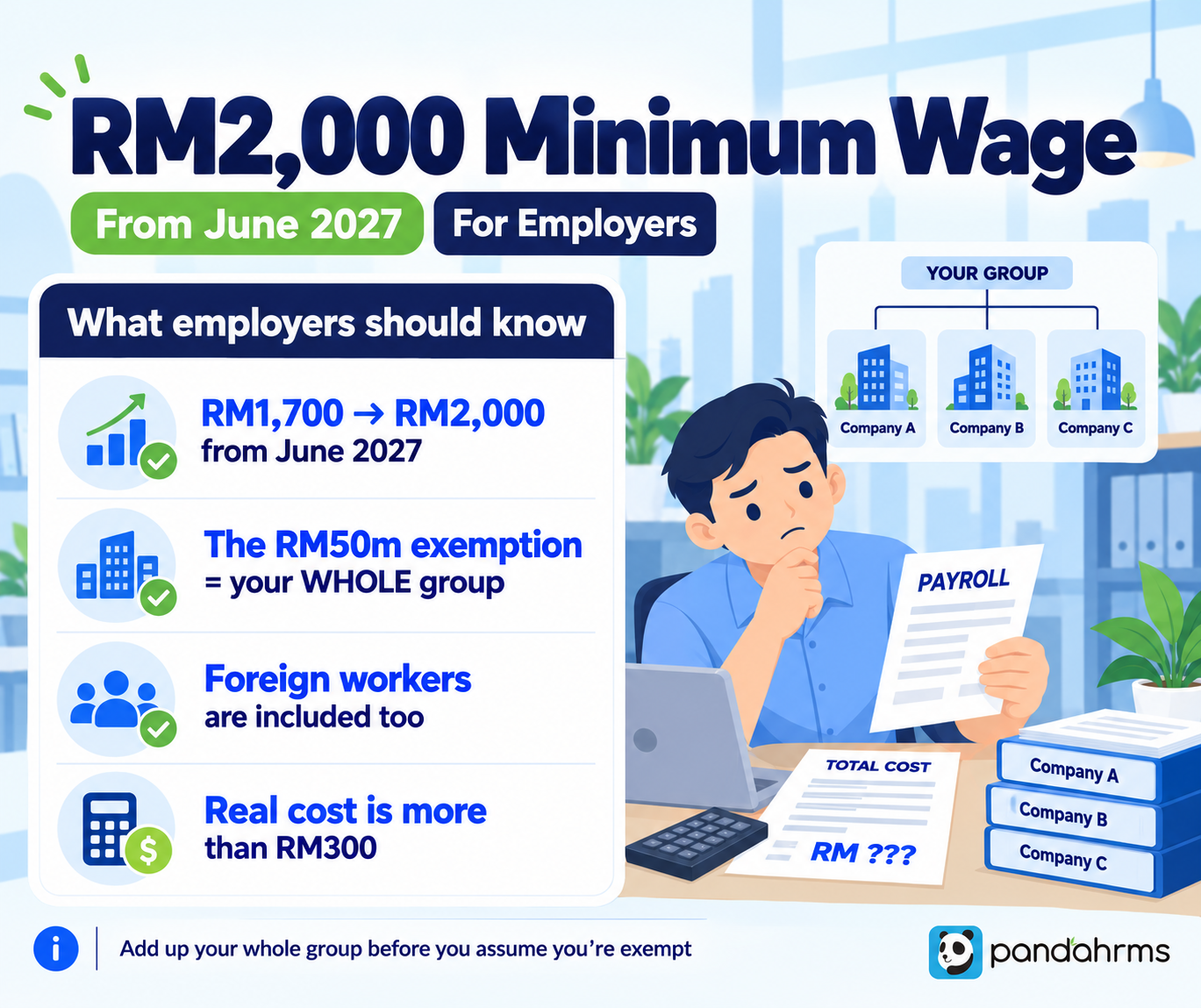
The Human Resources Minister has clarified that the RM50 million threshold is assessed on the whole company or group — not on each subsidiary separately. If a company belongs to a holding or parent company, the entire group’s total turnover is counted together.
So a business that looks exempt on its own may not be once the group is added up:
| Entity | Annual turnover |
|---|---|
| Company A | RM20 million |
| Company B | RM20 million |
| Company C | RM20 million |
| Group total | RM60 million → over RM50 million |
Looked at alone, each company is under RM50 million and seems to qualify for the exemption. But added up as a group, the total is RM60 million — above the RM50 million line. In that case the exemption would not apply, and all three companies’ employees would need to be paid the RM2,000 minimum wage.
Foreign Workers Are Included Too
Another point employers often get wrong: the minimum wage applies to all employees, including foreign workers — it always has, under the Minimum Wages Order. So if your business has to move to RM2,000, you cannot pay local staff RM2,000 and keep foreign workers at RM1,700. If the RM2,000 rate applies to you, it applies to your foreign employees as well. (Foreign workers are covered by statutory contributions too — see which wages are subject to SOCSO & EIS.)
The Real Cost Isn’t Just RM300
It’s tempting to think the impact is “RM300 per worker.” The basic increase is RM300 — but basic salary drives everything stacked on top of it. When basic pay rises, so do:
- EPF, SOCSO and EIS contributions (they’re a percentage of wages)
- Overtime (OT is calculated from the ordinary rate of pay)
- And, for foreign workers, the surrounding costs — levy, permit, accommodation and insurance — all sit on top
So the true cost of the move can be noticeably more than RM300 a head once the full package is added up. It’s worth modelling the total cost, not just the basic. (See how pay flows through to cost in our guide to take-home pay.)
What’s Still Unclear
Some details are still to be confirmed by the government, including:
- What happens if a group’s turnover later drops below RM50 million — can the exemption be regained, and from when?
- How eligibility is reassessed after a group restructuring or change in shareholding (selling a company, adding a new one, etc.).
- The exact point in time used to measure turnover for the threshold.
Until the implementing rules and the gazetted Minimum Wages Order are published, treat the above as the announced direction and confirm the final rules before you rely on them. (For the wider Budget picture, see our Budget 2027 highlights for employers.)
What Employers Should Do Now
- Add up your group’s turnover — not just one company — to see which side of RM50 million you’re really on.
- Model the full cost (basic + EPF/SOCSO/EIS + OT, plus levy/permit/accommodation/insurance for foreign staff), not just the RM300.
- Don’t split local and foreign rates — if RM2,000 applies, it applies to everyone.
- Watch for the implementation details before locking in your 2027 payroll plan.
Where Pandahrms Helps
When a wage floor moves, the work lands on payroll — and if you run several companies, it lands in several places at once. Pandahrms lets you update the minimum wage across affected staff and multiple companies, recalculates EPF, SOCSO, EIS and PCB automatically (for local and foreign employees), and generates the bank payment files so every salary is paid correctly. Instead of reworking spreadsheets for each entity, you update the figure and every payslip across the group stays compliant.
Final Thoughts
The thing employers fear most about RM2,000 isn’t the RM300 — it’s doing the group maths and discovering the exemption they counted on doesn’t apply. Add up your whole group’s turnover, remember foreign workers are in scope, model the real cost, and watch for the final rules. Do that now, and June 2027 becomes a planned adjustment rather than a nasty surprise.
Frequently Asked Questions (FAQs)
- Is the RM50 million exemption based on one company or the whole group?
The Human Resources Minister has clarified it is assessed on the whole company or group — if a company belongs to a holding/parent, the entire group’s total turnover is counted, not each subsidiary separately. - My company earns under RM50 million — am I automatically exempt?
Not necessarily. If your company is part of a group whose combined turnover exceeds RM50 million, the exemption may not apply. - Does the RM2,000 minimum wage cover foreign workers?
Yes. The minimum wage applies to all employees, including foreign workers. You cannot pay locals RM2,000 and keep foreign workers at RM1,700. - When does the RM2,000 minimum wage take effect?
From June 2027, up from RM1,700, under Budget 2027. - What if our group’s turnover later falls below RM50 million?
This is one of the details still to be confirmed by the government, along with how restructuring or shareholding changes are treated. Confirm with the final implementing rules.
Source: Budget 2027 (Belanjawan 2027) and clarifications by the Human Resources Minister on the RM2,000 minimum wage and the RM50 million exemption, as reported by national media (October 2026). Coverage of foreign workers reflects the existing Minimum Wages Order, which applies to all employees. Figures are policy announcements; the exact scope, the group-turnover test, and treatment of restructuring will be set out in the gazetted Minimum Wages Order and implementing rules. This article is general information, not legal advice; confirm the final rules for your situation.