When an employee is accused of serious misconduct — theft, fraud, insubordination, a safety breach — the instinct is often to act fast and dismiss. In Malaysia, that instinct is exactly what lands employers at the Industrial Court. Before you dismiss for misconduct, the law expects a fair process, and the centrepiece of that process is the domestic inquiry (DI). This guide explains what a DI is, when you need one, how to run it properly, and the mistakes that turn a justified dismissal into an unfair one.
What Is a Domestic Inquiry?
A domestic inquiry is an internal disciplinary hearing an employer holds to examine an allegation of misconduct against an employee before deciding on punishment. Think of it as a mini-trial inside the company: charges are put to the employee, evidence is presented, witnesses are heard, and an impartial panel decides whether the misconduct is made out — all before any decision to dismiss.
It is not a criminal trial and not a court. But it is the step that shows an employee was given a fair chance to answer the case against them — which is precisely what the Industrial Court looks for if the dismissal is later challenged.
Is a Domestic Inquiry Legally Required?
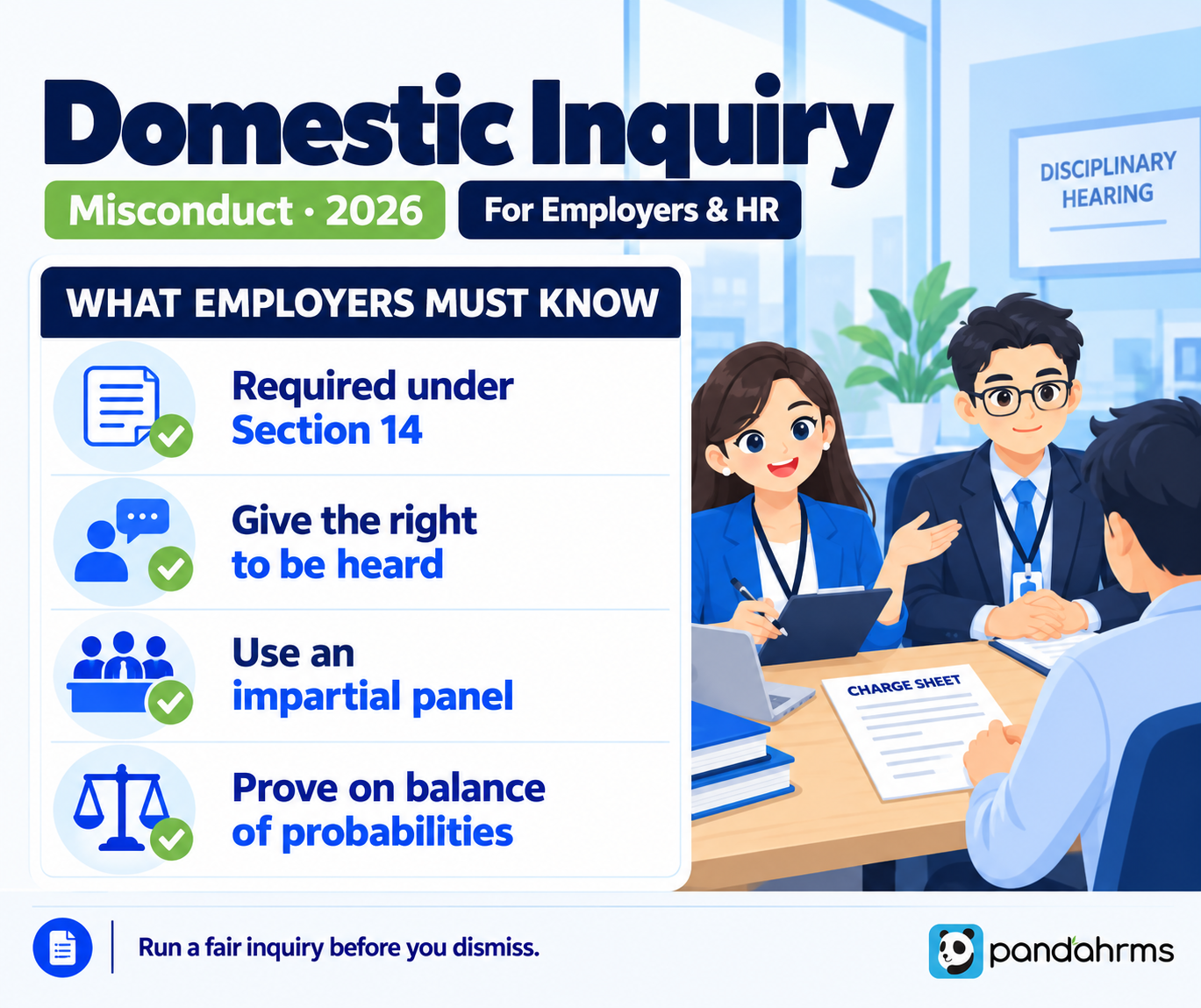
The starting point is Section 14(1) of the Employment Act 1955, which allows an employer — “on due inquiry” — to dismiss without notice, downgrade, or impose a lesser punishment on an employee for misconduct inconsistent with the conditions of service. The phrase “on due inquiry” is the legal anchor for holding a DI.
Here is the nuance every employer should understand: the courts have held that a failure to hold a domestic inquiry, or holding a defective one, is not automatically fatal to a dismissal. If the matter reaches the Industrial Court, the Court hears the evidence afresh (de novo) and decides for itself whether the misconduct is proven. A missing or flawed DI can, in principle, be “cured” at that stage.
But that is a gamble, not a strategy. Skipping the inquiry hands the employee an easy procedural argument, weakens your evidence, and makes the dismissal far harder to defend. In practice, a properly run DI is the single best protection an employer has. Treat it as essential, not optional.
When Do You Need a Domestic Inquiry?
A DI is for misconduct — not for poor performance, redundancy, or a genuine medical issue. Typical triggers include:
- Theft, fraud or dishonesty
- Insubordination or refusing a lawful, reasonable instruction
- Serious breach of company policy or safety rules
- Absence without leave / abandonment of work
- Harassment, violence or threatening behaviour
- Conflict of interest or breach of confidentiality
Poor performance is handled differently — through a performance-improvement process, not a misconduct inquiry. (For borderline cases, see our guide on issuing a warning letter.)
The Two Rules of Natural Justice
The Employment Act does not spell out the DI procedure. Instead, the requirements come from the principles of natural justice developed by the courts. There are two:
- The right to be heard — the employee must be told the specific charges against them, be given the evidence, and have a genuine opportunity to respond, call witnesses and question the employer’s witnesses.
- The rule against bias — the person or panel deciding the case must be impartial. Anyone who witnessed the incident, made the complaint, or has already formed a view should not sit on the panel.
Get these two right and most of the DI falls into place.
The Domestic Inquiry Process, Step by Step
Before the inquiry
- Complaint and investigation — gather the facts, documents and statements. Decide whether there is a genuine case to answer.
- Show-cause letter — put the allegation to the employee in writing and ask them to explain. (See: how to write a show-cause letter.) If the reply resolves it, you may stop here.
- Notice of inquiry and charges — if the explanation is unsatisfactory, issue a written notice stating the specific charges, the date, time and venue of the inquiry, and the employee’s right to be represented (usually by a colleague or union representative) and to bring witnesses. Give reasonable notice so they can prepare.
During the inquiry
- An impartial panel (commonly a chairman plus one or two members) runs the hearing; a separate person presents the company’s case.
- The charges are read and the employee enters a plea.
- The company presents its evidence and witnesses; the employee may question those witnesses.
- The employee presents their defence, documents and witnesses.
- Everything is minuted (recorded in writing) and signed.
After the inquiry
- The panel makes a finding on each charge (guilty / not guilty) based on the evidence, and may recommend a punishment.
- Management considers the finding and decides the outcome. The decision is communicated to the employee in writing.
Can You Suspend the Employee During the Inquiry?
Yes — Section 14(2) of the Employment Act allows an employer to suspend an employee for the purpose of an inquiry. The limits are specific:
- Suspension for a maximum of two weeks.
- The employee must be paid not less than half their wages during the suspension.
- If the inquiry does not find misconduct, the employer must restore the full amount of wages withheld.
Suspension here is a holding measure during investigation — it is not itself a punishment.
What Standard of Proof Applies?
A DI is not a criminal trial, so the employer does not have to prove the misconduct “beyond reasonable doubt.” The standard is the civil one — the balance of probabilities (more likely than not). Crucially, the burden of proof is on the employer: it is for you to establish that the misconduct happened and that dismissal was with just cause or excuse.
Possible Outcomes
Section 14(1) lets the employer, after a due inquiry, choose a proportionate punishment:
- Dismissal without notice (for proven serious misconduct)
- Downgrading of rank or position
- Suspension without wages for up to two weeks, or another lesser punishment
- A warning, where the misconduct is minor or a first offence
The punishment should fit the misconduct. Dismissing an employee for a first, minor slip is the kind of disproportionate response the Industrial Court frequently overturns.
Common Mistakes That Sink a Dismissal
- Vague charges the employee cannot properly answer.
- A panel member who witnessed the incident or had already decided the outcome.
- Not giving the employee a real chance to respond or to question witnesses.
- No minutes, no documents, no paper trail.
- A punishment that is out of proportion to the misconduct.
- Treating a performance problem as misconduct.
What Happens If You Get It Wrong?
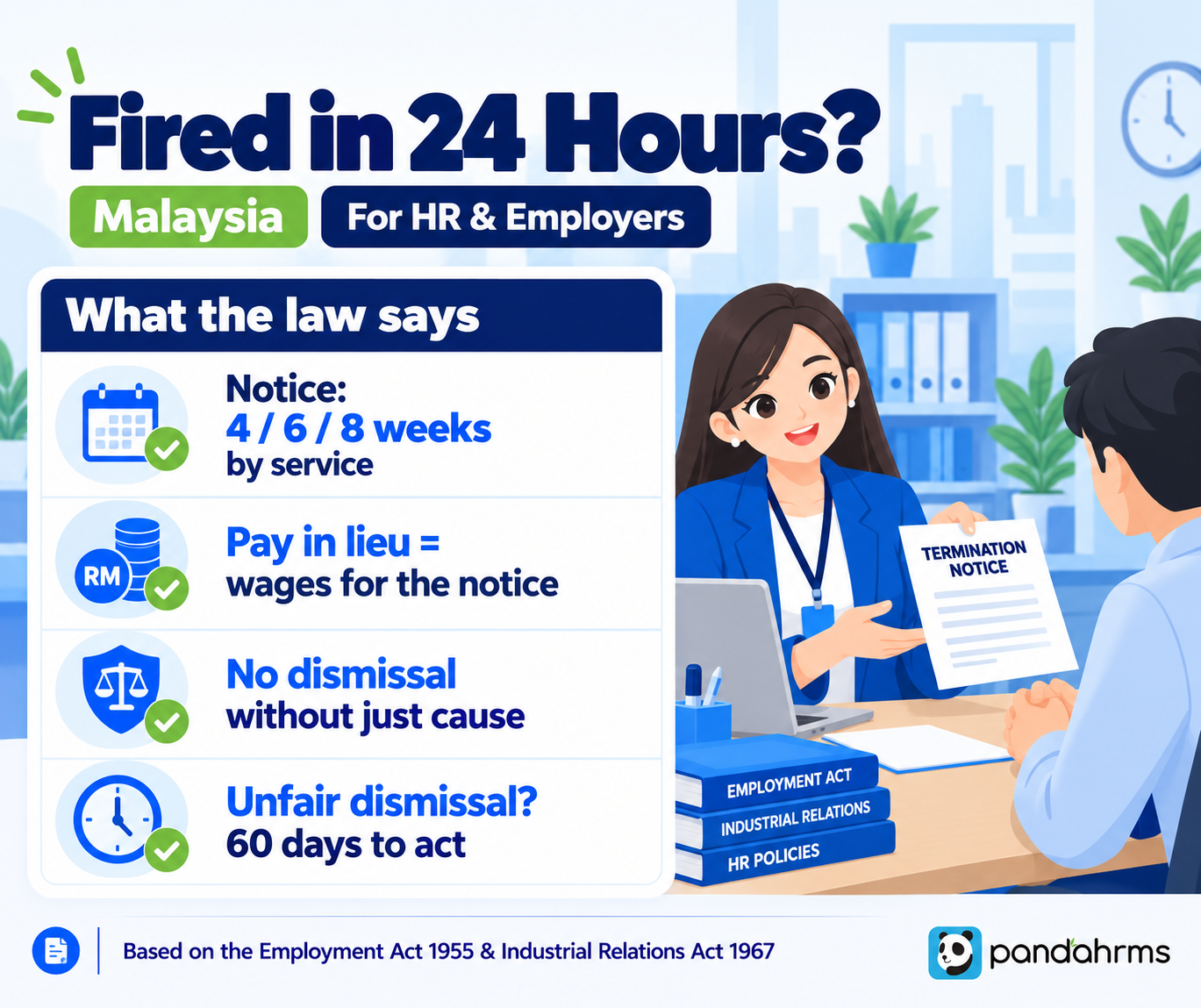
An employee who believes they were dismissed without just cause or excuse may make representations for reinstatement to the Director General of Industrial Relations within 60 days of the dismissal, under Section 20 of the Industrial Relations Act 1967. If conciliation fails, the matter can be referred to the Industrial Court, which can order reinstatement or compensation (back wages and compensation in lieu of reinstatement). A clean, well-documented DI is your best defence at that stage. (Related reading: constructive dismissal.)
How Pandahrms Helps
A domestic inquiry stands or falls on documentation. Pandahrms keeps each employee’s disciplinary history — warnings, show-cause letters, inquiry notes and outcomes — in one place, timestamped and easy to retrieve, so when you need to build or defend a case the paper trail is already there. Pair it with clear policies in your compliance records, and discipline becomes a documented process rather than a scramble.
Frequently Asked Questions (FAQ)
- Is a domestic inquiry compulsory before dismissing for misconduct?
Section 14(1) of the Employment Act requires dismissal for misconduct to follow a “due inquiry.” Courts have held that a missing or defective inquiry is not automatically fatal, because the Industrial Court can rehear the case, but skipping it is risky and weakens the employer’s position. Treat a proper DI as essential. - Can the employee bring a lawyer to the DI?
A domestic inquiry is an internal hearing, not a court. Employees are usually allowed to be represented by a colleague or a union representative rather than an external lawyer, though practice can vary. What matters most is that they get a genuine chance to be heard. - Can I suspend the employee while investigating?
Yes. Under Section 14(2), you may suspend for up to two weeks and must pay not less than half wages during the suspension. If the inquiry finds no misconduct, you must restore the full wages withheld. - What standard of proof is needed?
The civil standard — the balance of probabilities, not “beyond reasonable doubt.” The burden is on the employer to prove the misconduct and that the dismissal was with just cause or excuse. - Who should sit on the inquiry panel?
Impartial people who were not involved in the incident, did not make the complaint, and have not already formed a view. A panel member with a stake in the outcome breaches the rule against bias and can invalidate the inquiry. - Is a DI used for poor performance?
No. A DI is for misconduct. Poor performance should be handled through a performance-improvement process, not a disciplinary inquiry.
Source: Employment Act 1955 (Section 14 on dismissal, downgrading, punishment and suspension for misconduct) and the Industrial Relations Act 1967 (Section 20 on representations against dismissal), together with the principles of natural justice and established Industrial Court practice that a dismissal must be with just cause or excuse and proven on the balance of probabilities. Procedural details are drawn from settled practice, not a prescribed statutory procedure. This article is general information, not legal advice — confirm your specific situation with the Labour Department, the Industrial Relations Department, or an employment lawyer.