The death of an employee is one of the hardest moments a workplace can face. Alongside the grief, HR is suddenly responsible for a set of legal and financial steps that have to be handled correctly — and with care — for the family’s sake. Paid to the wrong person, released too early, or filed late, and a well-meaning employer can create tax problems, delay the family’s money, or expose itself to a claim. This guide sets out exactly what an employer in Malaysia must do when an employee passes away: the final pay, the LHDN filing, the EPF and SOCSO claims, and a clear checklist.
First Steps: People Before Paperwork
Before any form is filed, the first duty is a human one. Acknowledge the loss with the team, offer support and condolences to the family, and give them a single point of contact in HR so they aren’t passed around while grieving. Then, quietly, secure the practical basics: the employee’s records, company property and system access, and the documents you’ll need (employment file, last salary details, EPF/SOCSO numbers). Everything below flows from those records.
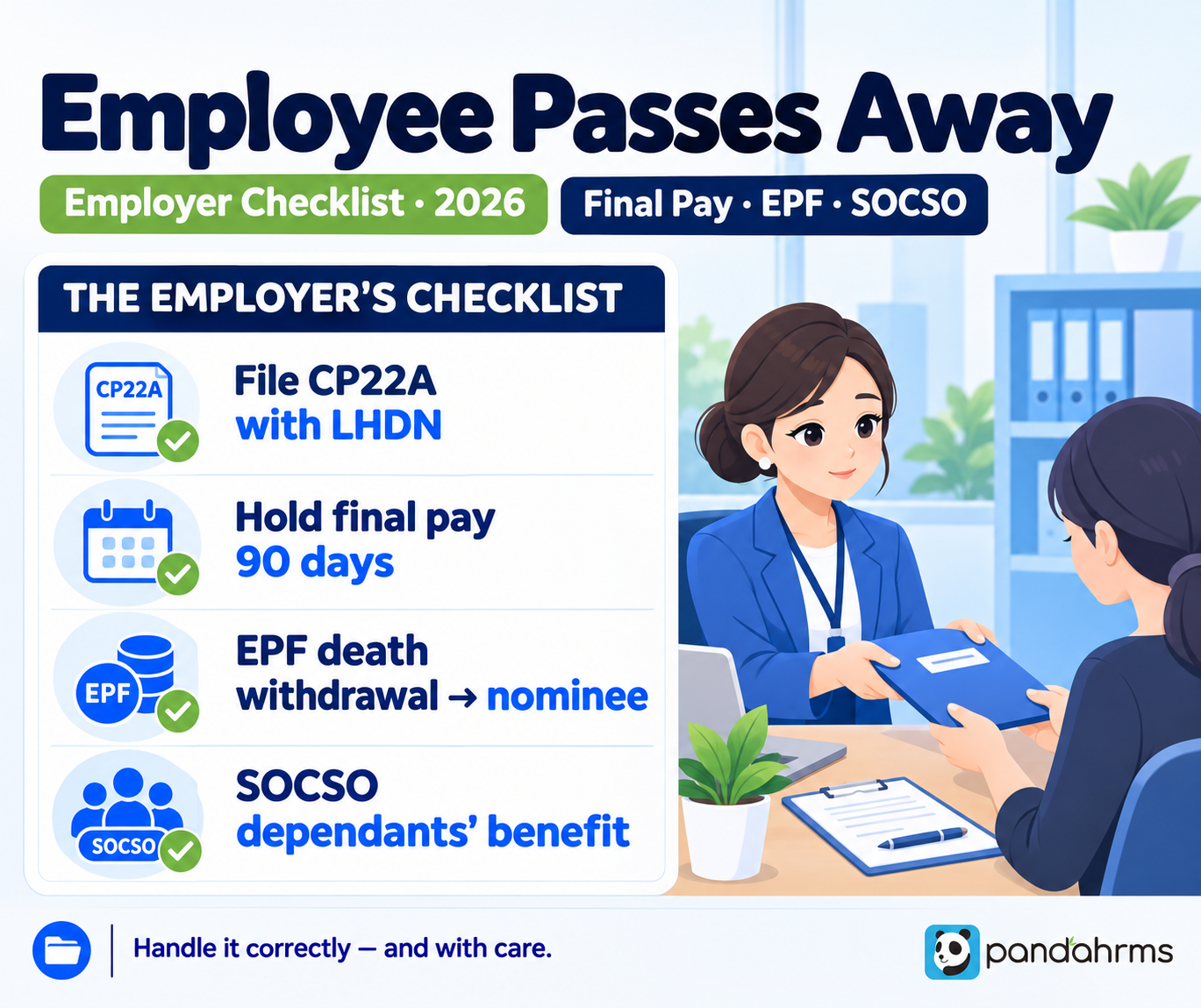
The Employer’s Checklist at a Glance
- Calculate the final pay owed — but don’t release it yet.
- File Form CP22A with LHDN and observe the tax-clearance hold.
- Pay the final sum to the legal estate representative, not on a verbal request.
- Help the family claim the deceased’s EPF savings (death withdrawal).
- Report to SOCSO and help dependants claim their benefits.
- Issue the EA form and close off records and insurance.
Final Pay: What’s Owed, and Who It Goes To
The employee’s final entitlements are calculated up to the date of death, and typically include:
- Unpaid salary for days worked;
- Unused annual leave encashed (see our leave encashment guide);
- Any earned overtime, allowances, commissions or contractual bonus.
The critical question is who you pay it to. You do not simply bank it into the deceased’s account or hand it to whoever asks. The money forms part of the deceased’s estate and must be paid to the legal personal representative — the executor named in a will (with a Grant of Probate) or the administrator (with Letters of Administration). For smaller estates, the family can obtain a distribution order through the Small Estates (Distribution) Act 1955 process at the Estate Distribution Unit. Always pay against proper legal documentation, never a verbal instruction — and, as below, not before LHDN clears it.
LHDN: File CP22A and Hold the Payment
Death is a form of cessation of employment, so the employer’s tax-notification duty applies. Under Section 83(3) of the Income Tax Act 1967, the employer must notify LHDN using Form CP22A:
- Deadline: not more than 30 days after being informed of the death (the form’s window is “not less than 30 days before cessation, or not more than 30 days after” — for a death, you file as soon as you’re informed).
- How: submitted online through the MyTax portal (e-SPC), mandatory since 2024.
- The 90-day hold: where CP22A is required, the employer must not release any money owed to the deceased without LHDN’s permission until 90 days after LHDN receives the form. This lets LHDN check for unpaid tax and issue clearance.
- Exemption: the form is generally not required if the employee’s income was already subject to Monthly Tax Deduction (PCB) and no termination benefit is payable, or if remuneration is below the PCB threshold.
In short: calculate the final pay now, file CP22A, and release the money only once LHDN clears it. (Related: the full CP22A guide.)
EPF: The Death Withdrawal
The deceased’s EPF savings don’t disappear — they’re paid out through a Death Withdrawal (Pengeluaran Kematian). Here’s what the employer and family need to know:
- The savings are paid to the member’s registered nominee. If there is no nominee, a next of kin or court-appointed administrator applies instead.
- For Muslim members, the nominee receives the money as an administrator (wasi) and distributes it according to faraid; for non-Muslim members, the nominee may be the absolute beneficiary.
- EPF may also extend a one-off compassionate death assistance (around RM2,500) to the next of kin — this is discretionary and subject to EPF’s conditions, so confirm eligibility with EPF.
The employer’s job here is to make sure the final month’s EPF contribution is remitted, and to give the family the employee’s EPF details and the documents they need to lodge the claim. (For the basics of EPF administration, see registering employees for EPF.)
SOCSO: Dependants’ Benefit, Survivors’ Pension & Funeral Benefit
SOCSO (PERKESO) is where the most meaningful support for the family often comes from. Which benefit applies depends on the cause of death:
- If the death is due to an employment injury or occupational disease — the dependants may claim the Dependants’ Benefit (Faedah Orang Tanggungan) under the Employment Injury Scheme: a monthly pension to eligible dependants (spouse, children, and in some cases parents), based on the deceased’s wages.
- If the death is from any cause (not work-related) and the employee was an active contributor under the Invalidity Scheme and met the contribution conditions — the dependants may claim the Survivors’ Pension (Pencen Penakat).
- Funeral Benefit (Bantuan Pengurusan Mayat) — a one-off payment (currently around RM3,000, or the actual funeral cost if lower) is payable to the person who met the funeral expenses.
The employer should report the death to SOCSO — especially where it is work-related, which must be reported as an employment accident — and help the dependants lodge their claim. Because the exact pension rates and conditions are set by PERKESO and updated from time to time, point the family to PERKESO to confirm the current amounts. (Related: which wages are subject to SOCSO.)
Don’t Forget These
- EA form — prepare the deceased’s EA form for the relevant period so the estate’s tax affairs can be settled.
- Group insurance — if the company has group term life or personal accident cover, notify the insurer and help the family claim.
- Records & access — close off system access, recover company property, and archive the employee’s records (retained per the usual record-keeping periods).
Handle It With Care
Behind every one of these forms is a grieving family waiting on money they may urgently need. The kindest thing an employer can do is be organised and prompt: file CP22A quickly so the 90-day clock starts, have the final-pay figure ready, and walk the family through the EPF and SOCSO claims rather than leaving them to work it out alone. Doing the admin well is the compassion.
How Pandahrms Helps
When an employee passes away, the last thing HR needs is to hunt through drawers for contribution numbers and leave balances. Pandahrms keeps each employee’s salary, leave, EPF and SOCSO details and documents in one place, works out the final-pay figure accurately, and generates the tax and statutory paperwork — so you can give the family fast, correct answers at the moment it matters most. See also our HR & payroll compliance checklist.
Frequently Asked Questions (FAQ)
- Can I pay the final salary directly to the employee’s spouse or family?
Not on a verbal request. The final pay is part of the estate and must go to the legal personal representative (executor or administrator), or through the Small Estates (Distribution) Act process. Always pay against proper legal documentation. - Do I have to notify LHDN when an employee dies?
Yes, by filing Form CP22A (online via MyTax e-SPC), generally within 30 days of being informed. You must not release money owed to the deceased without LHDN’s permission until 90 days after LHDN receives the form. The form may be exempt where income was already subject to PCB and no termination benefit is payable. - Who receives the deceased’s EPF savings?
The registered nominee, through a Death Withdrawal (Pengeluaran Kematian). If there is no nominee, a next of kin or court-appointed administrator applies. For Muslim members the nominee distributes the savings under faraid; for non-Muslims the nominee may be the absolute beneficiary. - What does SOCSO pay when an employee dies?
If the death is work-related, dependants may claim the Dependants’ Benefit (monthly pension). If from any cause under the Invalidity Scheme and conditions are met, they may claim the Survivors’ Pension. A one-off Funeral Benefit (around RM3,000, or actual cost if lower) is also payable. Confirm current amounts with PERKESO. - What counts as the final pay?
Unpaid salary up to the date of death, encashment of unused annual leave, and any earned overtime, allowances, commissions or contractual bonus. - Is the death benefit the same if the death happened outside work?
The SOCSO benefit differs: a work-related death may qualify for the Dependants’ Benefit under the Employment Injury Scheme, while a non-work death may qualify for the Survivors’ Pension under the Invalidity Scheme, subject to contribution conditions. The EPF death withdrawal and final-pay steps apply either way.
Source: Income Tax Act 1967 (Section 83(3)) and LHDN (HASiL) guidance on Form CP22A and the tax-clearance hold; Employees Provident Fund (EPF / KWSP) on the Death Withdrawal and nomination; Social Security Organisation (PERKESO / SOCSO) under the Employees’ Social Security Act 1969 on the Dependants’ Benefit, Survivors’ Pension and Funeral Benefit; and the Small Estates (Distribution) Act 1955 on estate distribution. Benefit amounts, pension rates and thresholds are set by the authorities and updated periodically — confirm current figures and eligibility with LHDN, EPF and PERKESO. This article is general information, not legal advice; for a specific case, consult the relevant authority or a professional adviser.