Deepavali 2026 falls on Sunday, 8 November — and most states have gazetted Monday, 9 November as the replacement. That substitution feels automatic, so employers assume the same logic applies whenever a public holiday lands on a non-working day. It doesn’t. Whether you owe a replacement depends on one distinction most HR teams blur: is that non-working day a rest day or an off day? This guide explains the rule, because getting it wrong means either shorting your staff a day or giving away one you never owed.
First, the Entitlement: Paid Public Holidays
Under Section 60D of the Employment Act 1955, an employee is entitled to paid holidays at the ordinary rate of pay on the gazetted public holidays (commonly 11 a year — the compulsory ones such as National Day, Agong’s Birthday, the state Ruler’s Birthday, Labour Day and Malaysia Day, plus the others the employer picks). The question is what happens when one of those holidays lands on a day the employee wouldn’t be working anyway.
The Distinction That Decides Everything: Rest Day vs Off Day
These two terms get used interchangeably, but the law treats them very differently:
- Rest day — the employee’s statutory weekly rest day under Section 59 (one full day per week, often Sunday). Every employee covered by the Act has one.
- Off day — an additional non-working day that is not the rest day. In a five-day week with Sunday as the rest day, Saturday is usually the off day.
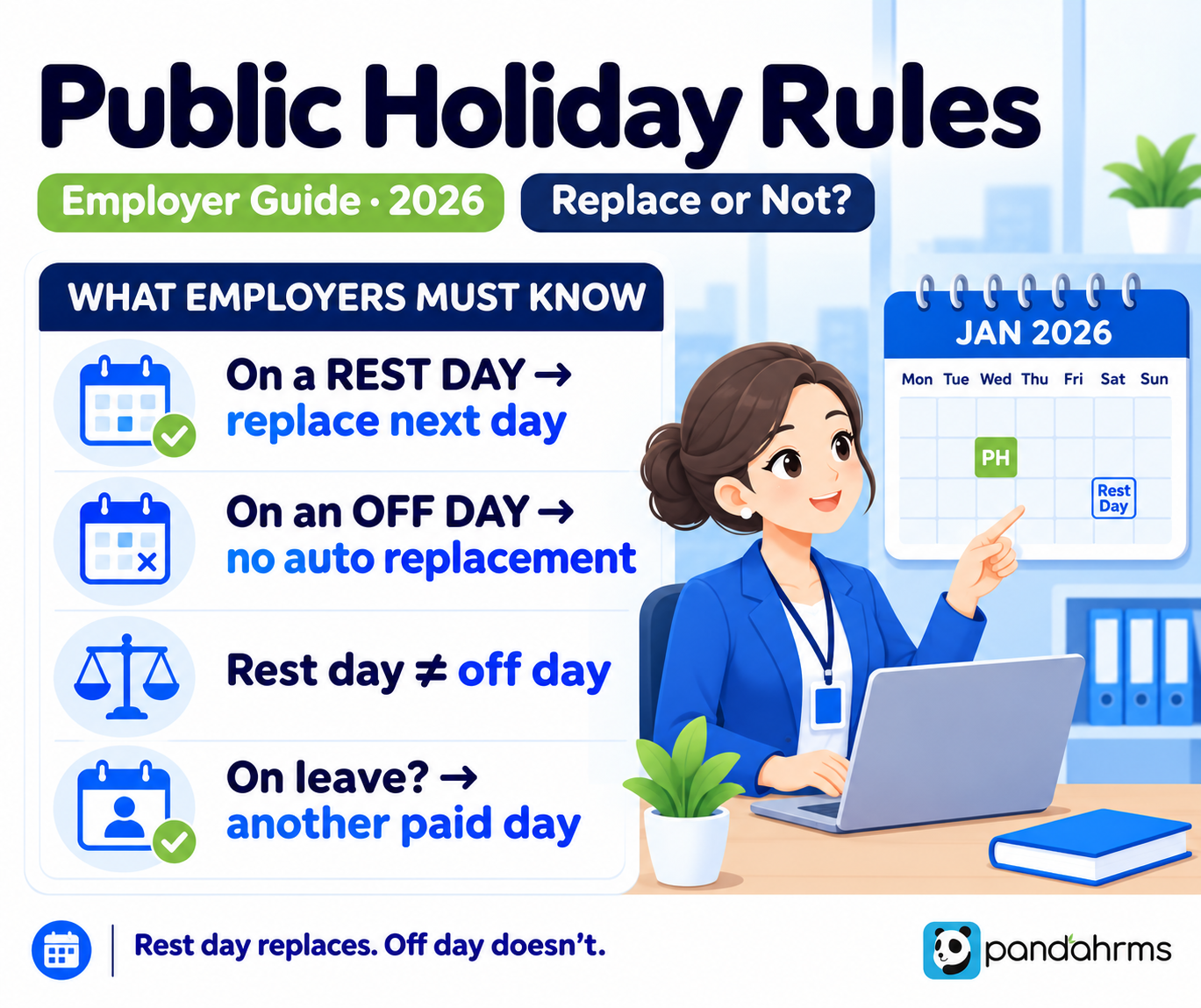
The substitution rule in the Employment Act applies to the rest day — not the off day. That single point answers most of these questions. (For the full distinction and how each is paid, see our guide to the difference between a rest day and an off day.)
Rule 1 — Public Holiday on a REST DAY: Replacement Required
Under the proviso to Section 60D(1), where a gazetted public holiday falls on an employee’s rest day, the working day immediately following the rest day becomes a paid holiday in substitution. This is automatic and statutory — you don’t need a policy for it.
This is exactly why Deepavali on Sunday (a rest day for many) rolls over to a paid holiday on the Monday.
Rule 2 — Public Holiday on an OFF DAY: No Automatic Replacement
Here’s the part employers get wrong. When a public holiday falls on an off day — a non-working day that is not the statutory rest day — the Employment Act does not require you to give a replacement holiday. The automatic substitution is written for rest days only; there is no equivalent provision for off days.
So if your company works Monday to Friday, Sunday is the rest day, and a public holiday falls on the Saturday off day, you are not legally obliged to grant another day off in its place. Many employers still do, as goodwill or because their contract or handbook promises it — and if your policy or contract says so, that promise is binding. But the Act itself does not force it.
Rule 3 — Public Holiday During Annual or Sick Leave
A related trap: if a gazetted public holiday falls on a day the employee is on annual leave or paid sick leave, Section 60D(1B) requires the employer to grant another day as a paid holiday (or treat that day as a holiday, not as leave). The employee shouldn’t lose a day of their leave balance to a public holiday.
Can an Employer Move a Public Holiday?
Yes, within limits. Under Section 60D(1A), an employer may substitute any of the gazetted public holidays with another day, provided the replacement is a fully paid holiday and employees are notified in advance. This is how companies shift an awkward mid-week holiday to a more practical day — but it must be a genuine paid substitute, not a quiet removal.
What If Staff Actually Work on the Holiday?
That’s a different question with its own pay rules — holiday pay at the higher rate plus overtime for extra hours, for employees covered by those provisions. (See our public holiday and overtime pay guide.) The rest-day-versus-off-day distinction above is about replacement, not about working the day.
Worked Example: Deepavali 2026
- On a rest day: Deepavali is Sunday, 8 November 2026. For an employee whose rest day is Sunday, the holiday falls on the rest day, so Monday 9 November becomes the paid replacement — matching the gazetted state replacement.
- On an off day: For a Monday-to-Friday employee whose off day is Saturday, a holiday landing on that Saturday carries no statutory replacement — unless the company chooses to give one.
Employer Takeaways
- Know each employee’s rest day — the substitution rule hinges on it.
- A public holiday on a rest day → the next working day is a paid replacement (statutory).
- A public holiday on an off day → no statutory replacement, but honour any contract or policy that promises one.
- A public holiday during annual or sick leave → give another paid day.
- Apply it consistently across staff, and spell out your off-day practice in the handbook so there’s no dispute.
How Pandahrms Helps
These rules only bite at the payroll stage, when someone has to decide whether a day is paid, replaced, or neither. Pandahrms holds each employee’s rest day, off days and the gazetted public holidays for their state, applies the rest-day substitution automatically, and flags holidays that overlap leave — so replacements are handled by rule, not by memory. For the full year ahead, see our Malaysia public holidays 2027 guide.
Frequently Asked Questions (FAQ)
- If a public holiday falls on a rest day, do I owe a replacement?
Yes. Under the proviso to Section 60D(1), the working day immediately following the rest day becomes a paid holiday in substitution. This is automatic. - If a public holiday falls on an off day, do I owe a replacement?
Not under the Employment Act. The automatic substitution applies to rest days, not off days. You may still give a replacement as goodwill, and you must honour one if your contract or policy promises it. - What’s the difference between a rest day and an off day?
The rest day is the statutory weekly rest day under Section 59 (one per week). An off day is an additional non-working day that is not the rest day — for example, Saturday in a five-day week where Sunday is the rest day. - What if a public holiday falls while an employee is on annual or sick leave?
Under Section 60D(1B), you must grant another day as a paid holiday, so the employee doesn’t lose a day of leave to the public holiday. - Can I move a public holiday to another day?
Yes. Under Section 60D(1A), you may substitute a gazetted public holiday with another day, as long as the replacement is a fully paid holiday and employees are told in advance. - Does this apply in Sabah and Sarawak?
The Employment Act 1955 covers Peninsular Malaysia and Labuan. Sabah and Sarawak have their own Labour Ordinances with closely similar rules — confirm the exact provision for those states.
Source: Employment Act 1955 — Section 60D on paid public holidays, the proviso to Section 60D(1) (substitution where a gazetted holiday falls on a rest day), Section 60D(1A) (employer substitution of a public holiday for another paid day with prior notice) and Section 60D(1B) (another paid day where a holiday falls during annual or sick leave), with Section 59 defining the weekly rest day. The Act applies to Peninsular Malaysia and Labuan; Sabah and Sarawak are governed by their own Labour Ordinances. Gazetted public holidays and their replacements are set by the federal and state governments each year. This article is general information, not legal advice — confirm your specific situation with the Labour Department or an employment lawyer.