Hiring foreign workers doesn’t change the Employment Act — minimum wage, working hours and the 7-day pay rule all apply the same. What changes is the statutory side of the payslip: the levy, EPF, SOCSO, EIS and how much tax you withhold. Get one wrong and you either underpay the government or over-deduct from a worker who is already on a tight wage.
Here’s how payroll and tax work for non-citizen employees in Malaysia in 2026 — including the big EPF change that caught many employers out.
The levy is your cost — not theirs
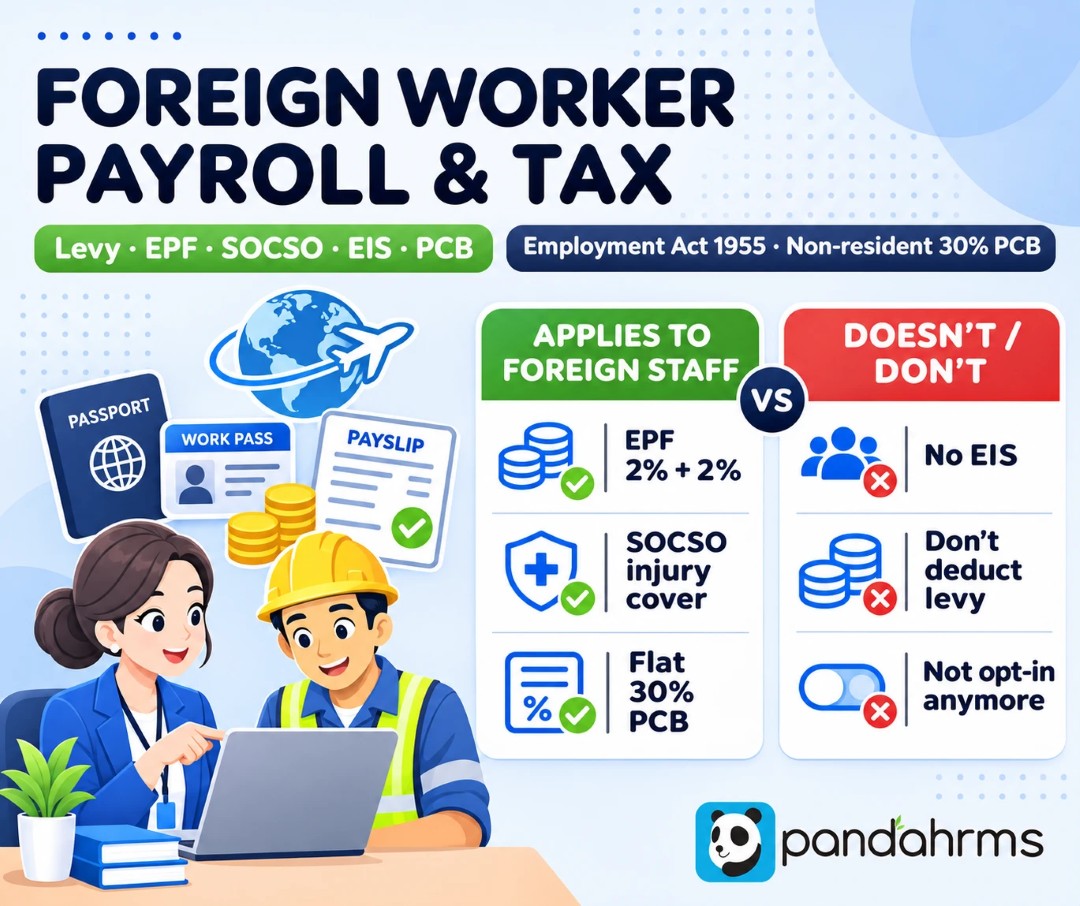
The foreign worker levy is paid by the employer and cannot be deducted from the worker’s wages. Rates vary by sector and are set per worker per year. Treat it as a cost of employment, not a payroll deduction — see our full foreign worker levy guide for the sector rates.
And yes — the minimum wage applies to foreign workers too. The coming RM2,000 floor (June 2027) covers non-citizens just like locals; see how the RM2,000 minimum wage counts foreign workers.
EPF: now mandatory for foreign workers
This is the change to know. Since October 2025 wages, EPF is mandatory for eligible non-citizen employees — not the old flat RM5, and no longer optional. The rate is 2% from the employer and 2% from the employee (subject to age and valid-pass conditions; domestic workers are treated separately).
If your payroll still treats foreign-worker EPF as “RM5 a month” or “opt-in”, it’s out of date. Budget for the 2% employer share and deduct the 2% employee share. The exact eligibility and rates are in our 2026 EPF contribution rates guide.
SOCSO: covered under the Employment Injury Scheme
Foreign workers with a valid work pass are registered with SOCSO, under the Employment Injury Scheme — the same scheme that protects a worker hurt at or on the way to work. This replaced the older Foreign Workers’ Compensation Scheme, so coverage now runs through PERKESO. Register them and contribute like any other employee for injury coverage. Which parts of pay count is the same question as for locals — see which wages are subject to SOCSO & EIS.
EIS: does not apply to foreign workers
The Employment Insurance System (EIS) is built around retrenchment benefits for Malaysian citizens and permanent residents. Foreign workers are outside EIS — you don’t deduct the EIS portion for them. So on a foreign worker’s payslip you’ll see EPF and SOCSO, but no EIS line.
PCB: the flat 30% non-resident rate
Tax is where foreign-worker payroll differs most. It hinges on tax residency, not nationality:
- A worker who has not been in Malaysia for 182 days in the calendar year is a non-resident — taxed at a flat 30% with no personal reliefs.
- Once they reach 182 days of presence in a calendar year, they become a tax resident and move to the normal progressive rates with reliefs.
In practice you withhold PCB at the flat 30% for a new arrival, then switch to resident rates once the 182-day test is met. For how monthly tax deduction works, see our guide to PCB (monthly tax deduction).
Foreign worker vs local: the payslip at a glance
| Item | Foreign worker | Local employee |
|---|---|---|
| Levy | Employer pays; not deductible from wages | None |
| EPF | Mandatory since Oct 2025 — 2% employer + 2% employee | Standard rates (e.g. 13%/12% employer + 11% employee) |
| SOCSO | Yes — Employment Injury Scheme | Yes — Injury + Invalidity |
| EIS | No | Yes |
| PCB | Flat 30% until 182 days, then resident rates | Resident progressive rates with reliefs |
Mixing foreign and local staff in one payroll run is completely normal — the system just needs to apply the right rules per worker. If you run several sites, see running payroll across multiple branches, and sanity-check the whole set-up against our HR & payroll compliance checklist.
Where Pandahrms helps
Pandahrms applies the right statutory treatment per employee automatically — mandatory foreign-worker EPF at 2%, SOCSO injury coverage, no EIS line, and flat 30% PCB that switches to resident rates once the 182-day test is met — all in the same payroll run as your local staff. Book a free Pandahrms demo to see foreign and local payroll handled together.
FAQ
- Is EPF compulsory for foreign workers now?
Yes. Since October 2025 wages, EPF is mandatory for eligible non-citizen employees at 2% from the employer and 2% from the employee — replacing the old flat RM5 arrangement. Check the current age and pass conditions before you run payroll. - Do foreign workers contribute to EIS?
No. EIS covers Malaysian citizens and permanent residents, because it funds retrenchment benefits for locals. You don’t deduct EIS for foreign workers. - Are foreign workers covered by SOCSO?
Yes, under the Employment Injury Scheme through PERKESO — covering accidents at work or commuting. This replaced the older Foreign Workers’ Compensation Scheme. - Why is a foreign worker taxed 30%?
Because they’re a non-resident until they’ve been in Malaysia for 182 days in the calendar year. Non-residents are taxed at a flat 30% with no reliefs. After 182 days they become tax resident and move to progressive rates. - Can I deduct the levy from a worker’s salary?
No. The foreign worker levy is the employer’s cost and cannot be passed on to the worker through a wage deduction. - Does minimum wage apply to foreign workers?
Yes. The minimum wage applies regardless of nationality, and the coming RM2,000 floor (June 2027) covers foreign workers too.