Imagine a government dashboard that can see, in real time, whether your company paid the right salary — on the right day — to every worker on your payroll. That’s the idea behind Malaysia’s planned e-Wages system, announced by the Human Resources Ministry alongside the 2027 Minimum Wage Order.
It isn’t live yet. But the direction is clear, and the employers who get their payroll in order now will have nothing to worry about when it arrives. Here’s what e-Wages is, why it’s coming, and the three things to get right today.
What is the e-Wages system?
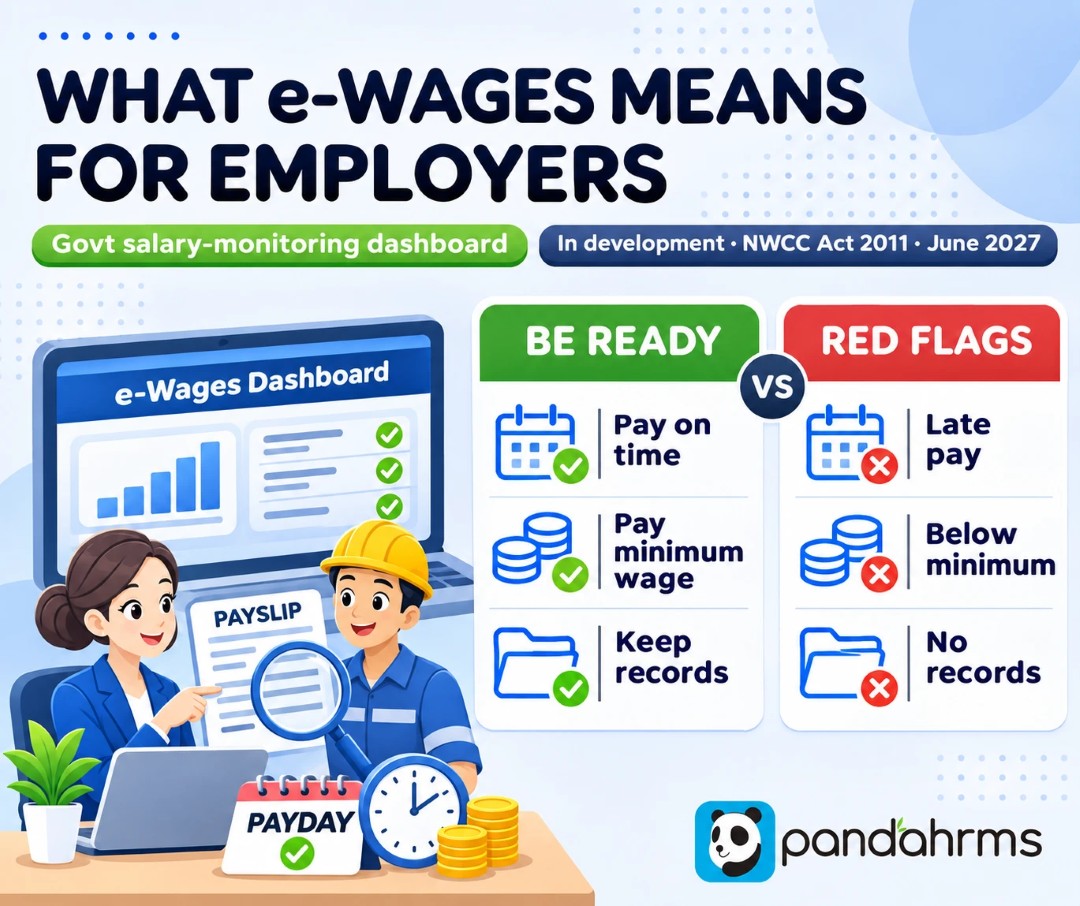
The Human Resources Ministry says it is developing an e-Wages system with a live dashboard to monitor whether employers comply with wage rules — specifically, whether workers are paid the correct wages on their designated payday.
Two things stand out from the announcement:
- It is intended to cover all workers, including non-citizens — foreign staff are in scope too.
- Its purpose is to strengthen enforcement against unpaid, delayed or incorrect wage payments.
Why now?
e-Wages is tied to the bigger 2027 wage reforms. The minimum wage is rising to RM2,000 from June 2027, and the government is also introducing a RM2,500 starting salary framework for graduates and semi-skilled workers. The Minister’s point was blunt: the government needs wage data to decide which companies fall under the new framework. In his words, “This is why we need e-wages, so we can obtain the data.”
To support it, amendments to the National Wages Consultative Council Act 2011 are to be tabled in Parliament, ahead of the new wage framework taking effect in June 2027. For the wider picture, see our Budget 2027 highlights for employers.
Important: it’s still in development
Let’s be clear about what has not been announced. The government has said it is developing e-Wages — it is not live, and it is not yet mandatory. As of now there is no launch date, no published penalty, and no detail on how employers will submit data. So there’s no need to panic or change anything overnight.
What this means for you: don’t wait for e-Wages to force your hand. The behaviours it will check — pay on time, pay at least the minimum, keep records — are already the law and already good practice. Fix those now and the dashboard is a non-event.
Three things to get right now
1. Pay on time
Under the Employment Act, wages must be paid within 7 days of the end of the wage period, and the wage period cannot exceed one month. A system that watches paydays will notice late pay first — so lock down your payroll cycle and pay dates.
2. Pay at least the minimum — to everyone
Pay no less than the minimum wage, and remember it applies to foreign workers too. With the floor moving to RM2,000 in June 2027, check that no one — local or foreign — sits below it.
3. Keep clean records
If the government can ask for proof that you paid correctly, you want that proof ready: payslips, payment dates and the amounts. Good payroll record-keeping turns an audit into a five-minute export instead of a scramble.
How a payroll system keeps you ready
Everything e-Wages will look for is what a proper payroll system already does: it runs on schedule so wages go out on time, it pays the correct statutory amounts, and it keeps a clean, exportable record of every payslip and payment. Pandahrms does exactly this — on-time runs, automatic EPF, SOCSO, EIS and PCB, and records you can pull in seconds. Book a free Pandahrms demo to see how ready your payroll would be.
FAQ
- Is the e-Wages system live yet?
No. The Human Resources Ministry has said it is developing e-Wages. There is no launch date, and it is not yet mandatory. - What will e-Wages do?
It is planned as a live dashboard to monitor whether employers pay workers the correct wages on their designated payday, and to help the government gather wage data for the new RM2,500 starting salary framework. - Will it cover foreign workers?
Yes. The system is intended to cover all workers, including non-citizens. - What are the penalties?
None have been announced. The government has described e-Wages as being in development and has not published penalties, a launch date, or how employers will submit data. - What should employers do now?
Get the basics right: pay wages within 7 days of the wage period, pay at least the minimum wage to every worker including foreign staff, and keep clean payroll records you can produce on request.