Messy expense claims are one of the quiet headaches of payroll. A staff member drives to a client, keeps a crumpled petrol receipt, and three weeks later HR is arguing over whether to pay it, whether it is taxable, and whether EPF applies. Multiply that across a sales team and month-end becomes a guessing game.
A clear travel, mileage and expense claim policy fixes this. It tells employees exactly what they can claim, at what rate, with what proof and by when — and it tells payroll how each claim is treated for tax, EPF, SOCSO and EIS. This guide shows you how to build one, how to set a fair mileage rate, and how Malaysia’s rules treat each type of payment in 2026.
Allowance vs Reimbursement: The Distinction That Decides Everything
Before you write a single rate, get this right, because it changes the tax and statutory treatment of every ringgit you pay.
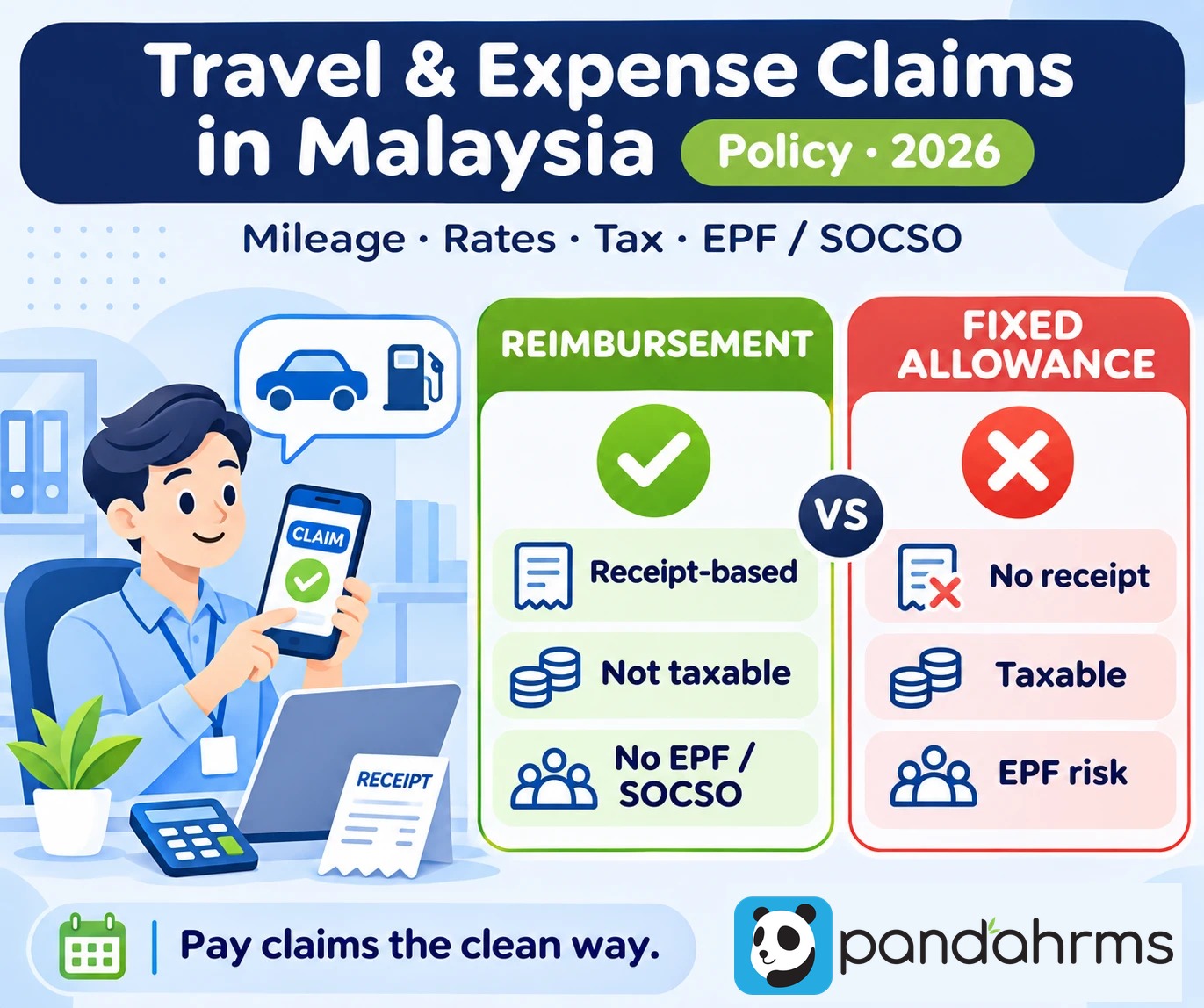
| Reimbursement | Fixed allowance | |
|---|---|---|
| What it is | Paying back the actual amount an employee spent on company business | A set sum paid every month regardless of what was actually spent |
| Proof needed | Receipt / tax invoice for each claim | None — it is paid automatically |
| Tax | Not taxable — it is a repayment, not income | Taxable, except where a specific exemption applies (see below) |
| EPF / SOCSO / EIS | Not wages — excluded | A genuine travelling allowance is excluded, but a fixed sum that is really extra pay can be caught |
The label on the payslip does not decide the treatment — the substance does. Calling something a “travel allowance” will not keep it out of EPF if it is really just a fixed top-up to salary. Pay back real expenses against receipts, and the treatment is clean.
What a Travel and Expense Claim Policy Must Cover
A policy that holds up has six parts. Keep each one short and specific.
1. What Can Be Claimed
List the categories: mileage or petrol for official travel, tolls and parking, public transport and e-hailing, accommodation and meals while travelling for work, and approved client entertainment. Spell out what is not claimable too — the normal commute from home to the usual workplace is personal, not official travel.
2. The Rates and Caps
Set a mileage rate per kilometre, a nightly accommodation cap, a daily meal rate or per diem, and any category limits. Caps stop disputes before they start.
3. Proof Required
A receipt or tax invoice for every claim; a simple mileage log (date, from–to, purpose, distance) for car travel. No receipt, no claim — state it plainly.
4. Approval Flow
Who approves, and up to what amount. A line manager up to a limit, a higher sign-off above it. Pre-approval for big-ticket items such as flights or hotels.
5. Submission Deadline
A cut-off — for example, claims must be submitted within 30 days and before the monthly payroll cut-off. Late claims roll to the next cycle.
6. How It Is Paid
Through payroll with the salary, or as a separate reimbursement run. Keep reimbursements as a distinct line from wages so the statutory treatment stays clear.
Mileage: How to Set a Fair Per-Kilometre Rate
There is no statutory mileage rate for the private sector in Malaysia — you are free to set your own. The practical approach is to pick a reasonable per-kilometre rate that covers fuel plus wear and tear, and apply it consistently. Many employers benchmark against the public-sector travelling rates as a reference point and land somewhere in the region of RM0.60–RM0.80 per km, but the figure is yours to decide.
Two rules keep a mileage scheme clean:
- Only official travel counts. Travel from home to the regular office is a personal commute and should not be claimable; travel to a client, a branch or an off-site job is.
- Keep it reasonable. A mileage claim that reimburses the genuine cost of duty travel is a reimbursement. A “mileage allowance” set far above real cost starts to look like disguised pay, which can pull it into tax and EPF.
Tax Treatment: What Is Exempt and What Is Not
Where you do pay a travel-related allowance (not a pure reimbursement), Malaysian tax law exempts several categories when they are for carrying out the job. These exemptions come from LHDN’s Public Ruling on perquisites.
| Payment | Tax treatment |
|---|---|
| Petrol, travel & toll allowance for official duties | Exempt up to RM6,000 per year; the excess is taxable (keep records to claim actual official-duty spend) |
| Parking rate or parking allowance | Exempt (a reasonable amount) |
| Meal allowance (regular, same rate to all; or per diem on duty) | Exempt (a reasonable amount) |
| Reimbursement of actual expense (with receipt) | Not taxable — it is a repayment, not a perquisite |
The RM6,000 cap applies to the travel/petrol/toll allowance line. A claim paid back against actual receipts is a reimbursement and sits outside the perquisite rules altogether — which is why a receipt-based policy is usually the cleaner, lower-tax route.
EPF, SOCSO and EIS: Are Travel Claims “Wages”?
The definition of “wages” in the EPF Act 1991 specifically excludes any travelling allowance or the value of any travelling concession, and SOCSO and EIS treat genuine travel reimbursements the same way. So a true reimbursement of duty-travel cost, and a genuine travelling allowance, are not wages and carry no EPF, SOCSO or EIS.
There is a catch, and the courts have enforced it: a payment dressed up as a “travel allowance” but which is really a fixed top-up to pay can be treated as wages and pulled back into EPF. The safeguard is simple — tie travel money to actual duty travel (receipts or a mileage log), and do not use a flat “allowance” as a way to quietly raise take-home pay. For a fuller view of which allowances count as wages, see our guide on which allowances are subject to EPF.
e-Invoice: What Changed for Claims
With e-Invoice rolling out, how you capture a claim matters for your own tax deduction. The key split:
- Expenses you claim as a business cost: keep the supplier’s e-Invoice, or — where the receipt is in the employee’s name — issue a self-billed e-Invoice so the company can support the deduction, per LHDN’s e-Invoice guideline.
- Pure internal reimbursements: an ordinary staff claim backed by a receipt can generally be self-declared without a third-party e-Invoice.
Because the rules are still bedding in, build the e-Invoice step into your claim form now. Our explainer on how e-Invoice affects HR, payroll and expense claims goes deeper.
Where the Right System Makes Claims Painless
A policy is only as good as the process behind it. With Pandahrms, employees submit a claim from the app with the receipt photo attached, it routes to the right approver against your policy limits, and approved claims flow straight into payroll as a separate reimbursement line — kept out of EPF, SOCSO and EIS wages automatically, with a full audit trail for LHDN. Mileage, per diem and category caps are enforced on the form, so out-of-policy claims never reach payroll. If you also want the step-by-step on vetting and approving claims, see our guide on how to manage employee claims.
Want to see claims, payroll and statutory handled in one place? Book a free Pandahrms demo and we will walk you through it.
Frequently Asked Questions
- Is petrol or travel allowance taxable in Malaysia?
A travel, petrol and toll allowance for official duties is tax-exempt up to RM6,000 per year; anything above that is taxable, though the employee can claim the actual amount spent on official duties if records are kept. A reimbursement paid back against real receipts is not taxable at all. - Do we pay EPF on travel claims and mileage?
No, for a genuine reimbursement of duty-travel cost or a true travelling allowance — the EPF Act excludes travelling allowances from wages, and SOCSO and EIS follow the same line. But a fixed “travel allowance” that is really extra salary can be treated as wages, so keep travel money tied to actual travel. - Is the normal commute from home to the office claimable?
No. Travel between home and the regular workplace is a personal commute. Only official travel — to a client, a branch or an off-site assignment — should be claimable under the policy. - What mileage rate should we use?
There is no statutory private-sector rate, so you set your own. Pick a reasonable per-kilometre figure that covers fuel and wear and tear, apply it consistently, and make sure it reflects genuine cost rather than acting as disguised pay. - Does a staff expense claim need an e-Invoice?
If the company is claiming the expense as a business cost, keep the supplier’s e-Invoice or issue a self-billed e-Invoice where the receipt is in the employee’s name. An ordinary internal reimbursement backed by a receipt can generally be self-declared — confirm against LHDN’s current e-Invoice guideline. - Should reimbursements go through payroll?
They can, but keep them on a separate line from wages so the EPF, SOCSO, EIS and tax treatment stays clear and the audit trail is clean. Mixing reimbursements into basic pay is what creates confusion later.
Source: Income Tax Act 1967, LHDN’s Public Ruling on perquisites, the EPF Act 1991 and LHDN’s e-Invoice guideline. This article is general information, not legal or tax advice — confirm your specific situation with LHDN, KWSP or a tax adviser.