Bonus, commission, incentive — in everyday talk they’re almost interchangeable: three words for “extra money on top of salary.” On a Malaysian payroll they are not the same thing, and treating them as if they were is exactly how employers end up under-contributing to a statutory fund, over-contributing to another, or mis-deducting tax. The label you type on the payslip doesn’t decide the treatment — the nature of the payment does. This guide sorts out what each one actually is, and precisely how EPF, SOCSO/EIS and PCB apply to each.
First, What Each One Actually Is
They overlap in everyday use, but each has a distinct meaning in pay terms:
- Bonus — an extra payment over and above normal wages, usually tied to company profit, year-end results, or a festive reward. It can be contractual (promised in the contract or policy) or discretionary (declared at the employer’s choice), and it’s typically a lump sum: an annual bonus, a 13th-month payment, a festive or performance bonus. A bonus is not tied to a single sale. (For the full range, see our guide to the 10 types of bonuses employers can offer.)
- Commission — pay calculated as a percentage or fixed rate of the sales or revenue an employee personally generates. It is directly tied to individual output, varies from month to month, and is earned transaction by transaction. For many salespeople it is the largest part of take-home pay.
- Incentive — a targeted payment designed to drive a specific result or behaviour: hitting a KPI, a production or output target, perfect attendance, a safety record. It can be individual or team-based, one-off or recurring, and it sits between a bonus and a commission — it rewards reaching a target, but it isn’t a straight percentage of sales.
Why the Difference Decides Your Payroll
This isn’t just semantics. Malaysia’s three main statutory items — EPF, SOCSO/EIS and PCB (monthly tax deduction) — each define “wages” or taxable income in their own way, and a bonus, a commission and an incentive do not line up the same way across all three. Classify one wrong and you either short a statutory fund (inviting arrears and penalties) or contribute on something you never needed to (cost for nothing).
The Treatment at a Glance
Here is how the three payment types are treated by each scheme:
| Payment type | EPF | SOCSO / EIS | PCB (income tax) |
|---|---|---|---|
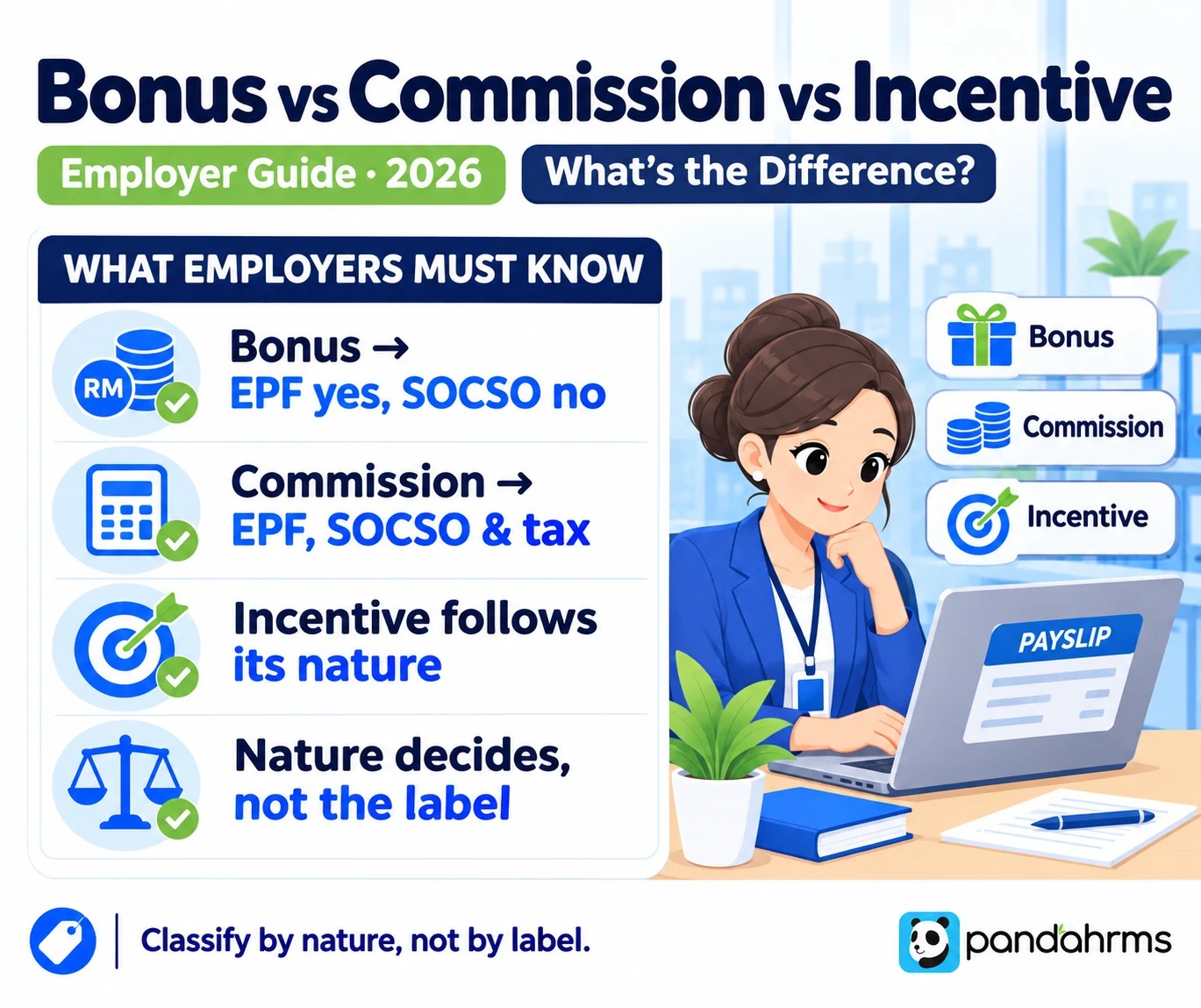
| Bonus | ✅ Yes | ❌ No (annual bonus excluded) | ✅ Yes |
| Commission | ✅ Yes | ✅ Yes | ✅ Yes |
| Incentive | ✅ Yes* | ✅ Yes* | ✅ Yes |
*An incentive that is really a one-off, discretionary lump sum follows the bonus rules — see below.
The outlier is the bonus: it attracts EPF but not SOCSO/EIS — the mirror image of overtime, which attracts SOCSO/EIS but not EPF.
Bonus — EPF Yes, SOCSO/EIS No, PCB Yes
The EPF Act’s definition of wages expressly includes bonus, so EPF is payable on it. For SOCSO and EIS, however, the annual bonus is specifically excluded from wages — so no SOCSO/EIS is deducted on it. For tax, a bonus is fully taxable and is treated as “additional remuneration” (it isn’t part of fixed monthly pay), so it carries its own PCB computation rather than the normal monthly formula. (See exactly which payments count as wages for EPF and as wages for SOCSO/EIS.)
One contractual note: a bonus the employee has earned under the contract or a declared scheme is owed — it forms part of their final pay if they leave. A purely discretionary bonus that hasn’t been declared yet is generally not a vested entitlement.
Commission — EPF, SOCSO/EIS and PCB All Apply
Commission is the most straightforward of the three. It counts as wages for EPF, it is expressly listed as wages for SOCSO and EIS, and it is taxable for PCB — so all three apply. Commission that an employee has earned is also a vested entitlement: once the conditions to earn it are met, it is owed even if the employee resigns before payout, and it forms part of their final pay. For PCB, a fixed commission paid every month is part of normal remuneration; commission paid irregularly is treated as additional remuneration.
Incentive — It Follows Its Nature
“Incentive” is the fuzziest label, and its treatment follows what the payment actually is, not what it’s called. A recurring incentive or incentive allowance tied to work or output — a monthly production incentive, an attendance incentive — is wages: EPF, SOCSO/EIS and PCB all apply, the same as any other allowance. But if an “incentive” is really a once-a-year, discretionary lump sum that functions as a bonus, it follows the bonus rules — EPF and PCB, but not SOCSO/EIS. The word on the payslip doesn’t change the test.
The Label Doesn’t Decide — the Nature Does
This is the single most important point. Renaming a bonus an “incentive,” or a commission a “bonus,” does not change how EPF, SOCSO and LHDN treat it. The authorities look at the substance: is it a reward over and above wages (bonus), pay for sales the employee generated (commission), or a payment to hit a defined target (incentive)? Classify by substance, apply the matching statutory rules, and keep it consistent across every employee and every month.
Where Employers Get It Wrong
- Deducting SOCSO/EIS on the annual bonus — it isn’t payable, and it raises cost for nothing.
- Leaving EPF off a commission or an incentive — both are EPF-liable, and missing them creates arrears.
- Calling a lump-sum bonus an “incentive allowance” and running SOCSO on it — the substance, not the label, governs.
- Using the normal monthly PCB formula on a bonus — a bonus is additional remuneration and needs the additional-remuneration computation, or the tax is wrong.
- Forgetting to report all three in the EA form and CP8D at year-end.
How Pandahrms Helps
These rules only bite at the payroll run, when each line has to be pushed into the right scheme. Pandahrms lets you configure every pay item — bonus, commission, incentive, allowance — once against each scheme’s rules, so the bonus flows into EPF and tax but not SOCSO/EIS, commission and recurring incentives flow into all three, and PCB applies the additional-remuneration treatment where it should. Every payroll run calculates consistently, and the figures carry straight through to the payslip and the year-end EA form and CP8D. (See what must appear on a Malaysian payslip.)
Frequently Asked Questions (FAQ)
- Is bonus subject to EPF and SOCSO?
Bonus is subject to EPF, but the annual bonus is excluded from SOCSO/EIS wages, so no SOCSO/EIS is deducted on it. It is still taxable, so PCB applies. - Is commission subject to EPF and SOCSO?
Yes. Commission counts as wages for EPF and is expressly treated as wages for SOCSO and EIS, and it is taxable for PCB — all three apply. - Is an incentive subject to EPF and SOCSO?
Usually yes — a recurring incentive or incentive allowance tied to work is wages for EPF and SOCSO/EIS and is taxable. But a one-off incentive that functions as an annual bonus follows the bonus rules (EPF and tax, not SOCSO/EIS). - What’s the difference between a bonus and a commission?
A bonus is an extra reward over and above wages, usually tied to company results or a year-end/festive payout. A commission is pay calculated as a percentage or rate of the sales the employee personally generates. - Does calling a payment an “incentive” change its EPF/SOCSO treatment?
No. The statutory treatment follows the nature of the payment, not the label. If it is really a bonus, it is contributed and taxed like a bonus. - How is a bonus taxed under PCB?
A bonus is “additional remuneration” because it isn’t part of fixed monthly pay, so it uses the additional-remuneration MTD computation rather than the normal monthly formula, and it must be reported in the EA form and CP8D.
Source: Employees Provident Fund Act 1991 — the definition of “wages”, which expressly includes bonus, commission and allowances and excludes items such as service charge, overtime, gratuity and travelling allowance; the Employees’ Social Security Act 1969 and the Employment Insurance System Act 2017 — wages subject to SOCSO/EIS, with the annual bonus, travelling allowance and gratuity excluded; and the Income Tax Act 1967 with LHDN’s Monthly Tax Deduction (PCB/MTD) rules on normal and additional remuneration. This article is general guidance, not legal or tax advice — confirm your specific pay items with EPF (KWSP), PERKESO and LHDN, or a qualified adviser.