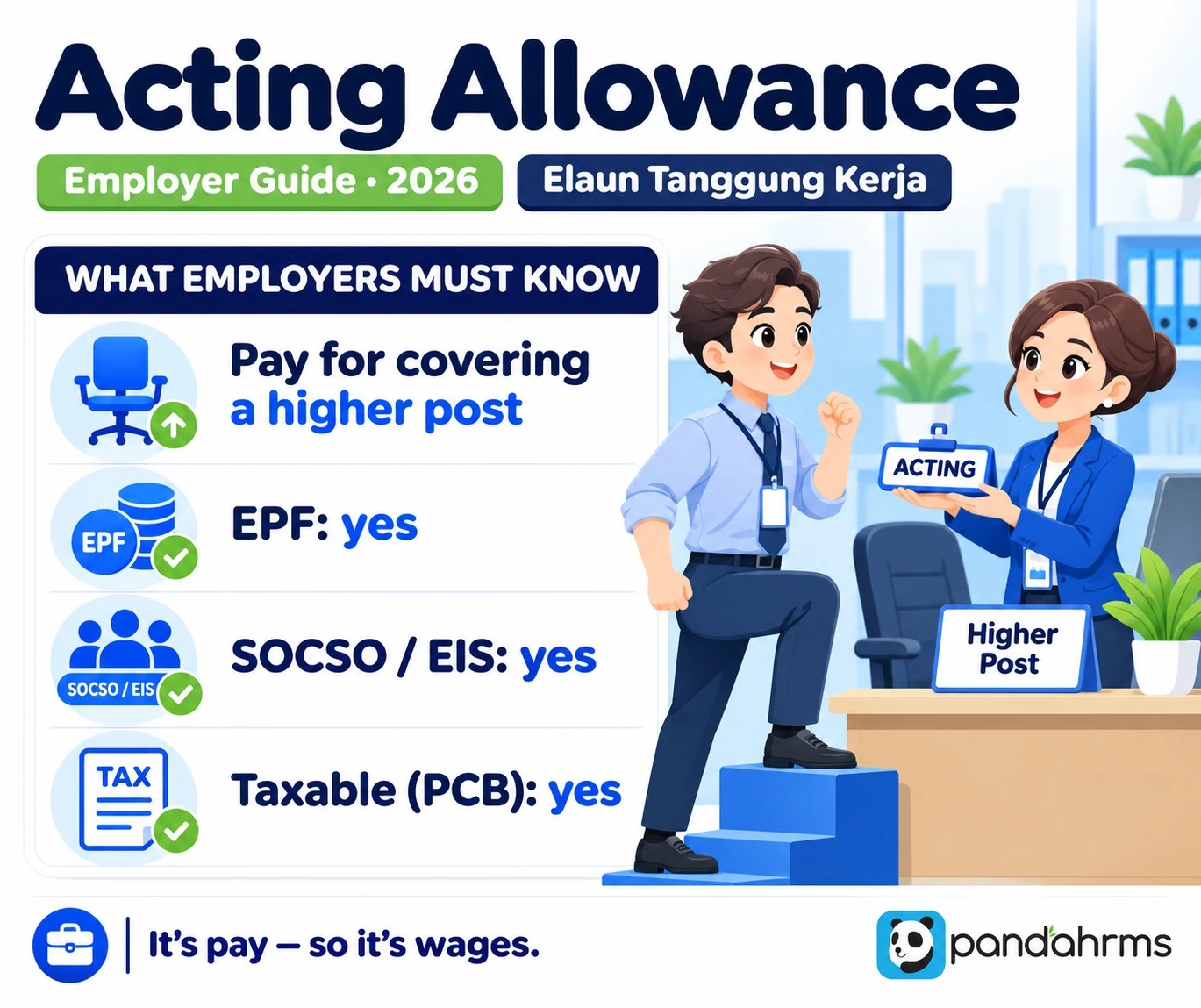
When a manager goes on long leave or a post sits vacant, someone below often steps up to carry the higher role for a while — and many employers pay an acting allowance (elaun tanggung kerja) for it. It’s a fair way to reward extra responsibility, but it raises a payroll question employers get wrong: is an acting allowance subject to EPF, SOCSO and tax? The short answer is yes to all three — and here’s exactly why, plus how to set and calculate it.
What Is an Acting Allowance?
An acting allowance is extra pay given to an employee who temporarily performs the duties of a higher position — covering for a manager on leave, or holding a vacant post until it’s filled. It is additional remuneration for taking on more responsibility. That matters, because it is pay for work, not a reimbursement of expenses — and that is what decides how the statutory deductions treat it.
Who Qualifies — and for How Long
There’s no statutory formula; it’s set by company policy. Typically an acting allowance applies when an employee formally takes on a higher role for a defined period (often beyond a short few days), with the acting arrangement and the allowance put in writing. It’s paid only for the acting period and stops when the employee returns to their substantive role or the post is filled.
How to Calculate It
Two common methods:
- Percentage of the gap — a percentage (often somewhere around 10–25%, by company policy) of the difference between the employee’s salary and the higher post’s salary.
- Fixed amount — a set monthly sum for acting in that grade.
Example: an executive on RM4,000 acts as a manager (RM6,000 grade). On a 20%-of-gap policy, the acting allowance is 20% × (RM6,000 − RM4,000) = RM400 a month for the acting period.
EPF, SOCSO/EIS and PCB Treatment
Because an acting allowance is remuneration for work, it is treated as wages across all three schemes:
| Scheme | Acting allowance? | Why |
|---|---|---|
| EPF | ✅ Yes | EPF’s definition of wages expressly includes allowances |
| SOCSO / EIS | ✅ Yes | Most allowances count as wages for SOCSO/EIS |
| PCB (income tax) | ✅ Yes | It is taxable employment income |
This lines up with the broader rule: see which payments count as wages for EPF and as wages for SOCSO/EIS.
Allowance vs Reimbursement — the Line That Matters
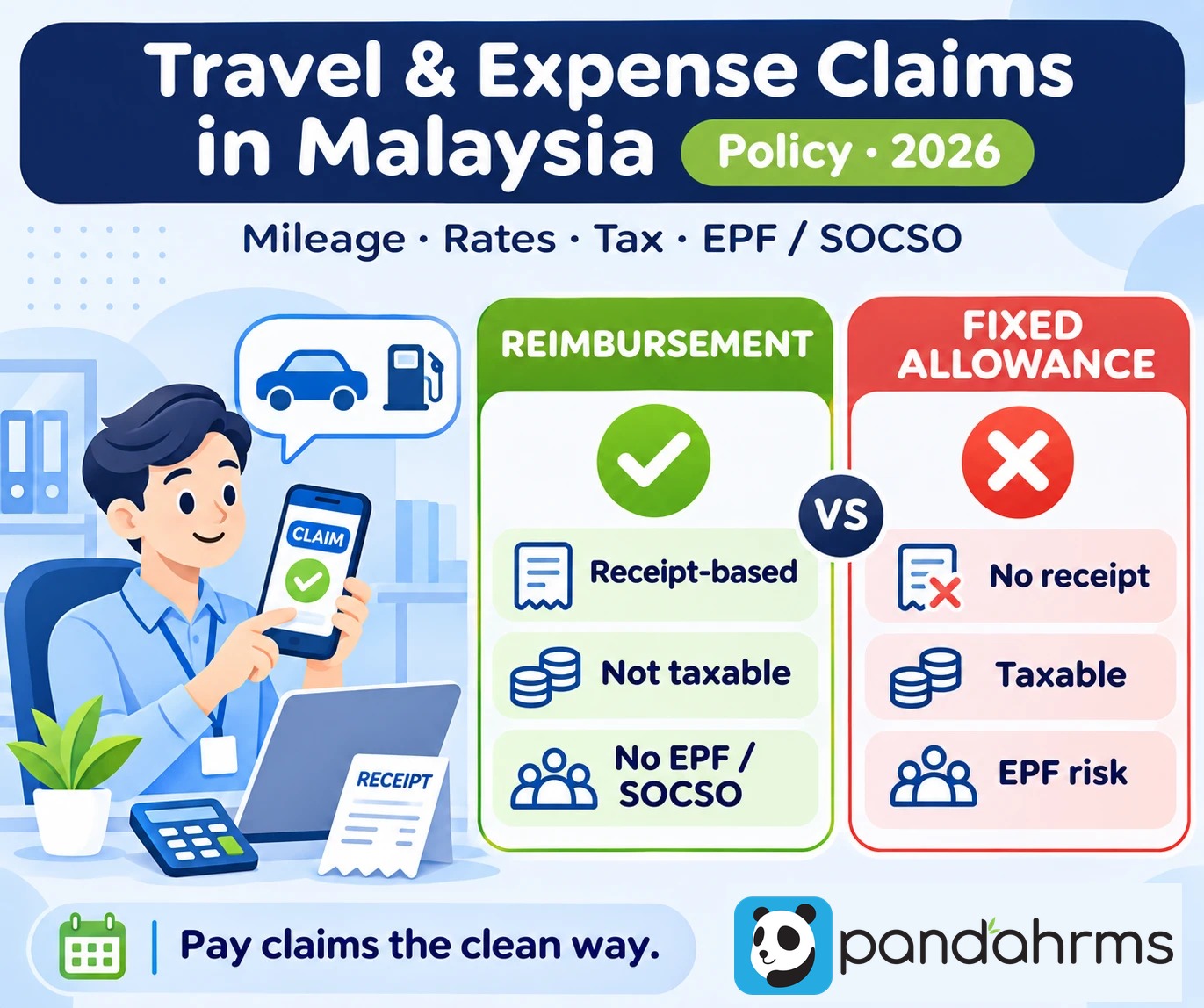
The reason some allowances are exempt from EPF and SOCSO is that they are really reimbursements of expenses — a travelling allowance covering mileage, for example. An acting allowance is the opposite: it is extra pay for extra responsibility, not a refund of a cost. So it does not fall into the exempt category — it is wages. (The same “nature, not the label” logic applies to bonus, commission and incentive.)
How Pandahrms Helps
With Pandahrms, an acting allowance is set up as a pay item that is EPF-, SOCSO/EIS- and PCB-liable, attached to the employee for the acting period, and ended automatically when the acting stops — so the contributions are calculated correctly every run and the allowance shows clearly on the payslip. No manual re-keying, and no guessing whether it should attract EPF or SOCSO. Want to see how a time-bound acting allowance runs through payroll? Contact us for a demo.
Frequently Asked Questions (FAQ)
- Is an acting allowance subject to EPF and SOCSO in Malaysia?
Yes. Because an acting allowance is remuneration for work, it counts as wages for EPF and for SOCSO/EIS, and it is taxable for PCB — all three apply. - How is an acting allowance calculated?
There’s no statutory formula; it’s set by company policy. Common methods are a percentage of the gap between the employee’s salary and the higher post’s salary, or a fixed monthly amount for acting in that grade. - Why is an acting allowance taxed when some allowances aren’t?
Allowances that are exempt are really reimbursements of expenses (such as a travelling allowance). An acting allowance is extra pay for extra responsibility, not a refund of a cost, so it is treated as wages. - Who qualifies for an acting allowance?
An employee who formally takes on the duties of a higher position for a defined period. The arrangement and the allowance should be put in writing, and the allowance stops when the acting ends. - Is an acting allowance the same as a salary increment?
No. An acting allowance is temporary, paid only while the employee covers the higher role; a salary increment is a permanent change to the employee’s basic pay.
Source: Employees Provident Fund Act 1991 (the definition of “wages” expressly includes allowances, with a specific list of exemptions such as travelling allowance and reimbursements); the Employees’ Social Security Act 1969 and the Employment Insurance System Act 2017 (most allowances are wages for SOCSO/EIS, with reimbursements and travelling allowance excluded); and the Income Tax Act 1967 with LHDN’s Monthly Tax Deduction (PCB/MTD) rules. An acting allowance is remuneration for work, not a reimbursement, so it is treated as wages. This article is general guidance, not legal or tax advice — confirm your specific pay items with EPF (KWSP), PERKESO and LHDN, or a qualified adviser.