In the course of employment, it is not uncommon for employees to join or leave a company partway through the month. This could happen due to new hires, sudden resignations, or mid-month onboarding. In such cases, employers are often faced with the question: How should salary be calculated for an incomplete month of service?
Until a few years ago, this was largely left to company policy. Some employers divided by calendar days, others by working days, and both were considered acceptable as long as the method was applied consistently.
That is no longer the position.
Since 1 January 2023, the Employment Act 1955 contains a prescribed formula for this exact situation. If your payroll still offers a choice between two methods, it is following an out-of-date rule.
Section 18A: The Formula the Law Now Requires
The Employment (Amendment) Act 2022 introduced Section 18A into the Employment Act 1955, which came into force on 1 January 2023. It sets out how wages are to be calculated for an incomplete month’s work:
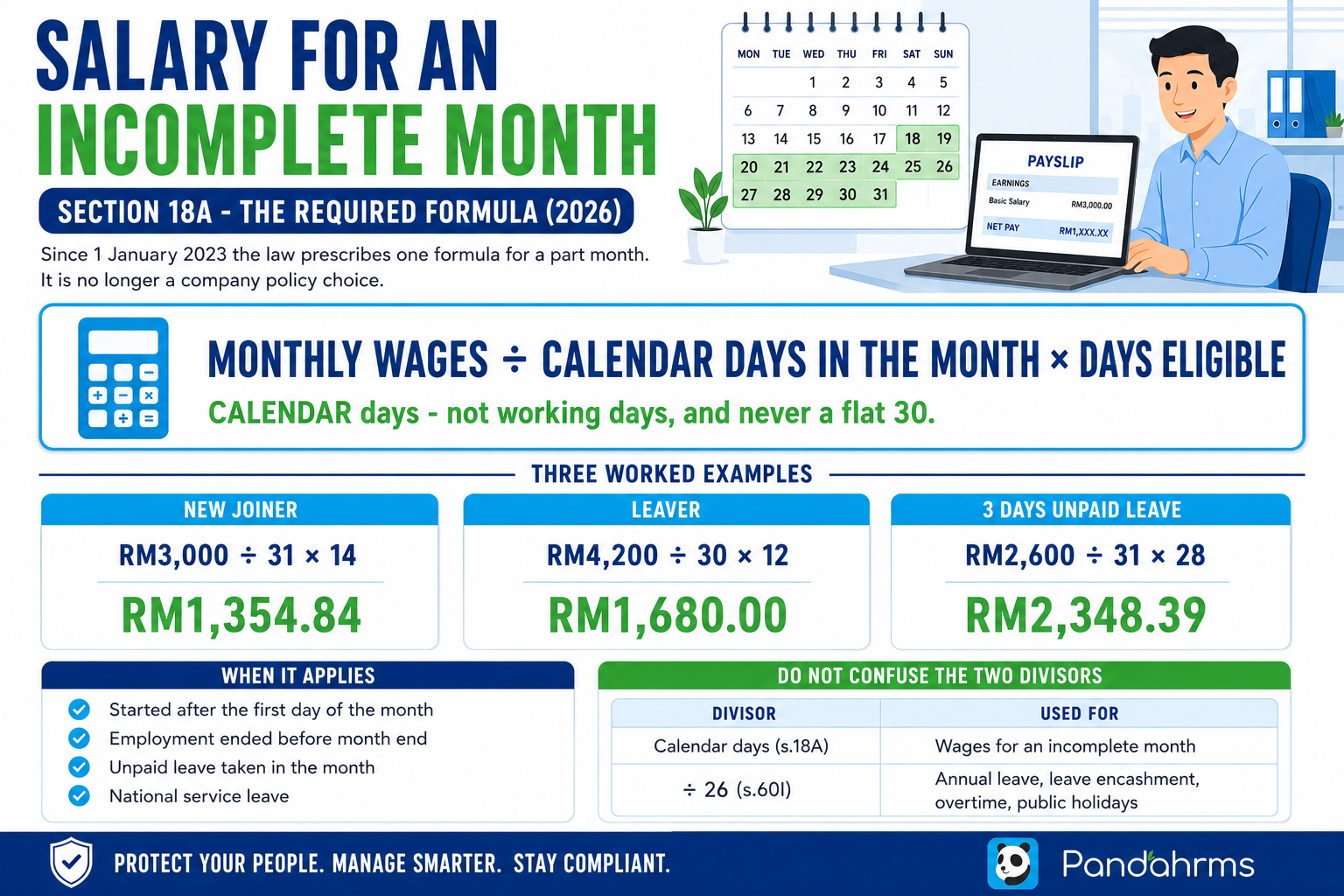
Wages for an incomplete month = (Monthly Wages ÷ Number of Days of the Particular Wage Period) × Number of Days Eligible in that Wage Period
Breaking it down:
- Monthly Wages — the agreed monthly salary under the contract of service.
- Number of Days of the Particular Wage Period — the calendar days in that month. 31 for January, 28 or 29 for February, 30 for April, and so on. The Labour Office has confirmed that this refers to calendar days, not working days.
- Number of Days Eligible — the days in that month for which the employee is entitled to be paid.
The divisor therefore changes from month to month. It is not a fixed 30, and it is not the number of working days.
When Section 18A Applies
The formula applies where, in a given wage period, the employee:
- started work after the first day of the month;
- had their employment terminated before the end of the month;
- took leave without pay for one or more days in that month; or
- took leave of absence to comply with any written law relating to national service.
In other words, it covers almost every real-world part-month scenario a Malaysian employer will meet.
Three Worked Examples
Example 1 — A new joiner
An employee earning RM3,000 a month starts on 18 August. August has 31 calendar days, and the employee is eligible for 14 of them (18 to 31 inclusive).
RM3,000 ÷ 31 × 14 = RM1,354.84
Example 2 — A leaver
An employee earning RM4,200 a month has a last working day of 12 September. September has 30 calendar days, and the employee is eligible for 12 of them.
RM4,200 ÷ 30 × 12 = RM1,680.00
Example 3 — Unpaid leave in the middle of the month
An employee earning RM2,600 a month takes 3 days of unpaid leave in October. October has 31 calendar days, so the employee is eligible for 28.
RM2,600 ÷ 31 × 28 = RM2,348.39
Notice what happens across the three examples: the same employee working the same number of days would be paid a slightly different amount in a 30-day month than in a 31-day month. That is the intended result of the formula, and it is not an error in your payroll.
Do Not Confuse This With the ÷26 Divisor
This is the single most common mix-up in Malaysian payroll, so it is worth stating plainly.
There are two different divisors in the Employment Act, and they are used for two different purposes:
| Divisor | Used for |
|---|---|
| Calendar days in the month (Section 18A) | Wages for an incomplete month — a joiner, a leaver, or unpaid leave |
| ÷ 26 (ordinary rate of pay, Section 60I) | Daily-rate computations such as annual leave, payment for untaken annual leave on termination, sick leave, overtime and public holiday pay |
So a new joiner’s first salary is prorated on calendar days, while the payout for their unused annual leave when they eventually resign is calculated at monthly wages ÷ 26. Using ÷26 for a part-month salary, or calendar days for a leave encashment, will both produce the wrong figure.
Deductions Still Apply on What Is Actually Paid
Once the prorated figure is settled, the statutory contributions follow the amount actually paid for that month, not the full monthly salary:
- EPF — contributions are based on the wages paid for the month, by the applicable rate and contribution band.
- SOCSO and EIS — based on the wage band the actual monthly wage falls into.
- PCB — computed on the remuneration for that month.
A part-month salary will often drop the employee into a lower contribution band for that month. That is correct and expected.
Key Considerations for Employers
To prevent payroll issues, employers should:
- Apply the Section 18A formula for incomplete months, rather than a house rule inherited from before 2023.
- Use the actual calendar days of that month as the divisor, not a flat 30.
- Keep the ÷26 ordinary rate of pay strictly for leave, overtime and public holiday computations.
- Make sure payroll staff can explain the calculation to an employee who asks — the first payslip is the one most likely to be queried.
- Review the wording in your employee handbook if it still says employees may be prorated by working days.
A small mistake in payroll can damage employee trust or lead to legal claims, especially when it involves final pay upon resignation or termination.
Why Manual Calculation Isn’t Ideal
Calculating prorated salary by hand — across multiple employees, months of different lengths, unpaid leave days and mid-month resignations — is slow and easy to get wrong. And because the divisor changes with every month, a spreadsheet built around a fixed 30 will quietly produce the wrong figure for most of the year.
Human error in payroll does not just create corrections. It creates the conversation where an employee no longer trusts the payslip.
Streamline Salary Calculations with Pandahrms
Pandahrms applies the Section 18A calculation automatically, using the correct number of calendar days for each month, and keeps the ordinary rate of pay separate for leave and overtime computations. Leave records, attendance and public holidays feed into the payroll run, so a mid-month joiner or leaver is handled without a manual workaround.
✅ Key Benefits of Using Pandahrms:
- Automated salary proration for new joiners, resignations and unpaid leave
- Correct divisor applied per month, with no fixed-30 shortcut
- Seamless integration with the attendance and leave modules
- Clear payslip generation, so employees can see how the figure was reached
- Saves HR time and reduces the risk of human error
Whether you’re a small business or a growing company, Pandahrms provides a reliable, cloud-based HR solution to simplify your monthly payroll process.
Frequently Asked Questions (FAQ)
1. Is there a legally required formula for prorating salary in Malaysia?
Yes. Since 1 January 2023, Section 18A of the Employment Act 1955 prescribes the formula: monthly wages divided by the number of days of the particular wage period, multiplied by the number of days the employee is eligible for.
2. Should I divide by calendar days or working days?
Calendar days. The Labour Office has confirmed that the number of days of the wage period refers to the calendar days in that month.
3. Can I still use a fixed divisor of 30 every month?
No. The divisor is the actual number of calendar days in that particular month, so it changes between 28, 29, 30 and 31.
4. Does the same formula apply when an employee resigns mid-month?
Yes. Section 18A covers employment ending before the end of the month, as well as employees starting after the first day and days of unpaid leave.
5. Why is unused annual leave paid out using ÷26 instead?
Because that is a different computation. Payment for untaken annual leave is made at the ordinary rate of pay, which for a monthly-rated employee is defined as monthly wages divided by 26. Section 18A applies to wages for an incomplete month, not to leave entitlements.
6. Do EPF, SOCSO, EIS and PCB apply to a prorated salary?
Yes. They are calculated on the wages actually paid for that month, which often places the employee in a lower contribution band for that month.