Interns are great for a business — an extra pair of hands, a pipeline of future hires, and a tax break if you do it right. But the moment you bring one on, the questions start: Do we have to pay them? Do we deduct EPF and SOCSO? Is an intern an “employee”? Get the answers wrong and you either overpay, under-protect the intern, or accidentally create an employment relationship you didn’t intend. This guide covers interns in Malaysia from the employer’s side: allowance, statutory contributions, and the agreement you should put in place.
Is an Intern an “Employee”?
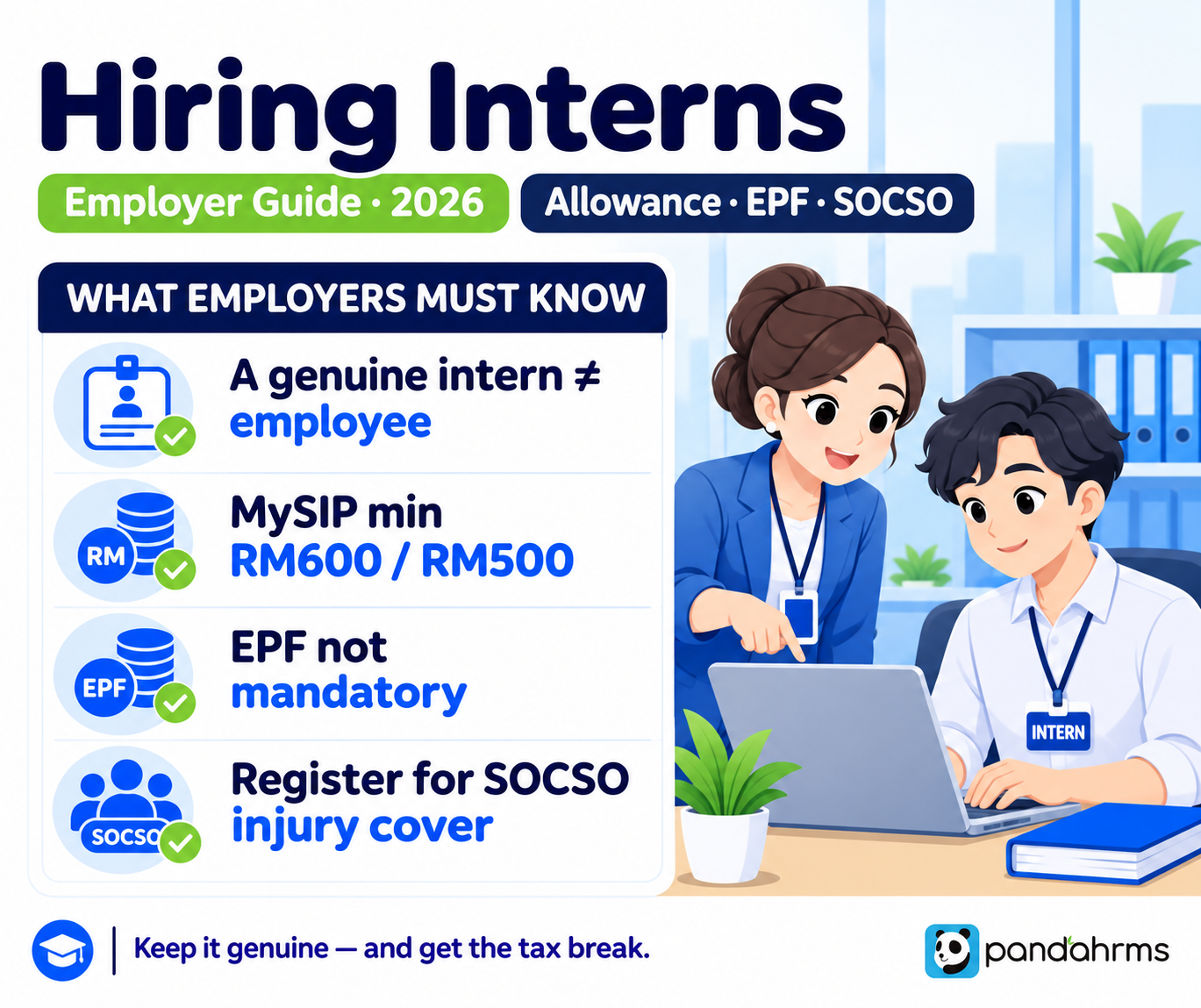
This is the question everything hinges on. A genuine intern — a student undergoing structured training as part of their studies — is generally not an employee under a contract of service. That means the Employment Act, minimum wage and automatic statutory contributions don’t apply in the same way they do for staff.
But — and this matters — if the “intern” is really doing the job of a regular employee, working set hours under the same control as staff, a court or the Labour Department can treat them as an employee regardless of the “intern” label. The test is the true nature of the arrangement, not what you call it. Keep an internship a genuine training placement, and document it as one.
How Much Should You Pay an Intern?
There is no separate statutory minimum wage for genuine interns. However, if you want the tax benefit (below), you need to meet the National Structured Internship Programme (MySIP) minimums set by TalentCorp:
| Intern level | Minimum monthly allowance (MySIP) |
|---|---|
| Master’s / Bachelor’s / Professional Certificate (or equivalent) | RM600 |
| Diploma / Malaysian Skills Certificate (SKM Level 1–5, or equivalent) | RM500 |
Under MySIP, the internship must run for a minimum of 10 weeks for an eligible Malaysian student, and the host company can claim a double tax deduction on the allowance and related costs (up to a capped amount per intern). The placement is verified by TalentCorp, which issues a Letter of Endorsement so you can claim the deduction through LHDN. Note too the 1:3 Internship Policy, fully in force from June 2026: companies hiring foreign professionals on Employment Passes are required to offer MySIP internship placements to local students.
EPF for Interns
Because a genuine intern is not an employee, EPF contributions are not mandatory for them. You may contribute voluntarily if you wish, but it isn’t required for a true internship. If, however, the arrangement is really employment, EPF applies like any other employee — another reason to keep the internship genuine and well-documented.
SOCSO for Interns
SOCSO is the one protection you should not skip. Students undergoing industrial training can be covered under SOCSO’s Employment Injury Scheme, so that if an intern is injured during the placement, they’re protected. Many employers register their interns with PERKESO for exactly this reason. Because the registration route and conditions for trainees are set by PERKESO, confirm the current requirement with SOCSO and register your interns accordingly — it’s inexpensive peace of mind for both sides.
Put an Internship Agreement in Place
A short written internship agreement keeps everyone clear and helps show the placement is training, not employment. It should cover:
- That this is a training placement, not a contract of service.
- Duration and working days/hours.
- The allowance amount and payment date.
- Scope of work / learning objectives.
- Confidentiality and ownership of work produced.
- Conduct, leave arrangements, and how either side can end the placement.
- Insurance / SOCSO coverage.
Quick Employer Checklist
- Keep the internship a genuine training placement — don’t use interns to fill a permanent role.
- Pay at least the MySIP minimum (RM600 / RM500) if you want the double tax deduction.
- Register interns with SOCSO for injury protection (confirm with PERKESO).
- EPF is not mandatory for genuine interns.
- Sign an internship agreement and keep it on file.
How Pandahrms Helps
Pandahrms lets you manage interns alongside staff — track allowances and payment dates, store the internship agreement and documents, and keep attendance — without mixing them into your employee payroll where they don’t belong. When an intern converts to a full hire, their record carries straight over. See our offer letter & contract guide for that next step.
Frequently Asked Questions (FAQ)
- Do I have to pay an intern in Malaysia?
There’s no separate statutory minimum wage for a genuine intern, but to claim the double tax deduction under MySIP you must pay at least RM600 (degree/professional) or RM500 (diploma/certificate) a month and run the internship for at least 10 weeks. - Do I need to pay EPF for an intern?
No — EPF is not mandatory for a genuine intern, because they are not an employee under a contract of service. You may contribute voluntarily. If the role is really employment, EPF applies. - Do interns need SOCSO coverage?
Students on industrial training can be covered under SOCSO’s Employment Injury Scheme, and many employers register their interns for this protection. Confirm the current registration requirement with PERKESO. - Can an intern be considered an employee?
Yes, if the arrangement is really employment — doing a regular job under the same control as staff — the “intern” label won’t change that. Keep internships genuine training placements and document them. - What is MySIP?
The National Structured Internship Programme by TalentCorp. Meeting its conditions (minimum allowance, minimum 10 weeks, eligible Malaysian student) lets the host company claim a double tax deduction for the internship costs.
Source: TalentCorp’s National Structured Internship Programme (MySIP) for the minimum allowance (RM600 for Master’s/Bachelor’s/Professional Certificate, RM500 for Diploma/SKM Level 1–5), the minimum 10-week duration and the double tax deduction, and the 1:3 Internship Policy (fully in force from June 2026) for Employment Pass–linked placements; the Employment Act 1955 on who is an “employee” under a contract of service; the EPF Act 1991 and the Employees’ Social Security Act 1969 (PERKESO) on statutory contributions and injury coverage for trainees. Whether an intern is an employee, and the current SOCSO registration route for trainees, depend on the facts and the authorities’ current rules — confirm with TalentCorp, EPF and PERKESO. This article is general information, not legal advice.