January is increment season in Malaysia. Most SMEs hand out raises the way they always have — a percentage here, a counter-offer there, a number that feels about right. It works until two people doing the same job discover they are paid very differently, or a strong hire walks away because the offer had no logic behind it.
A salary structure fixes that. It is the framework of job grades and pay ranges that decides what each role should pay — before emotion, negotiation or a resignation letter forces your hand. This guide shows a Malaysian employer how to build one from scratch, ready for the January review.
What is a salary structure?
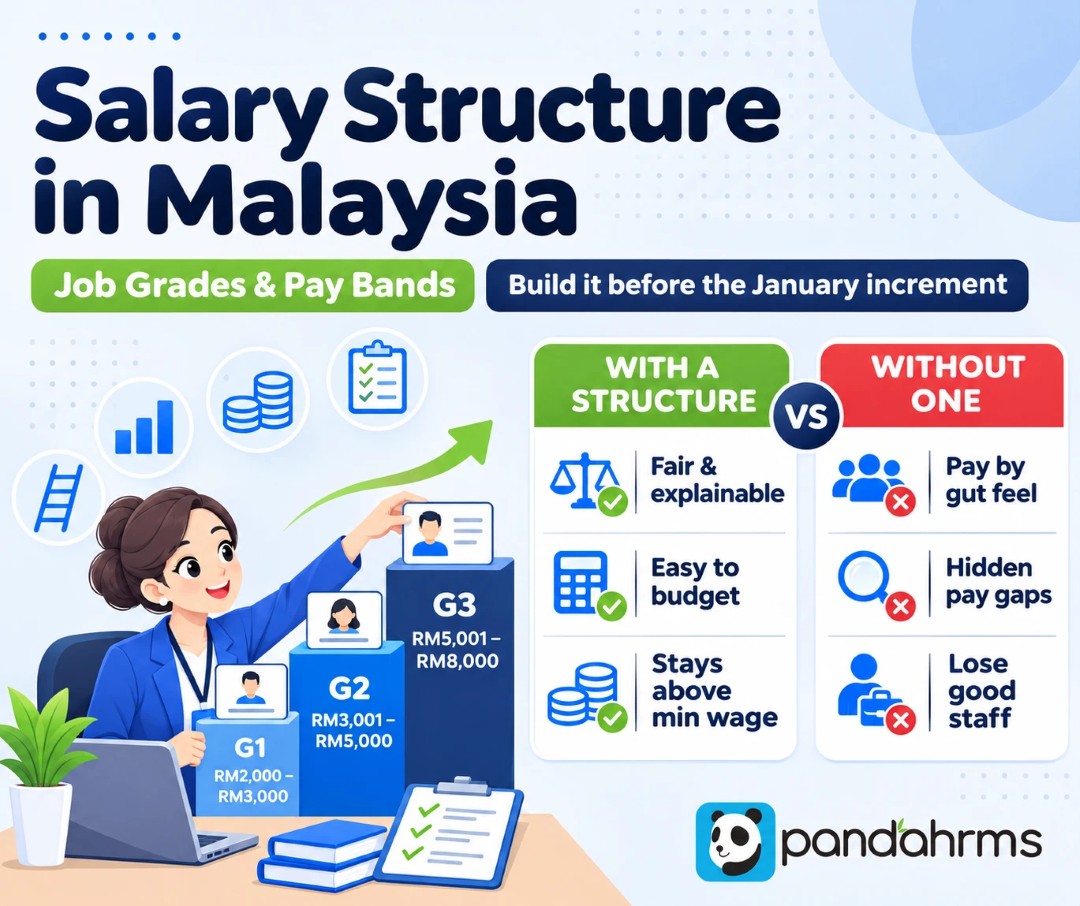
A salary structure is a defined set of job grades, each with its own pay range, that governs how much every role in your company can earn. Three ideas do most of the work:
- Job grade — a band of roles grouped by responsibility, skill and impact (for example, all senior executives sit in the same grade regardless of department).
- Pay range — the minimum, midpoint and maximum salary attached to a grade.
- Midpoint — the target “market rate” for a fully competent person in that grade; the minimum and maximum sit below and above it.
| Element | What it means | Rule of thumb |
|---|---|---|
| Minimum | Lowest pay for the grade — usually a new joiner still learning the role. | Must never fall below the statutory minimum wage. |
| Midpoint | Target market rate for a fully competent performer. | Set from market benchmarks, not gut feel. |
| Maximum | Ceiling for the grade — top performers at the limit of the role. | Beyond this, the person should be promoted, not just paid more. |
| Range spread | How wide the band is, from minimum to maximum. | About 30%–50% for most SME roles. |
| Compa-ratio | An employee’s salary divided by the midpoint of their grade. | 1.00 = exactly at market; below 0.80 or above 1.20 needs a look. |
Why every Malaysian SME needs one
- Fair, defensible pay. When someone asks why a colleague earns more, you can point to grade and performance instead of personality.
- Budgeting and forecasting. Grades let you cost out a whole increment round or a new hire before you commit.
- Staying above the legal floor. A structure forces you to check every band against the minimum wage, so no one quietly slips below it.
- Retention and cleaner offers. Candidates and staff trust a number that has a logic behind it far more than one that looks invented.
How to build a salary structure, step by step
Step 1: Define your job grades
List every role, then group them into grades by responsibility, decision-making and skill — not by who currently sits in the chair. Most SMEs need only four to seven grades (for example: Operations, Junior Executive, Senior Executive, Manager, Head of Department). Too many grades and the structure becomes impossible to maintain; too few and very different jobs get squeezed together.
Step 2: Benchmark the market
For each grade, find what the market actually pays. Use salary surveys, reputable job portals and what comparable employers in your industry and region advertise. Blend several sources rather than trusting one number, and record the date — pay data goes stale within a year or two.
Step 3: Build the pay ranges
Set a midpoint for each grade from your benchmarks, then build the minimum and maximum around it using a range spread of roughly 30%–50%. Let adjacent grades overlap a little — a strong Senior Executive can earn more than a brand-new Manager, and that is healthy. The overlap is what lets you reward depth without forcing a premature promotion.
Step 4: Check every band against the statutory floor
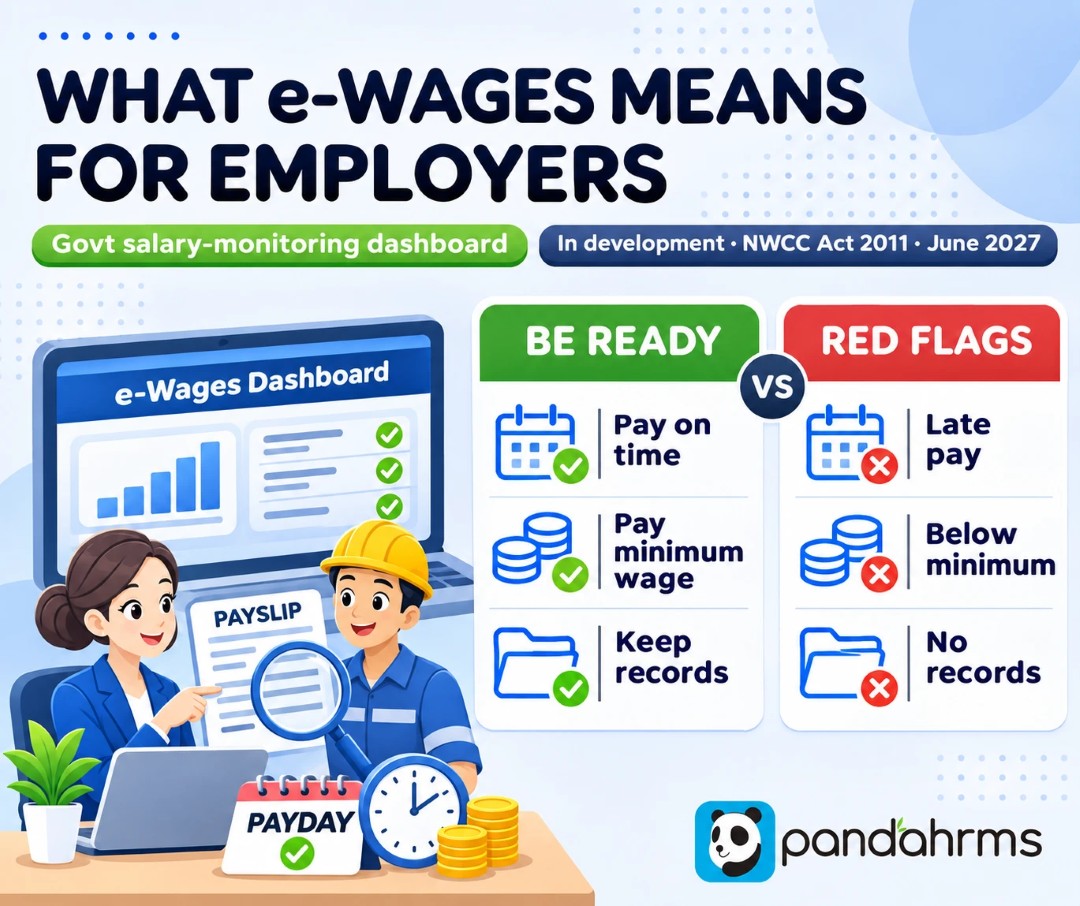
No band minimum may sit below the national minimum wage. The current rate is RM1,700 a month, and it rises to RM2,000 from 1 June 2027. Build that increase into your lowest grades now so you are not forced into an emergency correction later.
Step 5: Place your current employees
Work out each person’s compa-ratio (salary ÷ grade midpoint). Two situations need attention: someone paid above the maximum of their grade (a “red-circle” case — usually frozen until the band catches up or they are promoted) and someone paid below the minimum (a “green-circle” case — brought up to the floor on a plan). This is where a structure quietly surfaces the pay gaps you did not know you had.
Step 6: Set an increment and progression policy
Decide how people move through a band. The cleanest approach is a simple merit matrix: a larger percentage for strong performers who are still below midpoint, a smaller one for those already near the maximum. That keeps your increment budget flowing to the people with the most room to grow, instead of everyone drifting towards the ceiling. For how much the market is actually moving, see our guide on salary increments in Malaysia — how much and when.
A worked five-grade example
The figures below are illustrative — use them to see the shape of a structure, then drop in your own benchmarked numbers.
| Grade | Minimum (RM) | Midpoint (RM) | Maximum (RM) |
|---|---|---|---|
| G1 — Operations | 1,700 | 2,100 | 2,500 |
| G2 — Junior Executive | 2,600 | 3,250 | 3,900 |
| G3 — Senior Executive | 4,000 | 5,200 | 6,400 |
| G4 — Manager | 7,000 | 9,100 | 11,200 |
| G5 — Head of Department | 12,000 | 15,600 | 19,200 |
A salary structure does not remove judgement — it gives your judgement a frame. The goal is not to pay everyone the same, but to make every pay decision explainable.
Common mistakes to avoid
- Too many grades. Fifteen grades for forty people is unmanageable; aim for the fewest that still separate real differences in responsibility.
- Copying another company’s numbers. Their grades, cost base and market are not yours — benchmark, then decide.
- Setting it once and never updating. Review the midpoints at least yearly; the market moves and so does the minimum wage.
- Keeping it secret from managers. A structure only works if the people making pay decisions can actually use it.
- Ignoring the compa-ratio. Without it, everyone slowly drifts to the maximum and your increment budget quietly runs out.
Where the right HR system helps
A structure on a spreadsheet is only as good as the payroll that applies it. In Pandahrms you can hold each employee’s grade and salary in one place, see at a glance where they sit against their band, and run the January increment with the new figure flowing straight into payroll — EPF, SOCSO, EIS and PCB recalculated automatically, and the updated amount landing on the take-home pay you promised.
If you are rebuilding your pay framework before the year-end review, book a free Pandahrms demo and we will show you how to keep grades, ranges and payroll working as one system.
Frequently asked questions
- Is a salary structure required by law in Malaysia?
No. There is no legal requirement to have a formal salary structure. The only hard rule is that no one may be paid below the national minimum wage. A structure is good practice that protects you from pay disputes and uneven decisions, not a statutory obligation. - How many pay grades should an SME have?
Most small and mid-sized Malaysian companies work well with four to seven grades. Use the smallest number that still separates genuinely different levels of responsibility — more grades mean more admin and more borderline cases to argue over. - What is a compa-ratio and why does it matter?
It is an employee’s salary divided by the midpoint of their grade. A ratio near 1.00 means they are paid about the market rate; well below 1.00 may signal an underpaid, flight-risk employee, while above 1.20 means they are near the ceiling and due for promotion rather than another raise. - Can I just copy salary ranges from another company?
Not safely. Another employer’s grades reflect their cost base, industry and location, not yours. Use market surveys and job-ad data as a benchmark, then set ranges that fit your own budget and roles. - How often should the structure be reviewed?
At least once a year, ideally before your increment cycle. Check that midpoints still match the market and that every band minimum stays above the minimum wage — especially ahead of the rise to RM2,000 on 1 June 2027.