Factories, retail outlets, restaurants, security firms, clinics and warehouses all run on shifts — and all of them ask the same questions. Is a shift allowance compulsory? Does the law pay staff extra for working nights? And when you do pay it, how is it treated for EPF, SOCSO, EIS and tax? Getting this wrong either shortchanges your staff or quietly underpays your statutory contributions. Here is the clear version for Malaysian employers.
Is shift allowance compulsory in Malaysia?
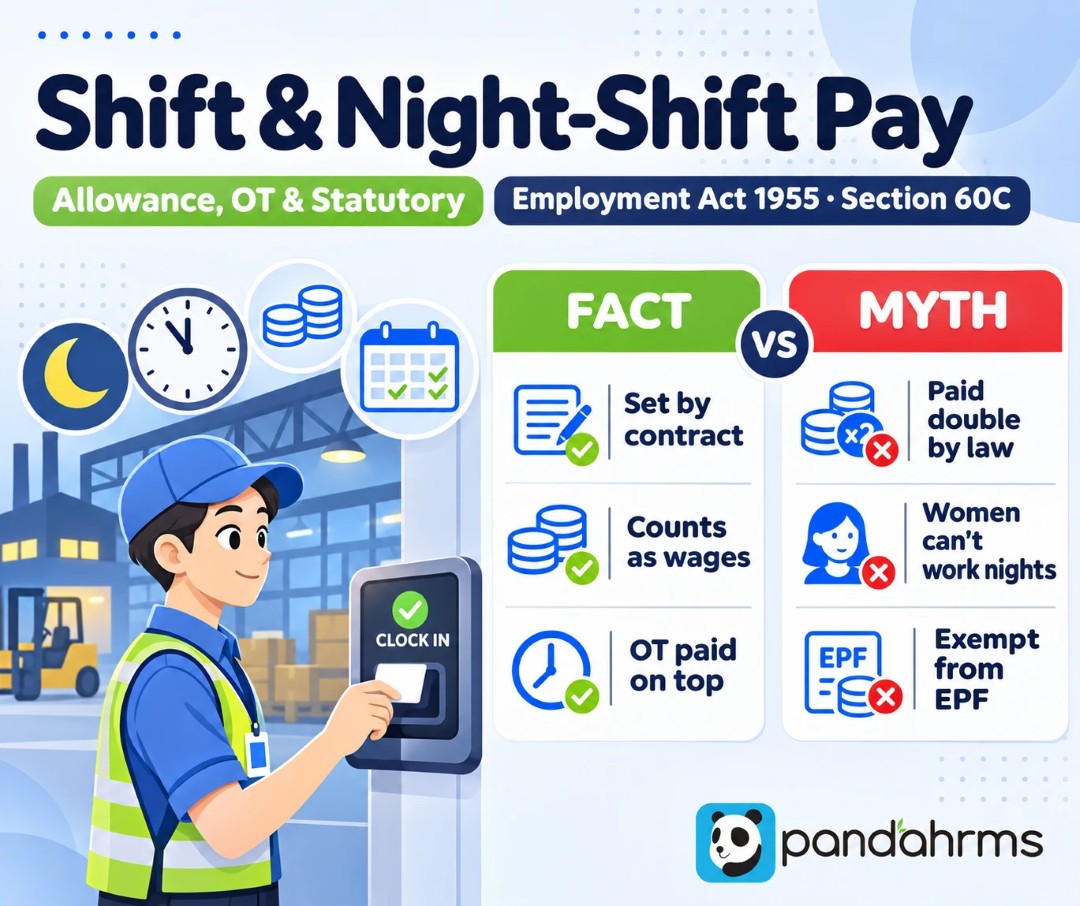
No. There is no general law that forces an employer to pay a shift allowance, and there is no statutory “night-shift premium” the way some countries have one. A shift or night-shift allowance is a contractual matter — it exists because you agreed to it in the employment contract or a written shift policy, not because the Employment Act fixes an amount.
The Employment Act 1955 does mention it. Section 60C(2A), added in the 2022 amendments, allows the Minister to make regulations on shift-work allowance entitlement — but it sets no figure, and that provision does not apply to employees earning more than RM4,000 a month unless they fall into blue-collar categories such as manual workers or drivers. Separately, the old restriction on women working at night in industrial undertakings (former sections 34 to 36) was repealed with effect from 1 January 2023, so the same shift, rest-day and overtime rules now apply to all employees regardless of gender.
There is no statutory night-shift premium in Malaysia. Night pay is whatever the contract says — plus overtime where the hours actually qualify for it. Once a shift allowance is a term of the contract, it cannot be reduced or withdrawn without the employee’s consent.
Shift allowance, overtime and rest-day pay are three different things
The most common mistake is to blur these together. They are separate, and an employee can be owed more than one at once.
| Payment | Required by law? | How it works |
|---|---|---|
| Shift / night allowance | No — contractual | A flat or hourly amount you set for working a shift, often extra for nights. |
| Overtime | Yes — statutory | At least 1.5× the hourly rate for work beyond normal daily hours. |
| Rest-day / holiday pay | Yes — statutory | Higher multipliers for work on a rest day or public holiday. |
So a night-shift worker who stays past normal hours is owed the night allowance you promised and statutory overtime on top. For the exact multipliers, see our guides to overtime pay and rest-day and public-holiday pay.
What the Employment Act says about shift work
Shift work is work that, by its nature, has to run continuously across two or more shifts. Under section 60C a shift worker can be required to work more than eight hours on a given day, as long as the average over the roster cycle does not exceed 45 hours a week, and no shift worker may be made to work more than twelve hours in any one day. If your rosters push people past those limits, read our breakdown of the 45-hour work week and how overtime changes under sections 60A and 60C.
How to set a shift or night-shift allowance
Step 1: Choose the model
Decide how the allowance is expressed: a flat amount per shift (for example RM10 per evening shift, RM15 per night shift), a percentage of basic pay, or an hourly uplift for hours worked at night. Flat-per-night is the easiest to communicate and to run in payroll.
Step 2: Set the amount by benchmarking
Because the law fixes no figure, look at what comparable employers in your industry pay, and make nights worth more than evenings so staff actually accept the harder slots.
Step 3: Put it in writing
Record the allowance in the employment contract or a written shift policy — who gets it, which shifts qualify, and how much. Remember that once it is an express term, you cannot cut or remove it later without the employee’s agreement, so write it in a way you can live with.
Step 4: Define eligibility and what counts as “night”
State clearly which hours make a shift a night shift, how rotation works, and whether part-shifts qualify. Clarity here prevents most disputes.
Step 5: Keep overtime separate
The allowance rewards when the person works; overtime pays for extra hours. Pay both where both apply — folding overtime into a flat allowance is a common and costly compliance error.
A quick worked example
An employee on a basic salary of RM2,500 works 22 night shifts in a month, with a night-shift allowance of RM15 per night.
- Night-shift allowance: 22 × RM15 = RM330
- Gross wages for the month: RM2,500 + RM330 = RM2,830
- That RM330 is part of wages — so it is included when you work out EPF, SOCSO, EIS and PCB (see below).
Is shift allowance subject to EPF, SOCSO, EIS and PCB?
Yes — a regular shift or night-shift allowance is part of “wages”, so it attracts EPF, SOCSO, EIS and PCB. It is worth seeing it next to other pay items, because they are not all treated the same way.
| Pay item | EPF | SOCSO | EIS | PCB (tax) |
|---|---|---|---|---|
| Shift / night allowance | Yes | Yes | Yes | Yes |
| Overtime | No | Yes | Yes | Yes |
| Travelling allowance (official) | No | No | No | Exempt to RM6,000/yr |
| Annual bonus | Yes | No | No | Yes |
The logic: EPF treats almost every fixed allowance as wages and carves out only a short list — overtime, travelling allowance, gratuity, service charge and termination benefits. SOCSO and EIS go the other way on overtime (it is counted) but leave out the annual bonus. A shift allowance is caught by all four. For the full lists, see which allowances are subject to EPF and which wages are subject to SOCSO and EIS. The same treatment applies to similar fixed allowances such as the acting allowance (elaun tanggung kerja).
Where the right HR system helps
Shift pay goes wrong when attendance, allowances and statutory deductions live in different places. In Pandahrms, the shift an employee actually works is captured by the attendance and roster module, the correct shift or night allowance is applied automatically, and payroll runs EPF, SOCSO, EIS and PCB on the right wage base — with overtime kept separate, the way the law requires.
If your team runs rotating or night shifts, book a free Pandahrms demo and we will show you how roster, allowance and payroll connect end to end.
Frequently asked questions
- Is an employer legally required to pay a night-shift allowance in Malaysia?
No. There is no statutory shift or night-shift allowance and no mandatory night premium. It is paid only if the employment contract or a company policy provides for it. Statutory overtime and rest-day rates still apply on top where the hours qualify. - Can women be made to work night shifts now?
Yes. The old restriction on women working at night in industrial undertakings (former sections 34 to 36 of the Employment Act) was repealed with effect from 1 January 2023, so the same shift, rest-day and overtime rules apply to all employees. - Is shift allowance subject to EPF and SOCSO?
Yes. A regular shift or night-shift allowance is treated as wages, so it is subject to EPF, SOCSO, EIS and PCB. Overtime is the exception for EPF — it is excluded from EPF but still counted for SOCSO and EIS. - Can I replace overtime with a flat shift allowance?
No. The two are different obligations. A shift allowance rewards working a particular shift; overtime is the statutory premium for extra hours. If an employee works beyond normal hours, you owe overtime in addition to any allowance. - Can we reduce or remove a shift allowance later?
Not unilaterally. Once a shift allowance is an express term of the contract, changing or withdrawing it needs the employee’s consent. Reducing it without agreement risks a breach-of-contract or constructive-dismissal claim.