An employee slips out to a clinic at 10am, comes back at noon, and hands HR a slip from the clinic. Is that sick leave? Should the two hours be paid, or deducted? This is one of the most common — and most mishandled — day-to-day payroll questions in Malaysia, because a time slip and a medical certificate (MC) are not the same document and don’t carry the same rights. Here’s the difference, and how to handle the hours.
What a Medical Certificate (MC) Does
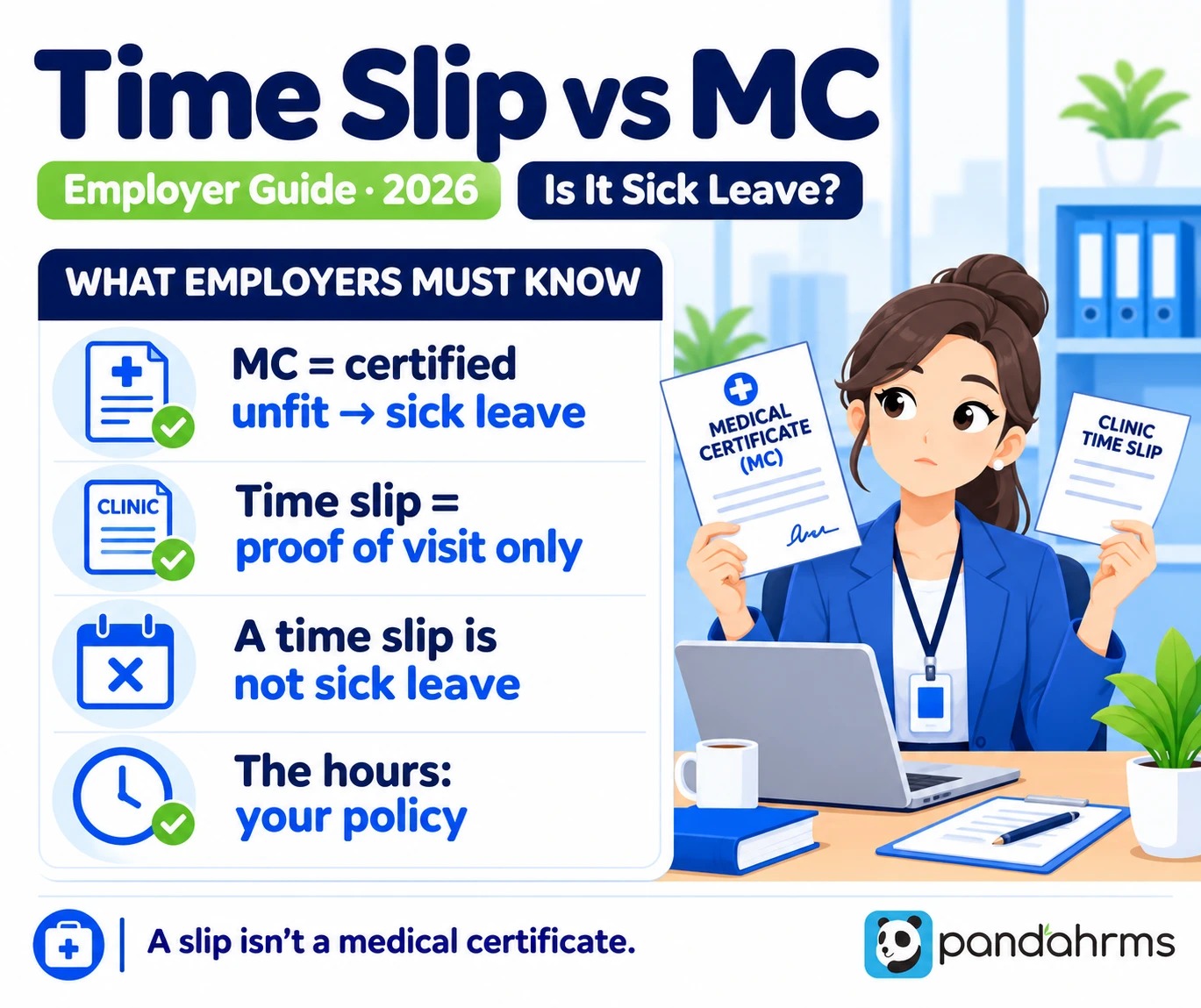
An MC is a doctor’s certification that an employee is unfit for work. It triggers paid sick leave under Section 60F of the Employment Act 1955, which gives an entitlement that scales with service — commonly 14 days (less than 2 years’ service), 18 days (2 to under 5 years) and 22 days (5 years or more) where no hospitalisation is needed, and up to 60 days in aggregate a year where hospitalisation is necessary. The certification must come from a registered medical practitioner (or a dental surgeon under Section 60F(1A)). (For the full picture, see our guide to types of leave in Malaysia.)
What a Time Slip Is
A time slip (sometimes a clinic chit or attendance slip) simply records that the employee attended a clinic and for how long — a time in and a time out. It is proof of a visit. It is not a certificate that the employee is unfit for work.
The Key Difference — and Why It Matters
An MC certifies incapacity; a time slip only proves attendance. Because Section 60F sick leave depends on being certified unfit by a registered practitioner, a time slip on its own does not entitle the employee to paid sick leave. If the clinic visit resulted in the doctor certifying the employee unfit, that’s an MC and sick leave applies. If the visit was a quick consultation and the employee returned to work, you have a time slip, not an MC — and the sick-leave entitlement is not triggered.
So Can You Deduct the Hours?
Here’s the part the law does not fix: how to treat the hours an employee spends at a clinic during working time is a matter of company policy, not statute. Common approaches:
- Paid — treat a short clinic visit as paid working time, as goodwill.
- Make up the time — ask the employee to work back the hours.
- Offset — deduct the hours from annual leave, or treat them as unpaid, if that’s your stated policy.
Any of these is acceptable as long as it is applied consistently and is spelled out in advance. What you should not do is improvise differently for different employees, or quietly cut a half-day of sick leave on the strength of a time slip that was never an MC.
Put It in the Handbook
The cleanest fix is a written policy: state when a time slip is accepted, whether those hours are paid, made up or unpaid, and when a proper MC is required (for example, for any absence counted as sick leave). That removes the case-by-case arguments and keeps payroll consistent. See our guide to the employee handbook.
How Pandahrms Helps
With Pandahrms, an MC is recorded as sick leave against the Section 60F entitlement, while a clinic time slip is handled under your own rule — paid, made up, or deducted — applied the same way for everyone, with the supporting document kept on file. The hours and the leave balance both flow into payroll correctly, so a time slip is never accidentally counted as a day of sick leave. Want to see how MCs and time slips are handled separately in payroll? Contact us for a demo.
Frequently Asked Questions (FAQ)
- Is a clinic time slip the same as an MC?
No. An MC certifies that the employee is unfit for work and triggers paid sick leave under Section 60F. A time slip only proves the employee attended a clinic and for how long; it does not certify incapacity. - Does a time slip entitle an employee to paid sick leave?
Not on its own. Section 60F sick leave depends on certification of unfitness by a registered medical practitioner. Without that, a time slip does not trigger the sick-leave entitlement. - Can I deduct the hours an employee spent at a clinic?
The law doesn’t fix this — it’s a policy choice. You may treat the hours as paid, ask the employee to make up the time, or deduct them (from annual leave or as unpaid), as long as your policy is clear and applied consistently. - Who can issue a valid MC?
A registered medical practitioner, or a dental surgeon under Section 60F(1A). The certification is what distinguishes an MC from an ordinary attendance slip. - What’s the best way to avoid disputes?
Set a written policy in the employee handbook: when a time slip is accepted, how the hours are treated, and when a proper MC is required. Apply it the same way for every employee.
Source: Employment Act 1955 — Section 60F on paid sick leave, which requires certification of unfitness by a registered medical practitioner (or a dental surgeon under Section 60F(1A)) and sets the days of entitlement by length of service, with a higher aggregate where hospitalisation is necessary. The treatment of hours spent attending a clinic during working time is not fixed by statute and is a matter of company policy. This article is general guidance, not legal advice — confirm your specific situation with the Labour Department or a qualified adviser.