Budget 2027 introduced a new wage benchmark that’s easy to confuse with the minimum wage: a proposed RM2,500 minimum starting monthly wage for graduates and semi-skilled workers, under a new workers’ income framework. Human Resources Minister Datuk Seri Ramanan Ramakrishnan welcomed the move, saying salaries should better reflect workers’ qualifications and skills. Here’s what the RM2,500 starting wage actually is, how it differs from the RM2,000 minimum wage, and what employers should do now.
What Budget 2027 Announced
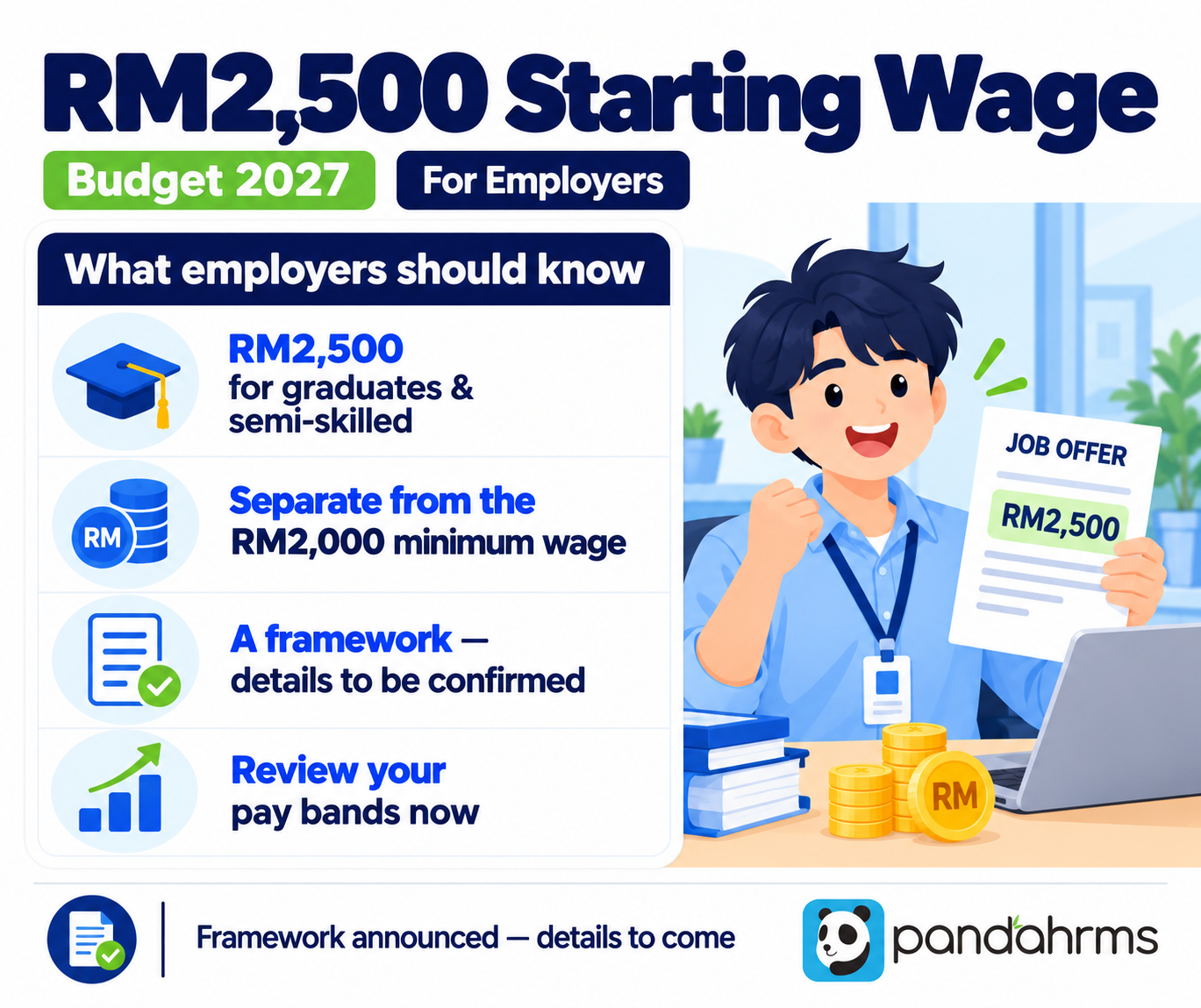
Under Budget 2027, the government proposed a RM2,500 minimum starting wage aimed at graduates and semi-skilled workers, as part of a broader “workers’ income framework” designed to align pay more closely with qualifications, skills and contribution. The Human Resources Ministry has said it will release further details on the implementation mechanism — so the exact scope, effective date and whether it will be mandatory are still to be confirmed.
RM2,000 vs RM2,500 vs RM3,400: Three Different Wage Lines
This is where most of the confusion comes from. Budget 2027 actually mentioned three separate wage figures, and they are not the same thing:
| Wage line | Amount | Who it’s for | Status |
|---|---|---|---|
| National minimum wage | RM2,000/month (from June 2027, up from RM1,700) | All employees | Mandatory (MSMEs with sales < RM50m exempt for now) |
| Starting-wage framework | RM2,500/month | Graduates & semi-skilled workers | Proposed framework — details to be confirmed |
| Living-wage benchmark | RM3,400/month (up from RM3,100) | GLC / GLIC employees (~230,000 workers) | Commitment by GLCs/GLICs |
In short: the RM2,000 minimum wage is the legal floor for everyone; the RM2,500 starting wage is a higher benchmark specifically for graduates and semi-skilled workers; and the RM3,400 living wage is a target GLCs and GLICs have committed to. (For the full breakdown of the RM2,000 rule, see our minimum wage RM2,000 guide.)
Who Counts as a “Graduate” or “Semi-Skilled” Worker?
The framework targets two groups:
- Graduates — typically those entering the workforce with a diploma or degree.
- Semi-skilled workers — workers with some training, certification or experience, sitting between unskilled and fully skilled/professional roles.
The precise definitions and the sectors covered will depend on the implementation details the Ministry has yet to publish.
Is the RM2,500 Starting Wage Mandatory?
Not yet. As announced, it is a framework — the government has signalled the intent and the figure, but the implementation mechanism, effective date and enforceability have not been confirmed. The Minister also urged private-sector employers to offer fairer wages in line with productivity and contribution, which points to encouragement rather than (for now) a hard legal mandate like the minimum wage. Wait for the Ministry’s detailed guidance before assuming any obligation.
What This Means for Employers
Even before the details land, the direction is clear: entry-level pay expectations are rising. If you hire fresh graduates or semi-skilled staff, your starting salaries will come under pressure — from this framework, from the RM2,000 minimum-wage floor, and from competition for talent. A few practical implications:
- Your current graduate/entry starting salaries may need a review if they sit below RM2,500.
- Raising entry pay can compress your existing pay bands — longer-serving staff just above entry level may expect adjustments too.
- Higher wages flow through to EPF, SOCSO, EIS contributions and your overall payroll cost.
How to Prepare Now
- Benchmark your entry-level pay against RM2,000 (the floor) and RM2,500 (the graduate/semi-skilled framework).
- Map your pay bands so a rise at entry level doesn’t create unfair gaps above it. (See our guide on salary increments.)
- Model the cost — including the knock-on EPF/SOCSO/EIS — so budgets are ready. (See how gross flows to net pay.)
- Watch for the Ministry’s implementation details before locking in policy. (For the wider picture, see our Budget 2027 highlights for employers.)
It’s also worth revisiting the Progressive Wage Policy, which pushes structured wage increases tied to productivity — a related direction of travel.
Where Pandahrms Helps
When wage floors move, the work lands on payroll. Pandahrms lets you update salaries across affected staff in one place, recalculates EPF, SOCSO, EIS and PCB automatically, and shows the full cost impact — so when the RM2,500 framework (or the RM2,000 minimum wage) takes effect, you adjust once and every payslip stays correct. Instead of reworking spreadsheets each time a benchmark changes, you keep pay bands and statutory contributions aligned effortlessly.
Final Thoughts
The RM2,500 starting wage is a signal, not yet a rule — but the signal is unmistakable: Malaysia wants entry-level pay, especially for graduates and skilled workers, to rise. Employers who review their pay bands now, model the cost, and watch for the implementation details will adjust smoothly rather than scramble when the rules firm up.
Frequently Asked Questions (FAQs)
- What is the RM2,500 starting wage?
A proposed minimum starting monthly wage for graduates and semi-skilled workers under Budget 2027’s workers’ income framework, meant to align pay with qualifications and skills. - Is it the same as the RM2,000 minimum wage?
No. The RM2,000 minimum wage (from June 2027) is the mandatory legal floor for all employees; the RM2,500 is a higher benchmark specifically for graduates and semi-skilled workers. - When does the RM2,500 starting wage take effect?
Not confirmed. The Human Resources Ministry has said it will provide details on the implementation mechanism. - Is the RM2,500 starting wage mandatory?
As announced it is a framework; the government has urged employers to adopt fairer wages, but the enforceability and effective date are still to be confirmed. - What should employers do now?
Benchmark entry-level pay, review pay bands, model the EPF/SOCSO/EIS cost, and watch for the Ministry’s detailed guidance.
Source: Budget 2027 (Belanjawan 2027) announcement, tabled on 9 October 2026, and statements by the Human Resources Minister, as reported by national media. Implementation details, scope and the effective date for the RM2,500 starting-wage framework are to be confirmed by the Human Resources Ministry. This article is general information, not legal advice; confirm the final rules before relying on them.