You have probably heard the stories of employees who hand in a resignation letter and walk out the same day — the classic “24-hour quit.” But what about the reverse? You turn up for work and your employer says, “Today is your last day.” Can they actually do that? Termination is one of the most sensitive topics in employment, right up there with wages. This guide explains what the law in Malaysia actually allows, and why “firing in 24 hours” is rarely as simple as it sounds.
First, What Counts as “Termination”?
Termination simply means ending the employment relationship that began when the contract of service was signed. Either side can end it — but each route carries different rights and obligations:
- Resignation — the employee chooses to leave, serving notice or paying in lieu.
- Termination with notice — either party ends the contract by giving the required notice (but, as we’ll see, the employer still needs a valid reason).
- Dismissal for misconduct — the employer ends it because of serious misconduct or a breach of contract, after proper process.
- Retrenchment / layoff — the role becomes redundant; termination benefits usually apply.
- Mutual separation (VSS / MSS) — both sides agree to part, normally with a separation package. This is by agreement, not something forced on the employee.
What the Employment Act Says About Notice
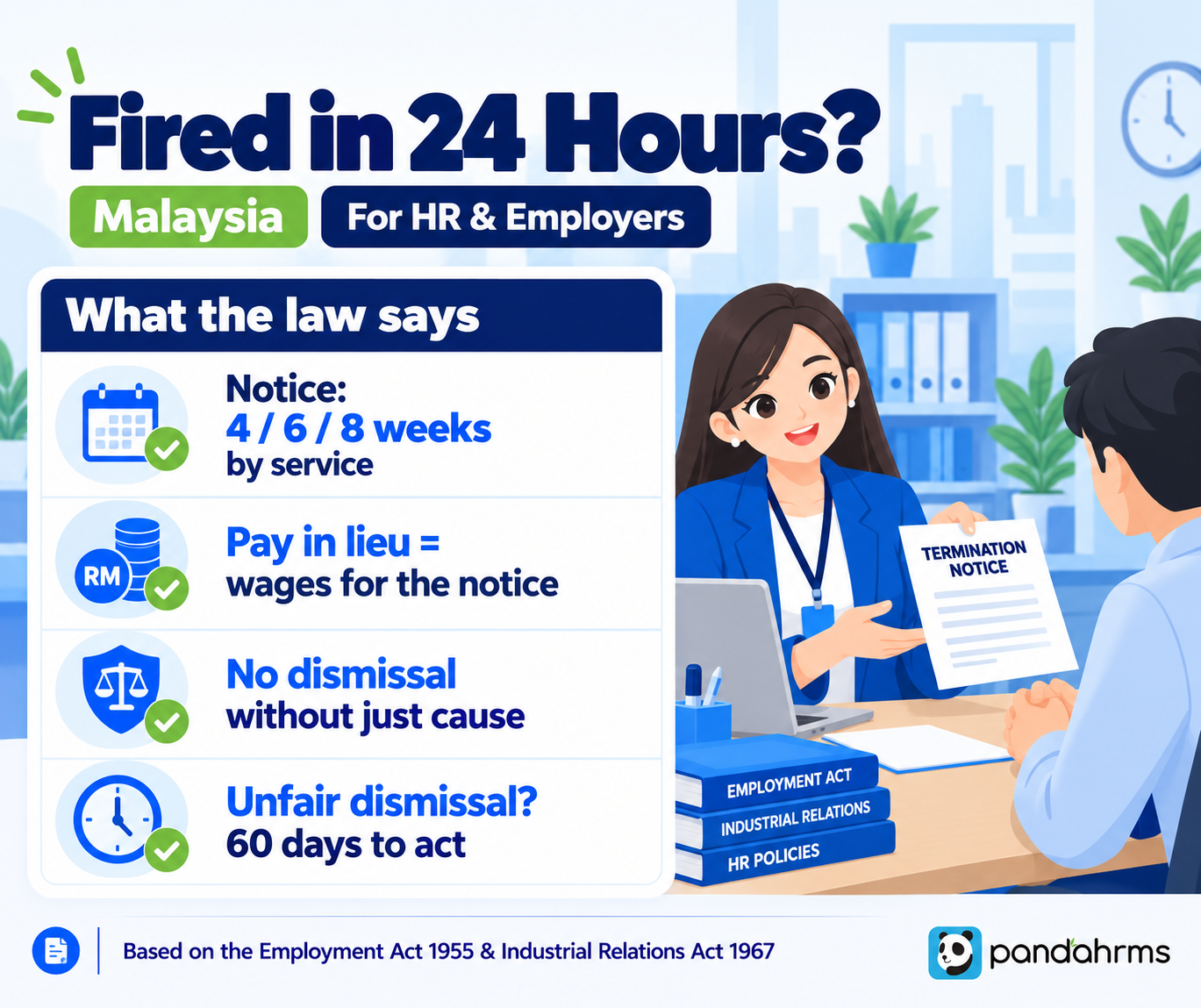
Under Section 12(1) of the Employment Act 1955, either party may give the other notice of its intention to terminate the contract of service. Section 12(2) adds that the termination must follow the notice period written in the contract. Where the contract is silent, the Act sets these minimum notice periods based on length of service:
| Length of service | Minimum notice (if the contract is silent) |
|---|---|
| Less than 2 years | 4 weeks |
| 2 years to less than 5 years | 6 weeks |
| 5 years or more | 8 weeks |
If your contract specifies a longer notice period, follow the longer one. The same notice rules apply both ways — to an employee who resigns and to an employer who terminates. (For the employer’s side of drafting this properly, see how to issue a proper notice of termination.)
So, Can an Employer Terminate You in 24 Hours?
Here is the part most people get wrong. The “24-hour” question actually mixes up two separate things:
- The notice period — which can be shortened to zero by paying in lieu of notice.
- The reason for the dismissal — which can never be skipped.
Even if an employer pays in lieu of notice, Malaysian law does not allow a dismissal without a valid reason. An employee has security of tenure under Section 20 of the Industrial Relations Act 1967, meaning they cannot be dismissed without just cause or excuse. The courts have repeatedly rejected “termination simpliciter” — ending employment by relying on a notice clause alone, with no reason given. In other words, a notice period (or pay in lieu) handles the how; it does not replace the why. And the burden is on the employer to prove the dismissal was justified.
So, can your employer walk up and end your job in 24 hours for no reason? No. That would expose them to an unfair dismissal claim.
When CAN an Employer Terminate Quickly?
There are situations where termination can happen fast — but each still needs a proper basis:
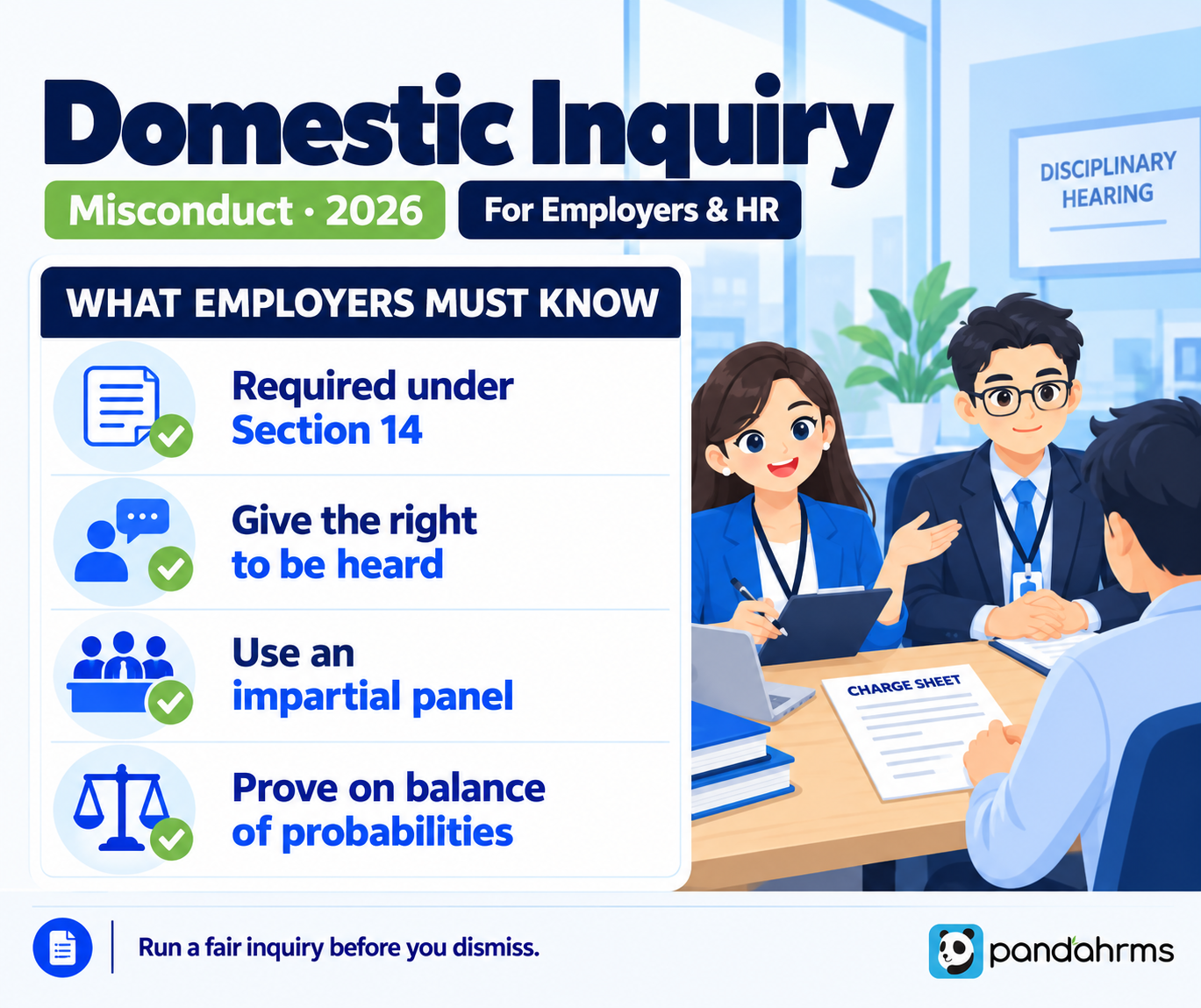
- Serious misconduct — an employer may dismiss for misconduct (for example theft, or repeated breaches after warnings), but should still follow due process: a show-cause letter and, where appropriate, a domestic inquiry. Skipping process is a common reason dismissals are later found unfair. (See: issuing a warning letter.)
- Paying in lieu of notice — this lets either side end the employment immediately without serving out the notice, but the dismissal still needs just cause.
- Genuine redundancy — a real retrenchment is a recognised reason, provided it is bona fide and follows a fair selection process.
Pushing someone out the same day because they came in late once, or simply to avoid the notice period, is exactly the kind of move that ends up at the Industrial Court. (Related: constructive dismissal.)
How Pay in Lieu of Notice Works
Under Section 13 of the Employment Act, either party may terminate without waiting out the notice period by paying the other an indemnity — an amount equal to the wages the employee would have earned during the notice period.
Worked example (illustration): an employee on RM2,500 a month with under two years of service has a 4-week notice period. Because the notice is defined in weeks, one clean way to value it is the weekly wage × the notice weeks:
- Weekly wage: RM2,500 × 12 ÷ 52 = RM576.92
- Pay in lieu: RM576.92 × 4 weeks = RM2,307.69
Note that the Employment Act does not fix a single divisor for this. Employers may compute the daily or weekly rate differently (and on gross or basic pay) depending on the contract, so the exact figure can vary. The principle is what matters: pay in lieu equals the wages for the notice period. When it is the employee who leaves early, the employer may deduct the shortfall from the final pay — see what an employer can legally deduct.
What This Means — for Employers and Employees
- Employers: have a genuine, documented reason before you terminate; follow the notice period (or pay in lieu); and keep records — warnings, show-cause letters, inquiry notes. A rushed, reasonless exit is the costliest route.
- Employees: check your contract’s notice period before resigning, and calculate any pay in lieu accurately. If you are dismissed without just cause, you may make representations for reinstatement to the Industrial Relations Department within 60 days under Section 20.
How Pandahrms Helps
Termination goes wrong most often at the paperwork and numbers stage — the missing warning letter, the miscalculated final pay, the notice period nobody checked. Pandahrms keeps each employee’s start date, contract notice period and disciplinary records in one place, works out the final pay (including pay in lieu, unused leave and lawful deductions), and generates clean, dated documents — so an offboarding is handled correctly instead of in a panic.
Frequently Asked Questions (FAQ)
- Can my employer fire me in 24 hours without any reason?
No. Even with notice or pay in lieu, a dismissal must be with just cause or excuse. Ending employment with no reason is “termination simpliciter,” which the courts do not recognise, and it exposes the employer to an unfair dismissal claim. - What is the minimum notice period for termination?
If the contract is silent: 4 weeks for under 2 years’ service, 6 weeks for 2 to under 5 years, and 8 weeks for 5 years or more. If the contract states a longer period, the longer one applies. - Can an employer end the job immediately by paying in lieu of notice?
Yes — pay in lieu of notice lets either side end employment without serving the notice period. But it only replaces the notice; the dismissal itself still needs a valid reason. - What if I’m dismissed for misconduct?
An employer can dismiss for serious misconduct, but should follow due process — a show-cause letter and, where appropriate, a domestic inquiry. Skipping the process is a common reason a dismissal is later found unfair. - How is pay in lieu of notice calculated?
It equals the wages the employee would have earned during the notice period. The Act does not fix one divisor, so the daily or weekly rate (and gross vs basic) should follow the contract — confirm the exact method before relying on a figure. - What can I do if I’m terminated without just cause?
You may make representations for reinstatement to the Director General of Industrial Relations within 60 days of the dismissal, under Section 20 of the Industrial Relations Act 1967.
Source: Employment Act 1955 (Sections 12 and 13) and the Industrial Relations Act 1967 (Section 20), with reference to established Industrial Court and appellate principles that a dismissal must be with just cause or excuse. Notice periods are statutory minimums that apply where the contract is silent; the contract may require longer. This article is general information, not legal advice — confirm your specific situation with the Labour Department or an employment lawyer.