Few HR requests come in as often as this one: “Can I get a letter to confirm I work here?” Employees need a letter of employment for a bank loan, a visa application, a rental, or a credit card — and they usually need it yesterday. It sounds trivial, but a letter that says too much can breach privacy, and one that says too little gets rejected by the bank. This guide covers exactly what a letter of employment is, what to include (and what to leave out), and gives you a free template.
What Is a Letter of Employment?
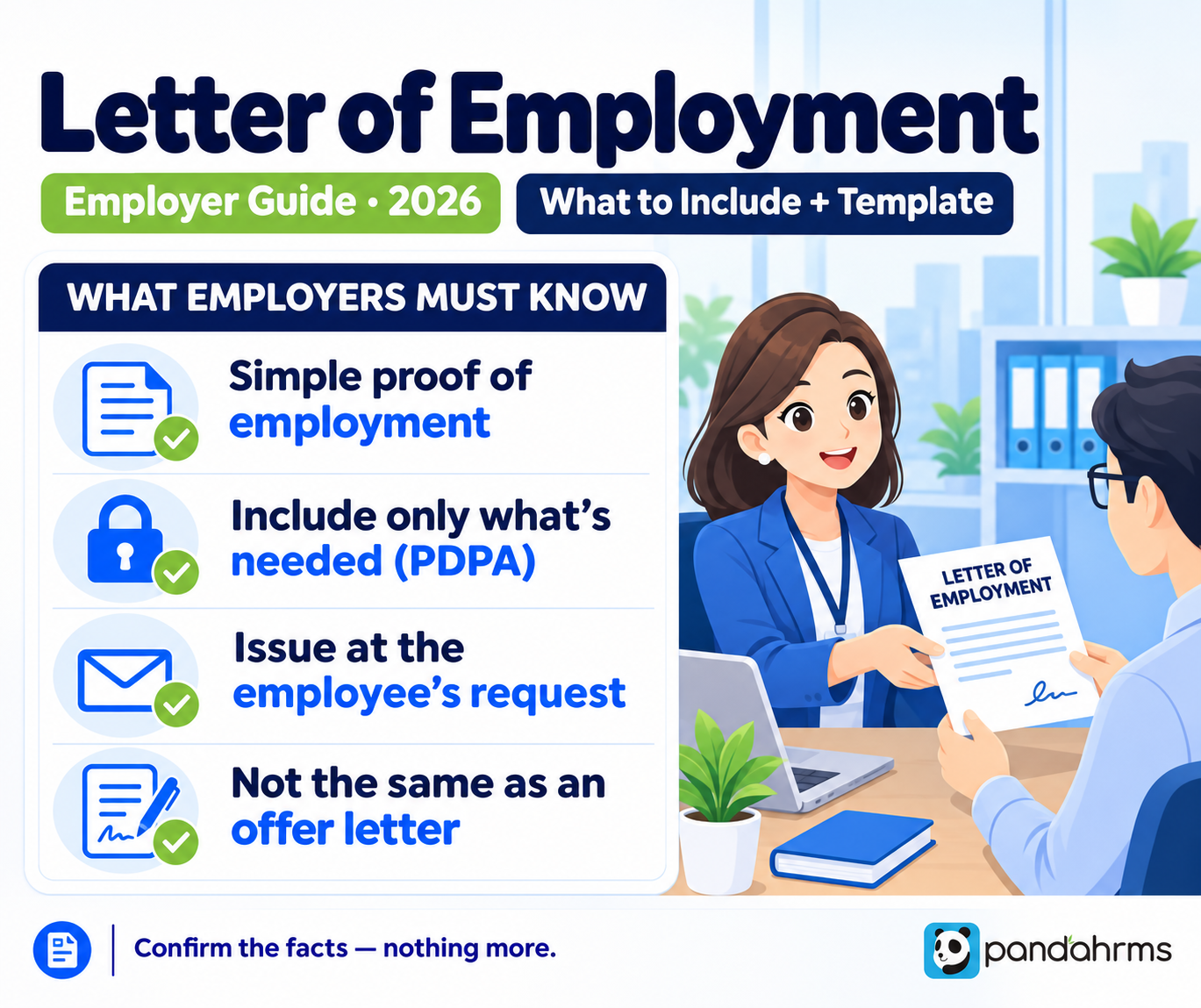
A letter of employment (also called an employment verification letter or surat pengesahan pekerjaan) is a short, formal letter from the employer confirming that a person is — or was — employed by the company. Its only job is to verify the employment relationship and a few basic facts a third party (a bank, embassy or landlord) needs to make a decision.
It is not the same as two documents people often confuse it with:
- An offer letter or employment contract — issued before employment starts, setting out the terms.
- An EA form — a year-end tax statement of earnings for income-tax filing.
A letter of employment is simply a current statement of fact: this person works here.
What to Include
Keep it factual and lean. A solid letter of employment contains:
- Company letterhead and the date.
- The addressee — “To whom it may concern,” or the specific bank/embassy if known.
- The employee’s full name and IC/passport number.
- Job title and department.
- Employment start date and current status (permanent, contract, full-time).
- Where the purpose requires it, the current salary — include this only when needed (e.g. a loan application).
- A line confirming the employee is in good standing (optional).
- The name, designation, signature and contact of the HR or authorised signatory, and the company stamp.
What to Leave Out — the PDPA Angle
A letter of employment discloses personal data, so the Personal Data Protection Act 2010 applies. Two rules of thumb:
- Disclose only what the purpose needs. A landlord usually needs confirmation of employment and salary band — not the employee’s full disciplinary history or exact bonus figures.
- Issue it at the employee’s request (or with their consent), and address it to the party they asked for. Don’t volunteer salary details to a third party who didn’t need them.
Also avoid making forward-looking promises — don’t state that employment “will continue for X years” or guarantee future income. Confirm the present facts only.
Free Letter of Employment Template
|
[Company Letterhead]
[Date]
To Whom It May Concern, RE: CONFIRMATION OF EMPLOYMENT – [EMPLOYEE NAME] This is to confirm that [Employee Name] (NRIC/Passport No.: [number]) is employed with [Company Name] as [Job Title] in the [Department] department. [He/She] has been employed with us since [Start Date] on a [permanent / contract / full-time] basis. [His/Her] current monthly salary is RM[amount].* [He/She] is an employee in good standing.This letter is issued at the employee’s request for [loan / visa / rental] purposes. Should you require further verification, please contact the undersigned. Yours faithfully, ____________________[Name & Designation] [Company Name] · [Contact] (Company stamp) *Include the salary line only where the purpose requires it. |
Good Practice for HR
- Set a standard turnaround (e.g. 2–3 working days) so requests don’t pile up.
- Decide who signs — usually HR or a department head — and keep it consistent.
- Keep a copy of every letter issued in the employee’s file.
- Use a template so the facts are accurate and the tone is consistent.
How Pandahrms Helps
A letter of employment should take two minutes, not two emails back and forth to find someone’s start date and salary. Pandahrms keeps each employee’s details — designation, start date, status and pay — in one place, so HR can produce an accurate, consistent letter on request and file a copy automatically. It’s the same single record that drives payroll and your wider HR documents.
Frequently Asked Questions (FAQ)
- Is an employer required to give a letter of employment?
There’s no specific statutory duty to issue one on demand, but it is standard practice and most employers provide it on reasonable request, since employees need it for loans, visas and rentals. - Should the letter state the employee’s salary?
Only when the purpose requires it, such as a loan or visa application. Under the PDPA, disclose only the personal data the purpose needs, and issue the letter at the employee’s request. - What’s the difference between a letter of employment and an offer letter?
An offer letter (or contract) is issued before employment begins and sets out the terms. A letter of employment is a current statement confirming that the person is employed now. - Can I give a letter of employment for a former employee?
Yes — issue a confirmation of past employment stating the dates and position held, at their request. Keep it to the facts and avoid comments beyond what was asked. - Who should sign it?
An authorised person — usually HR or a department head — with the company stamp. Keep the signatory consistent and retain a copy in the employee’s file.
Source: general Malaysian HR practice and the Personal Data Protection Act 2010 — in particular the Disclosure Principle (Section 8), under which an employer should not disclose an employee’s personal data to a third party without the employee’s consent or beyond the purpose for which it was collected; issuing the letter at the employee’s own request provides that consent. There is no prescribed statutory form for a letter of employment and no specific statutory duty to issue one on demand during employment — it is a matter of practice. This article is general information, not legal advice — adapt the template to your situation and confirm specific requirements with the requesting party (bank, embassy or landlord) or a professional adviser.