The Leave Was Approved. Then the Project Landed.
Sarah’s leave application was approved six weeks ago. Flights to Sabah are booked. Hotel paid.
Then your biggest client moves a go-live date — straight into her week off.
Every Malaysian employer hits this moment eventually. And the first question is always the same: we approved it, but can we take it back?
The honest answer: the law does not clearly say yes or no. That silence is exactly where employers get into trouble — so here is how to handle it properly.
Rejecting a Request vs Cancelling Approved Leave — Two Different Things
These two situations look similar but sit on very different legal footing.
| Rejecting a leave request | Cancelling approved leave | |
|---|---|---|
| When it happens | Before approval | After approval — plans may already be made |
| Legal position | Management’s right with genuine operational reasons | The Employment Act is silent — contract and policy decide |
| Employee’s position | Entitled to the days, not to specific dates | Has relied on your approval, often with money spent |
| Risk if done badly | Low, if reasons are real and alternatives offered | Morale damage, disputes, and in repeated cases constructive dismissal claims |
We covered the first column in detail in our guide on rejecting annual leave requests. This article is about the harder second column.
What the Employment Act Actually Says
Section 60E of the Employment Act 1955 sets the minimum annual leave entitlement:
| Years of service | Minimum annual leave |
|---|---|
| Less than 2 years | 8 days per year |
| 2 to 5 years | 12 days per year |
| More than 5 years | 16 days per year |
That is the entitlement. But on the specific question — can approved leave be cancelled? — the Act says nothing.
No section permits it. No section forbids it. Which means the answer comes from three places:
1. The employment contract — does it reserve the employer’s right to reschedule leave for operational needs?
2. Your leave policy or handbook — does it set out when and how approved leave can be revisited?
3. Reasonableness — if a dispute ever reaches the Industrial Court, the question will not be “was it allowed?” but “was it fair, and was it handled properly?”
If your contract and policy are silent too, you are relying entirely on the third — the weakest place to stand.
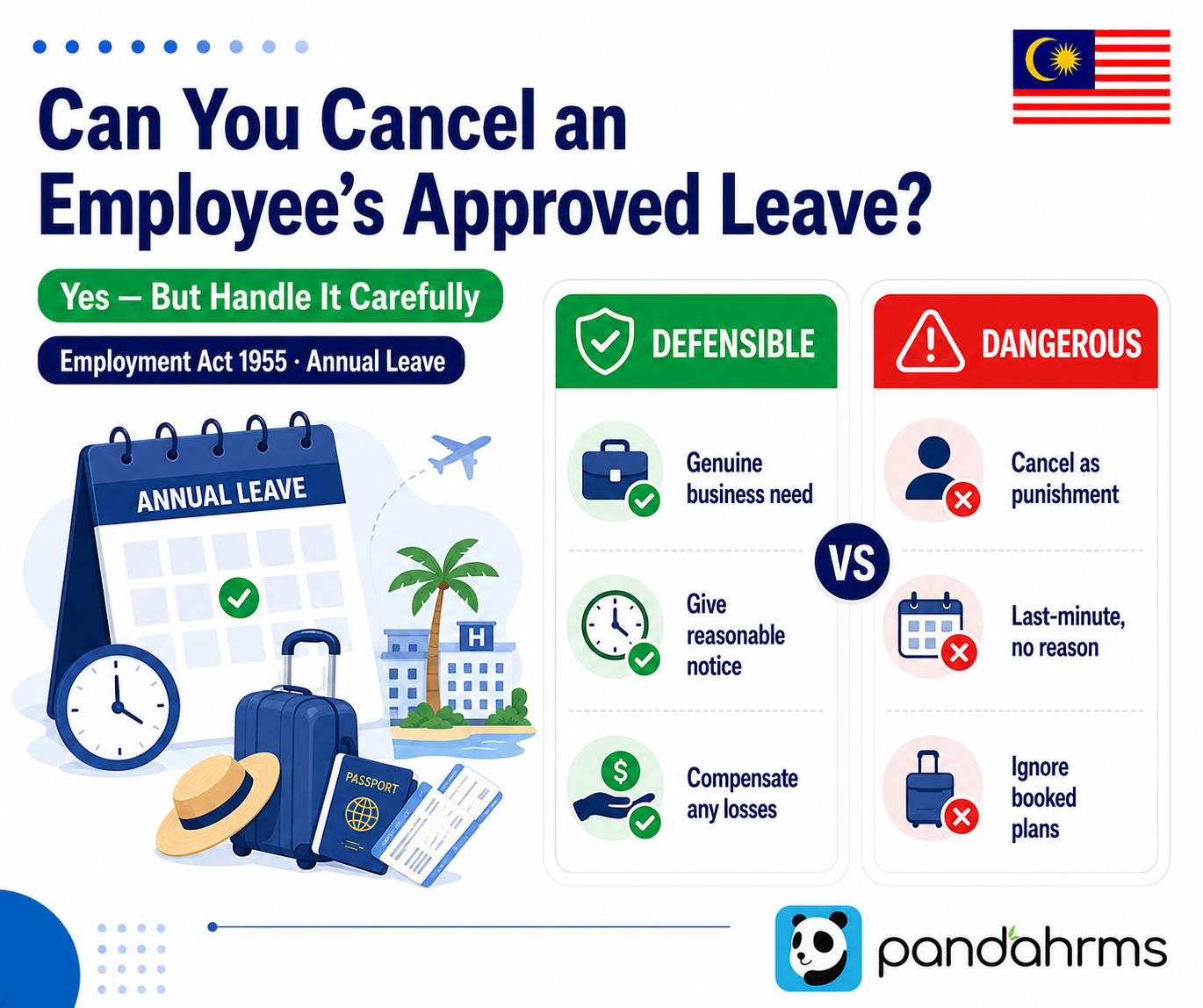
When Cancelling Approved Leave Is Defensible
There are situations where cancellation is a genuine business necessity:
✔ A real emergency — system outage, safety incident, regulatory deadline moved onto you.
✔ Sudden critical staff shortage — several resignations or medical emergencies at once.
✔ A business-continuity threat where this specific person’s presence is genuinely required — not merely convenient.
Notice what is not on the list: routine busy periods, poor manpower planning, or a manager who simply prefers full attendance. Those are reasons to reject a request early — not to cancel what you already approved.
When It Becomes Dangerous
Cancelling approved leave becomes a legal and retention problem when it is:
❌ Frequent. If “approved” leave keeps getting pulled back, approval means nothing — and employees act accordingly. Your best people quietly start interviewing.
❌ Targeted. Always the same employee, or applied inconsistently between staff. Inconsistency is what turns a management decision into a grievance.
❌ Uncompensated. The employee paid for flights on the strength of your approval. Pulling the approval and letting them absorb the loss is the fastest way to convert a scheduling issue into a formal dispute.
❌ Part of a pattern of pressure. Repeated arbitrary cancellations, combined with other unfair treatment, can support a constructive dismissal claim — the argument that the employer’s conduct destroyed the employment relationship. We explain how those claims arise in our guide to constructive dismissal in Malaysia.
The Right Way to Cancel Approved Leave
If a genuine emergency forces your hand, this is the process that protects both sides:
1. Talk first, instruct second. Explain the situation and ask — many employees will reschedule voluntarily when treated with respect. A mutual reschedule is not a cancellation at all.
2. Cover the employee’s sunk costs. Non-refundable flights, hotel deposits, cancellation fees — if the company takes back the approval, the company absorbs the cost. Put this in writing.
3. Restore every day. Cancelled leave goes straight back into the balance, and the employee picks the replacement dates with priority.
4. Document everything. The reason, the conversation, the compensation, the restored days. If it was a real emergency, the paper trail proves it.
5. Fix the root cause. If cancellations are happening more than rarely, the problem is manpower planning or the approval process itself — not the employees’ holiday timing.
Put It in the Policy Before You Need It
The strongest position is a leave policy that answers the question before it is asked. A good cancellation clause covers:
• Approved leave may only be rescheduled in a genuine operational emergency.
• The company reimburses documented, non-refundable costs caused by the change.
• Cancelled days return to the employee’s balance in full.
• The decision requires sign-off above the approving manager.
That last point matters: requiring a second signature is the simplest way to stop casual cancellations while keeping the emergency route open.
How Pandahrms Helps
Most leave disputes are really record-keeping disputes. Pandahrms Leave keeps the whole trail in one place:
• Every application, approval and change is time-stamped — who approved, who changed, when and why.
• Cancelled days flow straight back into the employee’s balance automatically — no spreadsheet corrections.
• Team calendars show clashes before approval, so leave is approved right the first time — the real fix for most cancellations.
• Staff apply and track their own leave in the mobile app, so balances are never a mystery.
Conclusion
Can you cancel approved annual leave in Malaysia? The Employment Act does not stop you — but it does not protect you either. The protection comes from a clear contract clause, a fair process, compensation for the employee’s reliance on your approval, and cancellation being a rare exception rather than a habit.
Approve carefully, cancel rarely, document always.
Can an employer legally cancel annual leave that was already approved in Malaysia?
The Employment Act 1955 neither permits nor prohibits it. The employer’s right depends on the employment contract and leave policy, and any cancellation should be for a genuine operational emergency, handled fairly and documented.
Must the employer pay for the employee’s cancelled travel bookings?
No law forces it, but reimbursing documented non-refundable costs is the widely accepted fair practice — the employee spent that money relying on the employer’s approval. Refusing to do so is how scheduling issues become formal disputes.
Do the cancelled leave days expire?
No. The days were never taken, so they remain in the employee’s balance. Under Section 60E the statutory entitlement stands, and the employee should be given priority in choosing replacement dates.
Can an employee refuse to come back from leave that was cancelled?
If the contract reserves the employer’s right to recall and the instruction is lawful and reasonable, refusal could be treated as a disciplinary matter — but employers should weigh this carefully. Forcing the issue over a defensible refusal (for example, the employee is overseas) creates far bigger problems than it solves.
Is repeatedly cancelling leave a constructive dismissal risk?
It can contribute to one. Repeated, arbitrary cancellations — especially targeted at one employee or done without compensation — can form part of a pattern of conduct that supports a constructive dismissal claim.