A new hire’s probation period quietly ends — and nobody does anything. No confirmation letter, no extension, no conversation. It feels harmless, but drifting past probation without a decision creates real risk in Malaysia: you may assume you can still let the employee go easily (you usually can’t), your own conduct can quietly “confirm” them, and probation can’t simply run on forever. This guide explains what a confirmation letter is, what the procedure after probation really is, and how to avoid the common — and costly — mistakes (with a free template).
What Is a Confirmation Letter?
A confirmation letter is the document an employer issues to confirm that an employee has successfully completed their probation period and is now a permanent (confirmed) employee. It marks the move from “trial” to “permanent” status, and usually records the confirmation date and any change in terms — a salary adjustment, new benefits, or a revised notice period.
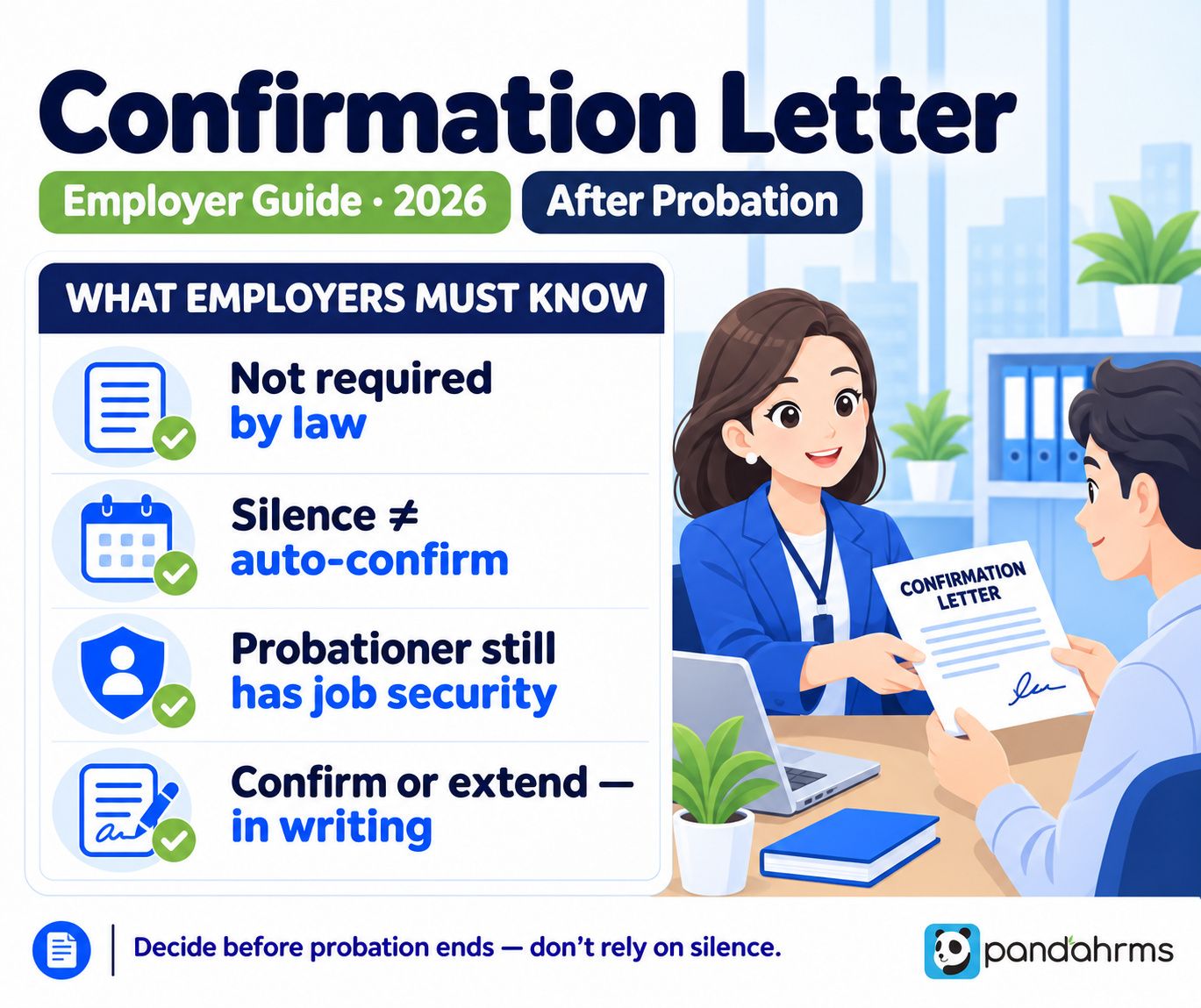
It is good practice, but note: the Employment Act 1955 does not require a confirmation letter, nor does it set a maximum probation length. Probation and confirmation are matters of contract and industrial-relations practice — which is exactly why how you handle the end of probation matters so much.
Is Confirmation Automatic When Probation Ends?
This is where employers get it wrong — in both directions. As a general rule, silence does not automatically confirm a probationer: if you say nothing, the employee usually just continues as a probationer, with the probation treated as running on. So doing nothing doesn’t “confirm” someone the moment the period lapses.
But silence is still risky, for two reasons:
- Your conduct can confirm them. If you start treating the employee as a confirmed staff member — for example, granting a benefit the contract reserves for confirmed employees — a court can hold they were “deemed confirmed” by that conduct, even without a confirmation letter.
- Probation can’t run on forever. An indefinitely extended or unreasonably long probation can itself be challenged.
The takeaway: don’t leave it ambiguous. Decide and act before the probation period ends — confirm, extend in writing, or address the performance issue. Relying on silence helps no one.
A Probationer Is Not an “At-Will” Employee
The other common misconception is that a probationer can be let go freely. They cannot. A probationer has the same security of tenure as a confirmed employee — they cannot be dismissed without just cause or excuse, and an unfairly dismissed probationer can bring the same Section 20 claim to the Industrial Court. “Still on probation” is not a licence to terminate without a valid reason and fair process. (For the full picture, see our probation guide.)
The Procedure After Probation Ends: Your Three Options
As probation approaches its end, review the employee’s performance and choose — and document — one of three clear outcomes:
- Confirm — the employee met expectations. Issue a confirmation letter.
- Extend — performance is borderline and you need more time. Extend the probation in writing before it expires, stating the new end date and what needs to improve.
- Do not confirm / terminate — if the employee has genuinely not met the standard, you may decline to confirm, but you still need a valid reason and fair process, including giving the employee a chance to improve and to be heard.
The one option that doesn’t exist is “ignore it.” Silence defaults to confirmation.
Extending Probation — Do It Right
Extension is allowed, but with limits:
- It must be done before the original probation period ends — you cannot extend a probation that has already lapsed.
- It should be in writing, with a clear new end date and the specific areas to improve.
- It cannot be indefinite or repeated endlessly — a never-ending probation can itself be challenged.
What a Confirmation Letter Should Contain
- Employee’s name and position.
- A clear statement that probation is successfully completed and the employee is confirmed.
- The confirmation effective date.
- Any changes to terms on confirmation — salary, benefits, notice period.
- A note that all other terms of the employment contract continue unchanged.
- Signature of the authorised person and a space for the employee to acknowledge.
Free Confirmation Letter Template
Adapt the following to your letterhead:
|
[Company Letterhead]
[Date]
[Employee Name]
[Designation]
RE: CONFIRMATION OF EMPLOYMENT Dear [Name], We are pleased to inform you that, following the successful completion of your probation period, you are hereby confirmed in your position as [Designation] with effect from [Confirmation Date]. With effect from the confirmation date, your [monthly salary will be revised to RM[amount] / terms remain as per your employment contract], and your notice period will be [X]. All other terms and conditions of your employment contract remain unchanged. We thank you for your contribution and look forward to your continued commitment. Yours sincerely, ____________________[Name & Designation] Acknowledged by: ____________________ Date: __________ |
How Pandahrms Helps
The confirmation trap is really a tracking problem. Pandahrms flags each employee’s probation end date before it arrives, so HR gets a reminder to confirm, extend or act — never miss the window and never accidentally “deem confirm” someone. It stores the confirmation and extension letters in the employee’s record alongside their contract, so the paper trail is complete. See also our guide to the offer letter & employment contract.
Frequently Asked Questions (FAQ)
- Is a confirmation letter required by law in Malaysia?
No. The Employment Act 1955 does not require a confirmation letter or set a maximum probation period. It is good practice because it records the employee’s change to permanent status and any new terms clearly. - If I don’t issue a confirmation letter, is the employee still on probation?
Generally they remain a probationer — silence alone does not automatically confirm them. But your conduct can: if you treat them as a confirmed staff member (for example, giving a confirmed-only benefit), a court may find them “deemed confirmed,” and probation cannot drag on indefinitely. Don’t rely on silence — to keep someone on probation longer, extend it in writing before it ends. - Can I dismiss a probationer freely?
No. A probationer has the same security of tenure as a confirmed employee and cannot be dismissed without just cause or excuse. An unfairly dismissed probationer can file a Section 20 claim. - Can I extend an employee’s probation?
Yes, but it must be done in writing before the original period expires, with a clear new end date and areas to improve. Probation cannot be extended indefinitely. - What should the confirmation letter include?
The employee’s name and position, a clear confirmation statement, the effective date, any changes to terms (salary, benefits, notice), a note that other terms continue, and signatures.
Source: Employment Act 1955 and the Industrial Relations Act 1967 (Section 20 on dismissal), together with established appellate and Industrial Court principles — including the Court of Appeal’s ruling that a probationer has security of tenure and cannot be dismissed without just cause or excuse, and case law that an employer’s conduct (such as granting confirmed-only benefits) can amount to a “deemed confirmation.” The Employment Act sets no fixed probation length and does not prescribe a confirmation procedure; probation and confirmation are governed by the employment contract and industrial-relations practice. This article is general information, not legal advice — confirm your specific situation with the Labour Department, the Industrial Relations Department, or an employment lawyer.