“We Provide Medical Benefits” Can Mean Almost Anything
Ask ten Malaysian employers whether they provide medical benefits and all ten will say yes.
Ask what that actually covers and the answers scatter.
One means paid sick leave. One means a panel clinic. One means RM600 a year of outpatient claims. One means a full group hospitalisation policy. One means “we pay if something serious happens” — which is not a benefit, it is a hope.
That vagueness is fine in conversation. It is expensive in an offer letter.
Because some of what you provide is required by law and you cannot withdraw it. The rest is a promise you chose to make, and once you write it down, you fund it every year.
Here is exactly where the line sits in 2026.
What the Employment Act 1955 Actually Requires
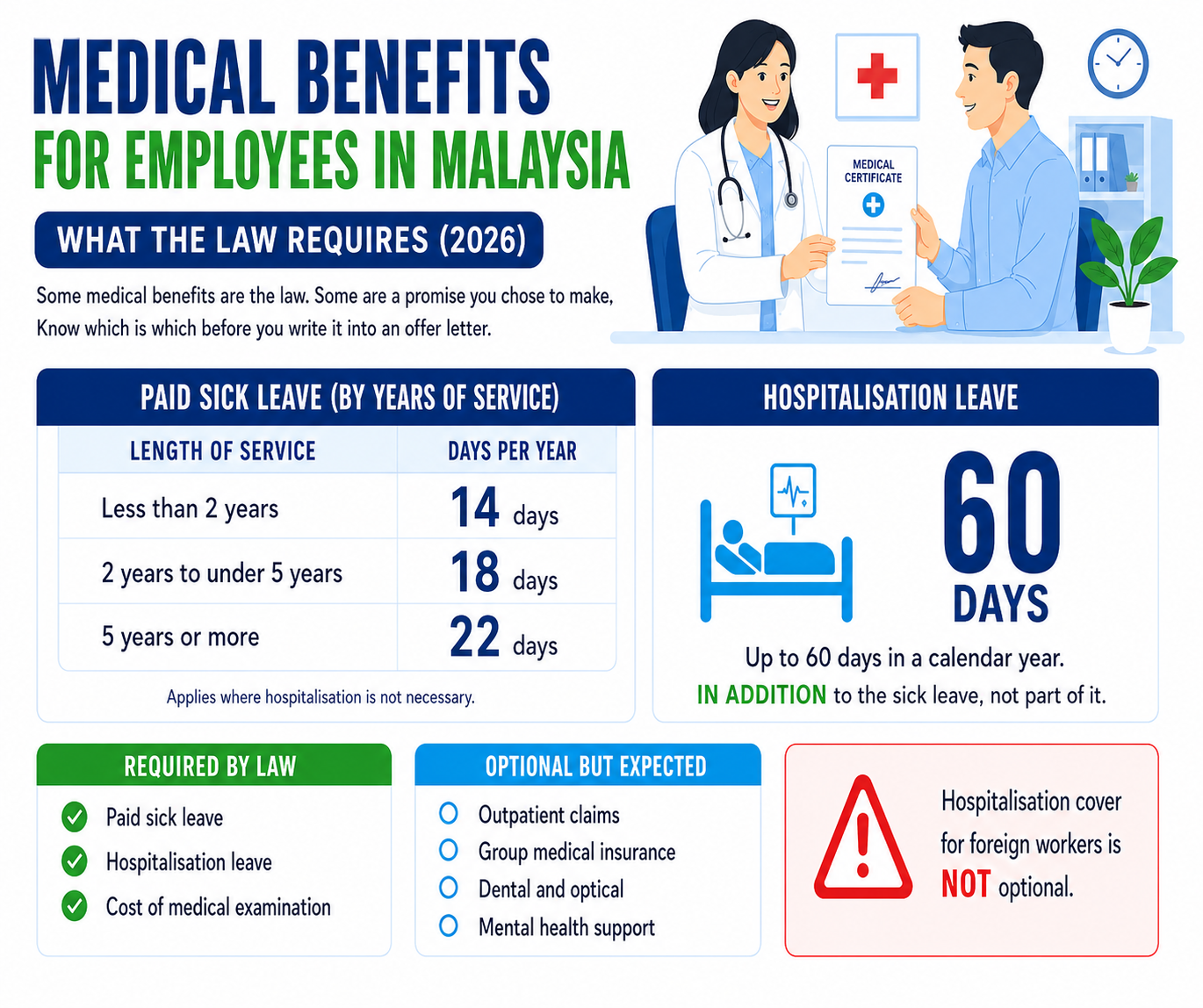
Two things are compulsory, and both live in Section 60F of the Employment Act 1955: paid sick leave, and paid hospitalisation leave.
Since the Employment (Amendment) Act 2022 took effect on 1 January 2023, these apply to all employees regardless of salary. The old wage ceiling is gone.
Paid sick leave, where hospitalisation is not necessary
| Length of service | Paid sick leave per calendar year |
|---|---|
| Less than 2 years | 14 days |
| 2 years or more, but less than 5 years | 18 days |
| 5 years or more | 22 days |
The leave must be certified by a registered medical practitioner, medical officer or dental surgeon.
Paid hospitalisation leave
Where hospitalisation is necessary, an employee is entitled to up to 60 days in a calendar year.
The Number Almost Every Employer Still Gets Wrong
This one matters, so read it twice.
Before the 2022 amendment, the 60 days of hospitalisation leave included the ordinary sick leave days. An employee who had already taken 14 days of MC was working within the same 60-day pot.
That is no longer the case.
Since 1 January 2023, hospitalisation leave was separated from sick leave. The two now run independently.
An employee with five years of service can take up to 22 days of paid sick leave and up to 60 days of paid hospitalisation leave in the same calendar year.
If your HR system or your employee handbook still deducts hospitalisation days from the sick leave balance, you are underpaying entitlement — and doing it in writing.
Check that setting today. It is one of the most common leftovers from pre-2023 policies.
The Rule That Protects You: 48 Hours
Sick leave is not unconditional.
Under Section 60F(2), an employee who is absent on sick leave that is not certified by a registered medical practitioner, medical officer or dental surgeon — or who is certified but fails to inform, or attempt to inform, the employer within 48 hours of the leave starting — is deemed to be absent from work without permission and without reasonable excuse.
That is your protection against the MC that appears three days later.
But it only works if the 48-hour rule is written into your handbook, communicated to staff, and applied consistently. A rule you enforce for one person and not another is not a rule.
What Is Optional — But Expected
Everything below is not required by the Employment Act for local employees. Employers offer it to compete for staff.
- Outpatient medical claims — a yearly cap, often RM500 to RM1,500, for clinic visits and medication.
- Panel clinics — an arrangement where the employee walks in and the bill comes to you.
- Group hospitalisation and surgical insurance — cover for inpatient treatment.
- Dental and optical — usually a small separate annual limit.
- Annual health screening — common from executive level up.
- Mental health support — the fastest-growing addition to Malaysian benefit packages.
- Maternity-related extras — beyond the statutory maternity leave entitlement.
One thing that is on the employer, though: where the Act requires a medical examination by a registered medical practitioner, the employer bears that cost.
Foreign Workers: This Part Is Not Optional
Here is the section most benefit guides leave out entirely.
Foreign workers in Malaysia must be covered under the Foreign Worker Hospitalisation and Surgical Scheme, known as SKHPPA (Skim Kemasukan Hospital dan Pembedahan Pekerja Asing). It is a mandatory scheme, not a benefit you choose to give.
The essentials:
- Annual cover of RM10,000 per worker.
- Premium of roughly RM120 a year.
- Cashless admission to government hospitals on a third-class room and board basis, with provision for emergency treatment.
- Policies are issued by approved insurers and takaful operators.
On who pays: for the plantation sector and domestic workers, the employer bears the policy. In other sectors, who carries the cost is settled between the parties. Either way, the worker must be covered — that part is not negotiable.
Note also that this is separate from SOCSO. Since 2019 foreign workers have been covered under PERKESO’s Employment Injury Scheme, which deals with work-related injury. SKHPPA deals with hospitalisation and surgery generally. They are not substitutes for each other.
Reimbursement or Insurance? A Straight Comparison
| Reimbursement (claims) | Group insurance | |
|---|---|---|
| Best for | Outpatient, small and frequent | Inpatient, rare and large |
| Cost behaviour | You pay only what is used | Fixed premium, used or not |
| Worst case exposure | Capped at the annual limit | Capped by the policy, not by you |
| Admin load | Receipts, approvals, payouts | One renewal a year |
| What staff notice | Immediate and visible | Invisible until they need it |
Most Malaysian SMEs end up running both: a modest outpatient claim limit for the everyday, and a group policy for the event that would otherwise be unaffordable.
The mistake is running neither and improvising each time — because improvising sets a precedent you will be held to by the next employee who asks.
Writing a Medical Benefit Policy That You Can Actually Fund
Four rules that save arguments later.
1. Separate the statutory from the discretionary, in writing
Your handbook should say plainly which items are the Employment Act entitlement and which are company benefits. Otherwise every benefit looks like a right, and withdrawing one looks like a breach.
2. Put a number on everything discretionary
“Medical benefits provided” is not a policy. “RM800 outpatient per calendar year, unused balance not carried forward” is.
3. Decide the dependant question before someone asks
Spouse and children included, or employee only? This is the single most common gap found when an employee submits a claim for their child.
4. Track sick leave and hospitalisation leave as two separate balances
Since 2023 they are two entitlements, not one. If your records merge them, your figures are wrong.
How Pandahrms Helps
Medical benefits fail on record-keeping far more often than on generosity.
With Pandahrms:
- Leave management tracks sick leave and hospitalisation leave as separate entitlements, with the correct 14, 18 or 22 day band applied by length of service.
- Claims lets staff submit a medical claim with the receipt attached from their phone, routes it for approval, and keeps the record — so the annual limit is a live figure, not a year-end surprise.
- Employee self-service on the mobile app for iOS and Android shows each person their remaining leave and remaining claim balance, which removes most of the questions your HR team is answering by WhatsApp.
- Payroll keeps the paid leave and reimbursed claims tied to the right month, so your cost per employee is a report rather than a guess.
You can read more about the leave module and the claims module.
Conclusion
Medical benefits in Malaysia are three separate things wearing one name.
There is what the Employment Act 1955 requires — paid sick leave of 14, 18 or 22 days, and up to 60 days of hospitalisation leave, now running independently of each other.
There is what is mandatory for foreign workers under SKHPPA, which is not a perk at all.
And there is everything else — outpatient claims, insurance, dental, screening — which is entirely your decision until the moment you write it into an offer letter.
Know which is which before you sign the letter. It is much harder to take a benefit back than to describe it accurately the first time.
Frequently Asked Questions (FAQ)
1. Are employers in Malaysia required to provide medical insurance?
For local employees, no. Group medical or hospitalisation insurance is optional. What is required under the Employment Act 1955 is paid sick leave and paid hospitalisation leave. For foreign workers, hospitalisation and surgical cover under SKHPPA is mandatory.
2. How many days of paid sick leave is an employee entitled to?
Where hospitalisation is not necessary: 14 days a year for less than 2 years of service, 18 days for 2 to under 5 years, and 22 days for 5 years or more.
3. Is hospitalisation leave part of the sick leave entitlement?
Not since 1 January 2023. The Employment (Amendment) Act 2022 separated them. Up to 60 days of hospitalisation leave a year is an entitlement in addition to the 14, 18 or 22 days of sick leave.
4. What happens if an employee does not inform the employer about their MC?
Under Section 60F(2), an employee whose sick leave is not certified by a registered medical practitioner, medical officer or dental surgeon, or who does not inform or attempt to inform the employer within 48 hours of the leave starting, is deemed absent from work without permission and without reasonable excuse.
5. What is SKHPPA and who pays for it?
SKHPPA is the mandatory Foreign Worker Hospitalisation and Surgical Scheme, providing RM10,000 of annual cover for around RM120 a year. For the plantation sector and domestic workers the employer bears the policy; in other sectors the parties decide who carries the cost. The worker must be covered either way.
6. Must employers pay for a medical examination?
Where the Employment Act requires an employee to be examined by a registered medical practitioner, the cost of that examination is borne by the employer.