It happens more often than employers expect: an employee goes on maternity leave and, somewhere in those 98 days, decides not to return. Can she resign while she’s still on maternity leave? Does she keep her maternity allowance? Does she still have to serve notice? And — just as important — what an employer must not do. This guide walks through resigning during maternity leave in Malaysia from the employer’s side, so you handle it correctly and fairly.
The Starting Point: Maternity Leave & Allowance
Under Section 37 of the Employment Act 1955, a female employee is entitled to 98 consecutive days of maternity leave for each confinement (in force since 1 January 2023 for Peninsular Malaysia and Labuan). She is entitled to a paid maternity allowance during that leave if she meets the eligibility conditions — broadly, that she was employed for at least 90 days in the nine months before her confinement and employed at some point in the four months before it. The allowance is paid by the employer (not SOCSO), provided she has fewer than five surviving children at the time of confinement — a woman with five or more surviving children still gets the 98 days’ leave, but not the paid allowance. (For the detail, see our guide to leave entitlements.)
Can She Resign During Maternity Leave?
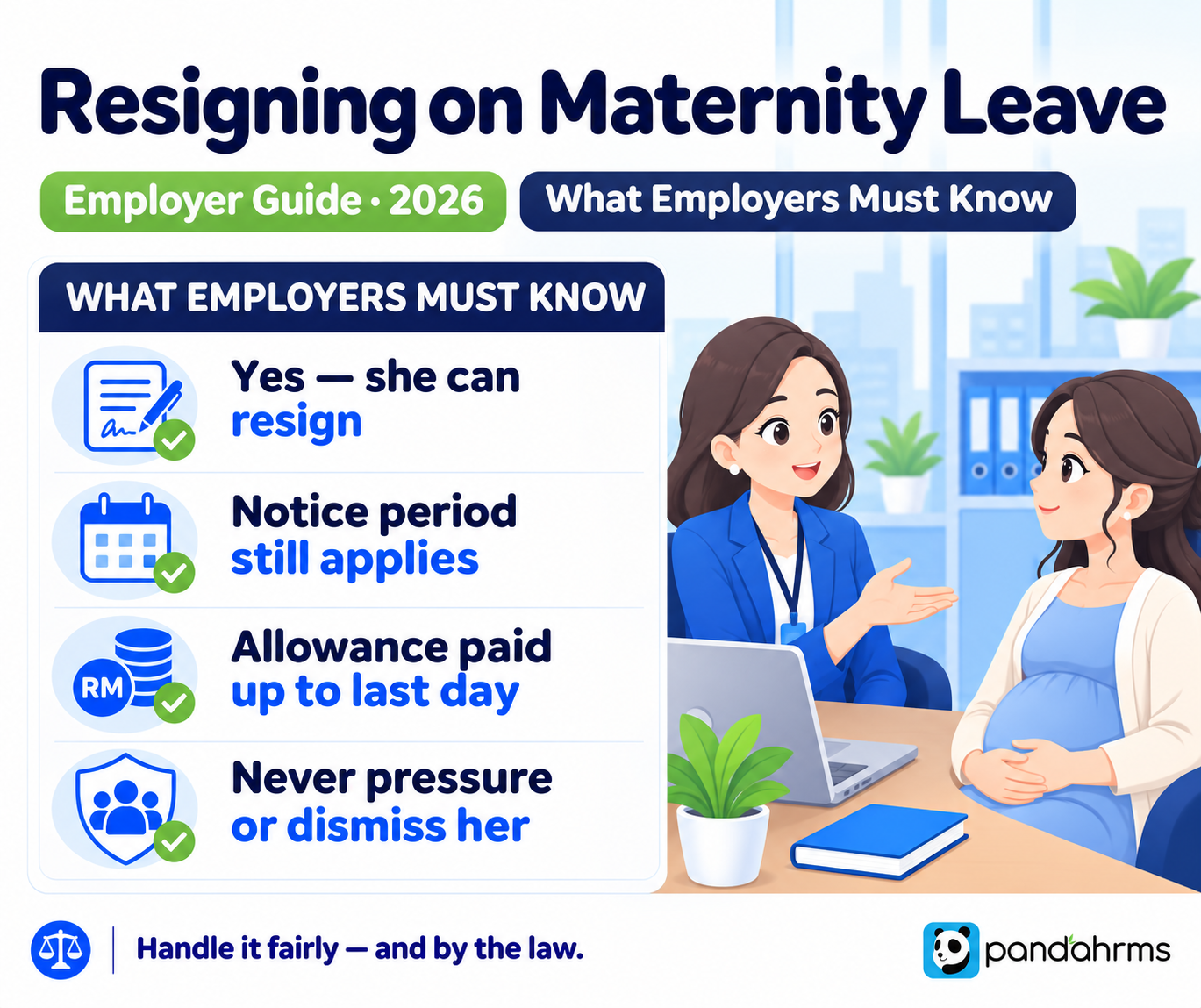
Yes. Maternity leave does not freeze the employment contract or take away the employee’s right to resign. A woman on maternity leave can hand in her resignation just like any other employee — the decision is hers, and you cannot refuse to “accept” a valid resignation.
What does still apply is the notice period in her contract. She must give the contractual notice (or pay the employer an indemnity in lieu of notice), and that notice can run during her maternity leave — the leave and the notice period overlap; the leave doesn’t pause the clock. In practice, many employees time the resignation so the notice runs out around the end of their leave.
What Happens to the Maternity Allowance?
This is the part to handle carefully, because the law here is not fully settled:
- For the period she remains employed (including a notice period running through the leave), her maternity allowance clearly continues and must be paid.
- For the part of the leave after her employment ends, there are two views. One treats the allowance as flowing from being an employee, so it stops on her last day. The other — argued by employment lawyers — is that once maternity leave has started, the right to the allowance is already “vested”, so the full allowance remains payable even though she resigns.
Given that uncertainty, the safe employer position is clear: do not use the resignation as a reason to withhold the maternity allowance. Pay what is plainly owed, and take advice before stopping any part of it — withholding an allowance she may be entitled to risks an unlawful-deduction or unfair-treatment claim. (Related: post-maternity leave allowance.)
What Employers Must NOT Do
Two hard rules protect a pregnant employee or new mother:
- Do not dismiss her during her maternity leave. Terminating a female employee during her maternity leave is an offence under the Employment Act — the clearest exception is a genuine closure of the business. Even where there is a separate reason such as serious misconduct, the employer carries a heavy burden to prove the dismissal had nothing to do with the pregnancy or confinement. Pushing someone out around maternity is exactly the kind of case that ends up at the Industrial Court.
- Do not pressure her to resign. If an employee feels forced out — benefits cut, role stripped, treated differently after announcing a pregnancy — a “resignation” can be argued to be a constructive dismissal, which carries the same legal risk as an unfair dismissal.
A genuine, voluntary resignation is fine. A resignation that you engineered is not.
How to Handle It Properly
- Accept the resignation in writing and confirm the last working day and how the notice period is treated.
- Calculate the maternity allowance due up to her last day, alongside any other final pay — unused annual leave, outstanding salary.
- Keep it respectful and documented. Don’t treat a resigning new mother any differently from any other leaver.
- File the usual exit paperwork (tax, EPF/SOCSO cessation) as for any resignation.
How Pandahrms Helps
Maternity, notice periods and final pay overlapping at once is exactly where payroll errors creep in. Pandahrms tracks the maternity leave, the notice period and the allowance together, works out the correct final settlement up to the last working day, and keeps the documentation clean — so a sensitive exit is handled accurately instead of guessed at. See our employee handbook guide for setting clear leave and resignation policies up front.
Frequently Asked Questions (FAQ)
- Can an employee resign while on maternity leave in Malaysia?
Yes. Maternity leave doesn’t remove the right to resign. She must still give the contractual notice (or pay in lieu), and that notice can run during the maternity leave. - Does she keep her maternity allowance if she resigns?
The allowance for the period she remains employed (including a notice period running through the leave) is clearly payable. Whether it continues after her employment ends is unsettled — one view is that it stops, another is that once maternity leave has started the allowance is “vested” and remains payable in full. The safe employer position is not to withhold it because of the resignation; pay what is owed and take advice before stopping any part. - Does she still have to serve notice?
Yes. The resignation notice period in her contract applies as normal, or she pays an indemnity in lieu of notice. The maternity leave does not pause the notice period. - Can I dismiss an employee who is on maternity leave?
Terminating her during her maternity leave is an offence under the Employment Act; the clearest exception is a genuine closure of the business. Even for a separate reason such as serious misconduct, you must be able to prove the dismissal had nothing to do with the pregnancy — otherwise it is prohibited and exposes you to prosecution and an unfair dismissal claim. - What if she felt pressured to resign?
If an employee is pushed out around pregnancy or maternity — through cut benefits, demotion or different treatment — the resignation can be argued to be a constructive dismissal, carrying the same risk as an unfair dismissal. Keep any resignation genuinely voluntary.
Source: Employment Act 1955, Section 37 (98 days’ maternity leave in force from 1 January 2023; maternity allowance eligibility — employed at least 90 days in the nine months and at any time in the four months before confinement, and fewer than five surviving children; employer-paid; and the protection making it an offence to terminate during maternity leave, subject to a business-closure exception) and Sections 12–13 (notice of termination and indemnity in lieu), together with Industrial Relations Act 1967 principles on unfair and constructive dismissal. The Act applies to Peninsular Malaysia and Labuan, with separate ordinances in Sabah and Sarawak. Whether the maternity allowance continues after a resignation is not fully settled in law. This article is general information, not legal advice — confirm specific cases with the Labour Department or an employment lawyer.