She Resigned With Nine Days of Leave Left. What Do You Owe Her?
It is the last week of the month. A staff member of three years hands in her resignation, works her notice, and on her final day someone in accounts asks the question nobody prepared for:
“She still has nine days of annual leave. Do we have to pay that out?”
Yes. On exit, it is the law — not a goodwill gesture, not a negotiation, and not something an employee has to ask for nicely.
The harder question is the second one: how much. Get the divisor wrong and every final payslip you have ever issued is wrong by the same margin.
What Leave Encashment Means
Leave encashment is paying an employee cash for annual leave they were entitled to but did not take.
It comes up in two very different situations, and they are not governed the same way:
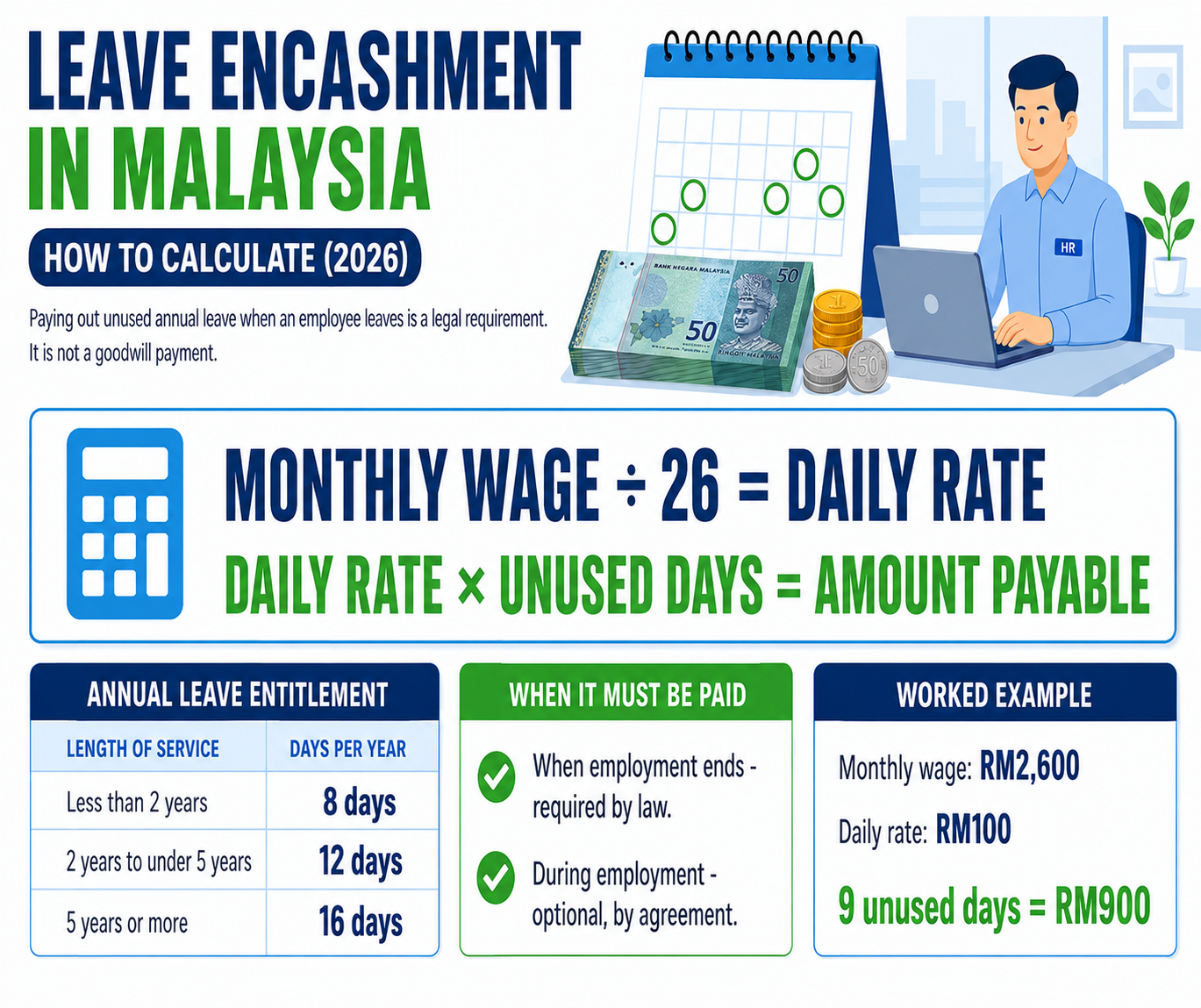
- When employment ends — resignation, termination, contract expiry. Payment is required.
- During employment — an employee asks to sell back leave instead of taking it. This is optional, by agreement between employer and employee, and entirely a matter of company policy.
Most disputes come from employers treating the first case like the second.
Who Is Entitled to Annual Leave
Under Section 60E(1) of the Employment Act 1955, paid annual leave is set by length of service:
| Length of service | Paid annual leave per year |
|---|---|
| Less than 2 years | 8 days |
| 2 years to under 5 years | 12 days |
| 5 years or more | 16 days |
These are minimums. You may give more, and many employers do.
If an employee has not completed twelve months of continuous service, the entitlement is in direct proportion to the completed months of service. So a joiner who leaves after seven months does not get zero — they get seven-twelfths of the annual entitlement, and any of that they did not use still has to be paid.
The Formula
Payment for untaken annual leave is made at the employee’s ordinary rate of pay. For a monthly-rated employee, Section 60I defines that as:
Ordinary rate of pay = Monthly wages ÷ 26
Leave encashment = Ordinary rate of pay × Number of unused days
The 26 is fixed. It does not change with the length of the month and it is not the number of working days in that month.
Example 1 — Two years of service
Monthly wage RM2,600. Entitlement 12 days. Six days untaken at resignation.
- Daily rate: RM2,600 ÷ 26 = RM100.00
- Encashment: RM100.00 × 6 = RM600.00
Example 2 — Six years of service
Monthly wage RM4,500. Entitlement 16 days. Nine days untaken.
- Daily rate: RM4,500 ÷ 26 = RM173.0769…
- Encashment: RM4,500 ÷ 26 × 9 = RM1,557.69
Note what happens if you round first: RM173.08 × 9 gives RM1,557.72, three sen higher. Neither is dishonest, but they are different numbers. Decide whether you round at the daily rate or only at the final figure, write it down, and apply it to everyone.
Example 3 — A part-year joiner
Monthly wage RM3,120. Joined 1 February, resigns after completing 7 months. First-year entitlement 8 days, pro-rated.
- Pro-rated entitlement: 8 × 7 ÷ 12 = 4.6667 days
- Daily rate: RM3,120 ÷ 26 = RM120.00
- If none was taken: RM120.00 × 4.6667 = RM560.00
Round in the employee’s favour and state the rounding rule in your handbook, so the same answer comes out no matter who runs the payroll.
The ÷26 Trap: Do Not Use It for a Part-Month Salary
This is the mistake we see most often, and it runs in both directions.
There are two different divisors in the Employment Act, and each has its own job:
| Divisor | What it is for |
|---|---|
| ÷ 26 — ordinary rate of pay, Section 60I | Daily-rate computations: annual leave, leave encashment, sick leave, overtime, public holiday pay |
| ÷ calendar days in the month — Section 18A | Wages for an incomplete month: a joiner, a leaver, or unpaid leave |
So on a leaver’s final payslip you will often use both: Section 18A for the part-month salary, and ÷26 for the leave payout. They are not interchangeable.
We cover the part-month side in full here: How to Calculate Salary for Incomplete Months in Malaysia: The Section 18A Formula.
Is Leave Encashment Subject to EPF, SOCSO and EIS?
This is the question that decides whether your final payslip is actually correct, and the answer is not the same for all three.
| Contribution | Applies to leave encashment? |
|---|---|
| EPF | Yes. Payment for unutilised annual leave is treated as wages for EPF purposes |
| SOCSO | No. Annual leave encashment is excluded from the SOCSO wage computation |
| EIS | No. EIS follows the same wage definition as SOCSO |
That split catches people out, because the intuition is that all three move together. They do not.
For context, items such as gratuity, retirement and termination benefits, payment in lieu of notice, and travelling allowances sit outside the EPF wage definition — but leave encashment is not one of them.
Where a leave payout forms part of a wider termination or retirement package, the treatment can be less obvious. If you are in that situation, confirm the position with KWSP and PERKESO for that specific payment rather than assuming.
Carry Forward or Encash?
Under Section 60E(2), annual leave should be taken within twelve months of the end of the twelve-month period of continuous service it relates to. Leave not taken in that window may be forfeited.
That gives you three workable policies:
| Policy | What it does | Watch out for |
|---|---|---|
| Use it or lose it | Balance resets at year end | Staff dump leave in December; December coverage collapses |
| Limited carry forward | Say 5 days, expiring by a set date | Needs tracking of two balances at once |
| Encash on request | Employee sells back unused days | A growing cash liability if left uncapped |
Whichever you pick, write it down. A carry-forward rule that lives in one person’s head is not a rule, and it will be argued with on the day someone leaves.
Can an Employee Clear Annual Leave During the Notice Period?
This is usually where the argument actually starts.
In practice it is a question of agreement. Some employers allow the notice period to be offset with annual leave; others require notice to be worked and pay the leave out instead. Both approaches are used in Malaysia.
What matters is that your position is stated in the contract or handbook before the resignation lands, and applied the same way to everyone. Deciding it case by case is how one employee ends up with a better deal than another doing the same job — and how you end up explaining that at the Labour Office.
Five Mistakes That Cost Employers Money
- Using ÷30 or the working days in the month instead of ÷26. The ordinary rate of pay divisor is fixed at 26 for a monthly-rated employee.
- Forgetting the pro-rated entitlement for a part-year employee. Under twelve months of service does not mean no annual leave.
- Skipping EPF on the payout. It is EPF-liable, and unpaid contributions are a compliance problem, not a rounding issue.
- Charging SOCSO and EIS on it anyway. The opposite error, and it shorts the employee’s take-home.
- Relying on a leave balance nobody has reconciled. If your leave register and your approved leave applications disagree, the payout is wrong before you even open the calculator.
How Pandahrms Helps
Leave encashment goes wrong at the record-keeping stage far more often than at the arithmetic stage.
With Pandahrms:
- Leave management applies the correct 8, 12 or 16 day entitlement by length of service, pro-rates the first year automatically, and enforces your carry-forward rule so balances are live rather than reconstructed at year end.
- Payroll uses the ordinary rate of pay for the encashment and keeps it separate from the Section 18A part-month calculation, with EPF, SOCSO and EIS applied correctly to each.
- Employee self-service on the mobile app for iOS and Android shows each person their own balance all year, which is the single best way to stop a nine-day surprise on the last day.
More on the leave module and payroll.
Conclusion
Leave encashment is a small calculation with a large number of ways to get it wrong.
The rules that matter: pay it when employment ends because the law requires it, use monthly wages ÷ 26 for the daily rate, pro-rate the entitlement for anyone under twelve months of service, apply EPF to the payout but not SOCSO or EIS, and never confuse the ÷26 ordinary rate with the Section 18A part-month formula sitting on the very same payslip.
Get the balance right during the year and the final payslip takes care of itself.
Frequently Asked Questions (FAQ)
1. Is leave encashment compulsory in Malaysia?
When employment ends, yes — an employee must be paid for annual leave they were entitled to but did not take. During employment it is optional and by agreement.
2. How is the daily rate calculated?
For a monthly-rated employee, the ordinary rate of pay is monthly wages divided by 26. The encashment is that daily rate multiplied by the number of unused days.
3. What if the employee has not worked a full year?
The annual leave entitlement is pro-rated in direct proportion to the completed months of service, and any unused portion is still payable on exit.
4. Is leave encashment subject to EPF?
Yes. Payment for unutilised annual leave is treated as wages for EPF purposes and contributions apply.
5. Is it subject to SOCSO and EIS?
No. Annual leave encashment is excluded from the wage computation for SOCSO and EIS.
6. Can unused annual leave be carried forward instead?
Yes, if your policy allows it. Under Section 60E(2) the leave should be taken within twelve months of the end of the service year it relates to, and leave not taken in that window may be forfeited. State your carry-forward rule in writing.
7. Does the ÷26 divisor also apply to a new joiner’s first salary?
No. A part-month salary is calculated under Section 18A using the calendar days in that month. The ÷26 ordinary rate of pay is for leave, overtime and public holiday computations.