Your Best Technician Resigned on a Tuesday. Here Is Where He Went.
He had been with you for four years.
No warning. No complaint. Just a resignation letter and a two-week notice period.
When you asked why, the answer was the one every employer in Malaysia has heard by now:
“I found something with better pay.”
Here is the part that stings.
He did not need a recruiter, a headhunter, or a friend on the inside to find it. He needed a phone and about ninety seconds.
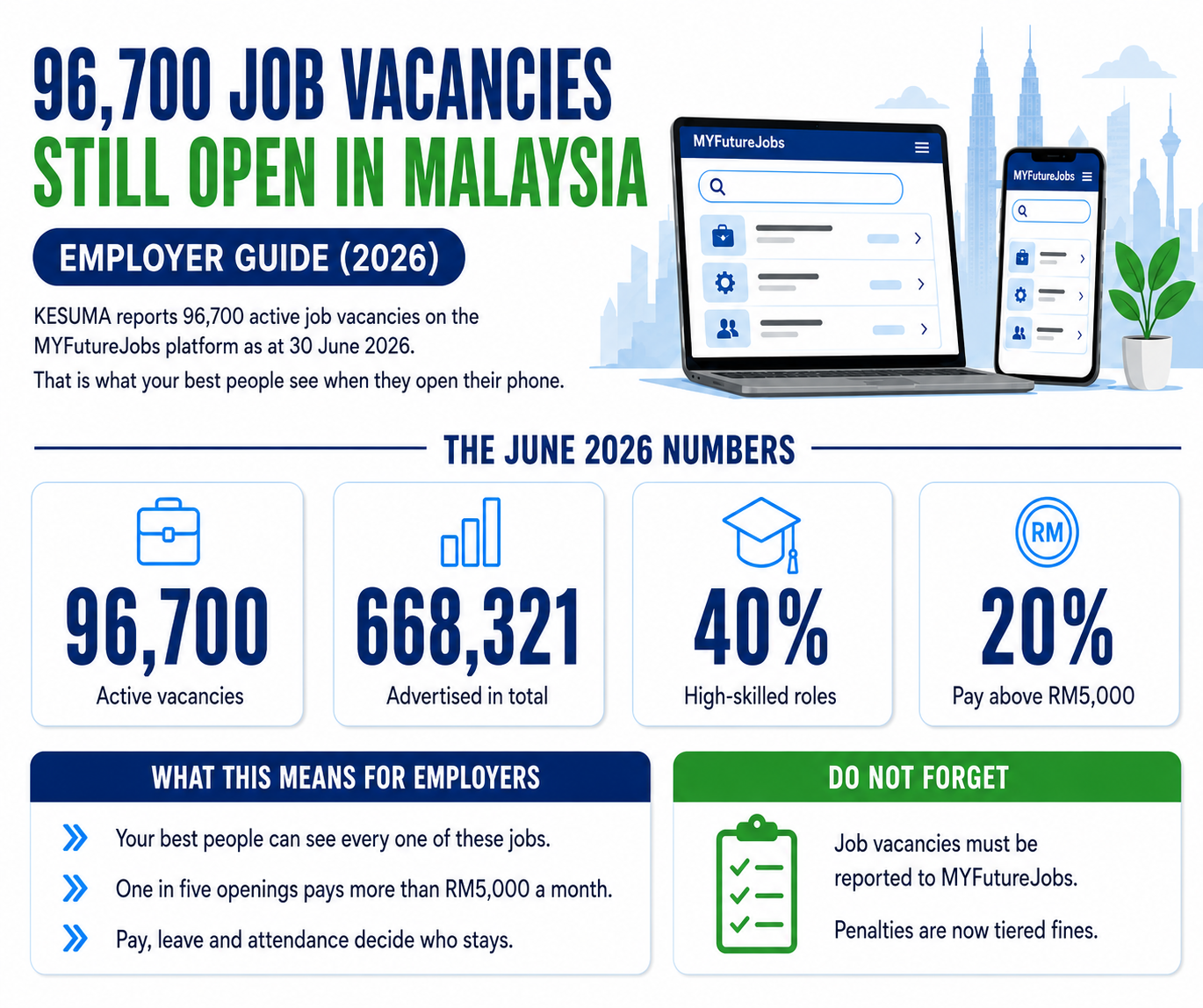
As at 30 June 2026, there were 96,700 active job vacancies still open on the MYFutureJobs platform, according to KESUMA, Malaysia’s Ministry of Human Resources.
That is not a hiring statistic. That is your competition for every person on your payroll.
What KESUMA Actually Reported
The figures were shared in late July 2026 and reported by The Star, Free Malaysia Today and theSun. MYFutureJobs is the national employment platform managed by PERKESO (SOCSO).
Here is the full picture:
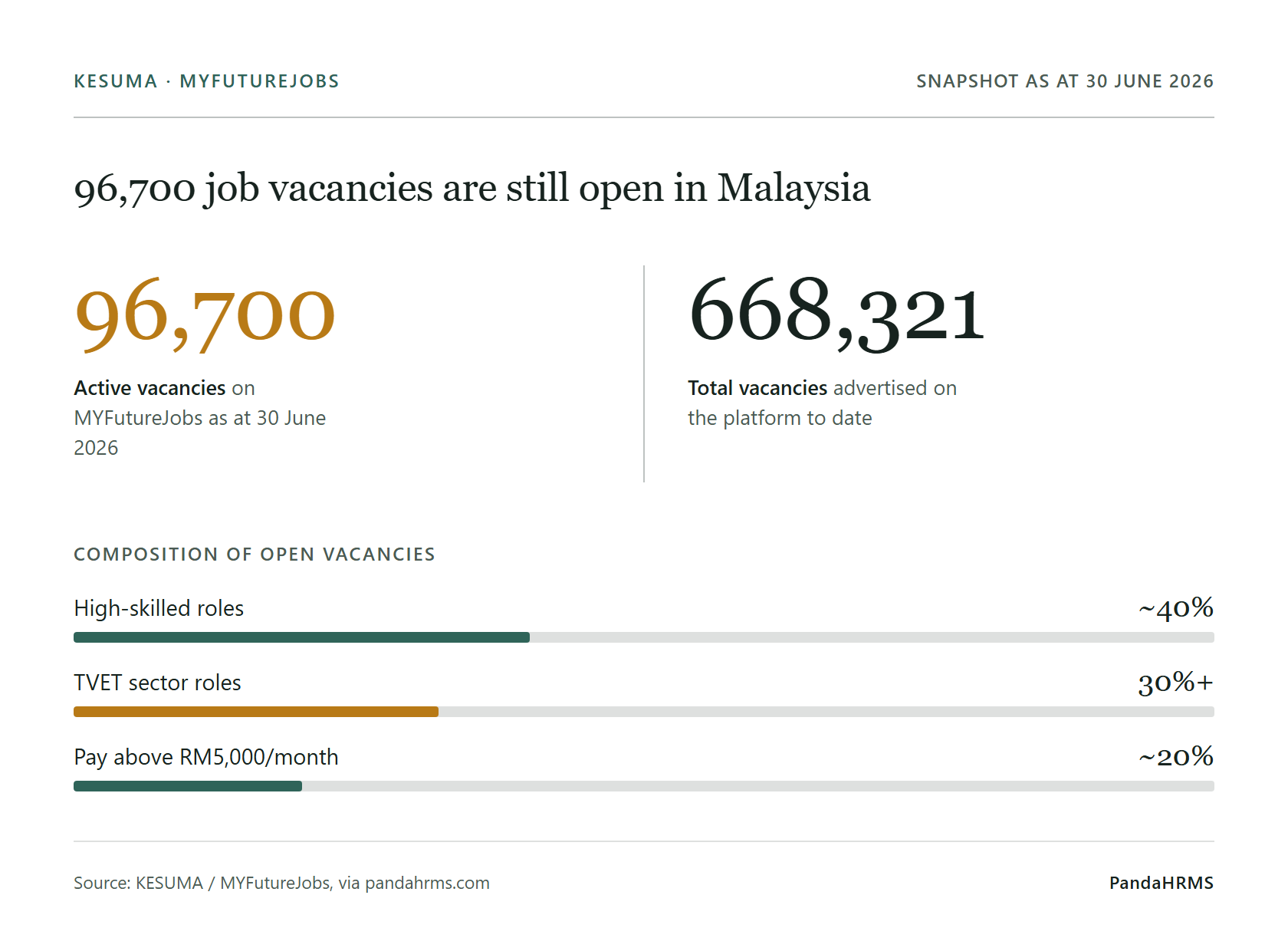
The placement activity behind those listings is just as telling. Between January and May 2026, 2,989 career programmes were organised, 86,594 job seekers took part, 14,029 secured employment, and another 15,809 were called forward to the next interview stage.
In other words, this is not a dormant listings board. People are moving.
Why “40% High-Skilled” Should Worry You More Than the Headline
Most employers read a big vacancy number and think about hiring.
Read it the other way.
If almost four in ten open positions are high-skilled, the roles being advertised are not entry-level seat-fillers. They are the supervisors, the technicians, the accounts executives and the team leads — the people who already know how your business runs.
Those are the staff who are expensive to lose and slow to replace.
And with more than 30% of the openings sitting in the TVET space, the skilled trades are being actively competed for too.
One in Five Openings Pays Above RM5,000
This is the number that quietly resets salary expectations across the market.
When almost 20% of advertised vacancies carry a salary above RM5,000 a month, your team no longer benchmarks their pay against the person sitting next to them. They benchmark it against a listing they scrolled past at lunch.
You do not have to match every offer in the market. But you do need to know where your own salary bands sit before someone else tells your staff.
That means being able to answer three questions from your own records, today:
- What does each role in my company actually cost me, all-in?
- When was each person last given an increment, and how much?
- Which of my people have not had a pay review in more than 18 months?
If those answers live in a spreadsheet that only one person maintains, you are guessing.
The Part Most Employers Forget: You Are Required to Report Your Vacancies
There is a compliance side to all of this, and it catches employers out regularly.
Under Section 45F of the Employment Insurance System Act, employers are required to notify PERKESO in writing when they have a job vacancy or a newly created position — before recruiting for it.
This is the reporting duty that feeds MYFutureJobs in the first place. The 96,700 figure exists because employers lodge their openings.
In 2026 the penalty structure for failing to report was revised. The previously proposed flat maximum fine of RM10,000 was replaced with a tiered penalty system, following feedback from employers and MSME groups.
Two things are worth being very clear about:
- The fines became more proportionate.
- The reporting requirement itself did not go away.
We covered the revised penalty structure in detail here: PERKESO Job Vacancy Reporting 2026: New Tiered Fines Replace the RM10,000 Penalty.
Three Things to Check Before You Advertise Your Next Vacancy
1. Report the vacancy first
Lodge the opening with PERKESO before you start recruiting, not after you have shortlisted someone. It is a written notification, and it is the step that turns into a penalty when skipped.
2. Know your real cost per hire before you set the salary
The advertised salary is not the cost. Add employer EPF, SOCSO, EIS, HRD levy where applicable, and any allowances you have promised. Set the band against the full figure, not the headline one.
3. Get the statutory setup done in the first week
EPF registration, SOCSO and EIS, the tax number, the signed contract, the leave entitlement and the confirmation date. Every one of these is a deadline, and every one of them is cheaper to do on day one than to fix in month three.
Our full new-hire list is here: New Employee Onboarding Compliance Checklist Malaysia 2026.
How Pandahrms Helps Employers Stay Ready
You cannot control how many jobs the market advertises. You can control how well your own house is run.
With Pandahrms, employers keep the records that make these decisions possible:
- Payroll — accurate monthly runs with EPF, SOCSO, EIS and PCB handled, so your true cost per employee is a report, not a guess.
- Employee database — one place for contracts, positions, increments and confirmation dates.
- Leave management — balances, carry-forward and approvals visible to both HR and the employee.
- Time and attendance — including GPS and geofence clock-in for staff who work away from the office.
- Claims — submitted, approved and recorded without paper.
- Employee self-service — payslips, leave and claims on the mobile app for iOS and Android, so your HR team stops answering the same five questions.
Retention is not a poster in the pantry. It is being able to see, in a few clicks, who has not had a review, who is carrying too much unused leave, and what each person actually costs you.
Conclusion
96,700 open vacancies is good news for Malaysia. It means the labour market is moving and people have options.
For employers, it means something simpler and more urgent: your staff have options too.
The employers who come out of 2026 well will not be the ones who advertised the loudest. They will be the ones whose payroll was accurate, whose leave was fair, whose statutory obligations were met on time, and whose people had no reason to go looking.
Start with your own records. The market will take care of the rest.
Frequently Asked Questions (FAQ)
1. How many job vacancies are currently open in Malaysia?
KESUMA reported 96,700 active job vacancies on the MYFutureJobs platform as at 30 June 2026. A total of 668,321 vacancies have been advertised on the platform overall.
2. What is MYFutureJobs?
MYFutureJobs is Malaysia’s national employment platform, managed by PERKESO (SOCSO). It connects job seekers with employers and supports the country’s labour market planning.
3. Are employers legally required to report job vacancies?
Yes. Under Section 45F of the Employment Insurance System Act, employers must notify PERKESO in writing of a job vacancy or a newly created position before recruiting for it.
4. Was the RM10,000 fine for not reporting vacancies removed?
The proposed flat maximum fine of RM10,000 was replaced in 2026 with a tiered penalty structure. The obligation to report vacancies was not removed.
5. What proportion of the vacancies are well-paid or high-skilled?
Almost 40% of the advertised vacancies are high-skilled roles, more than 30% sit in the TVET sector, and almost 20% offer a salary above RM5,000 a month.