The New Hire Started on Monday. Nobody Registered Him.
He signed the contract. He got a desk, a login and a name tag.
Six weeks later, someone runs the EPF submission and notices his name is not on the list. Nobody had registered him, and nobody had contributed for him.
This is not rare, and it is not usually laziness. It happens because most employers assume an EPF account appears by itself the moment somebody joins.
It does not. And the clock is shorter than people think.
Register as an Employer First — Within 7 Days
Before you register anybody else, you register yourself.
An employer must register with the EPF within 7 days from the date the employer becomes liable to contribute — that is, as soon as the first employee is employed.
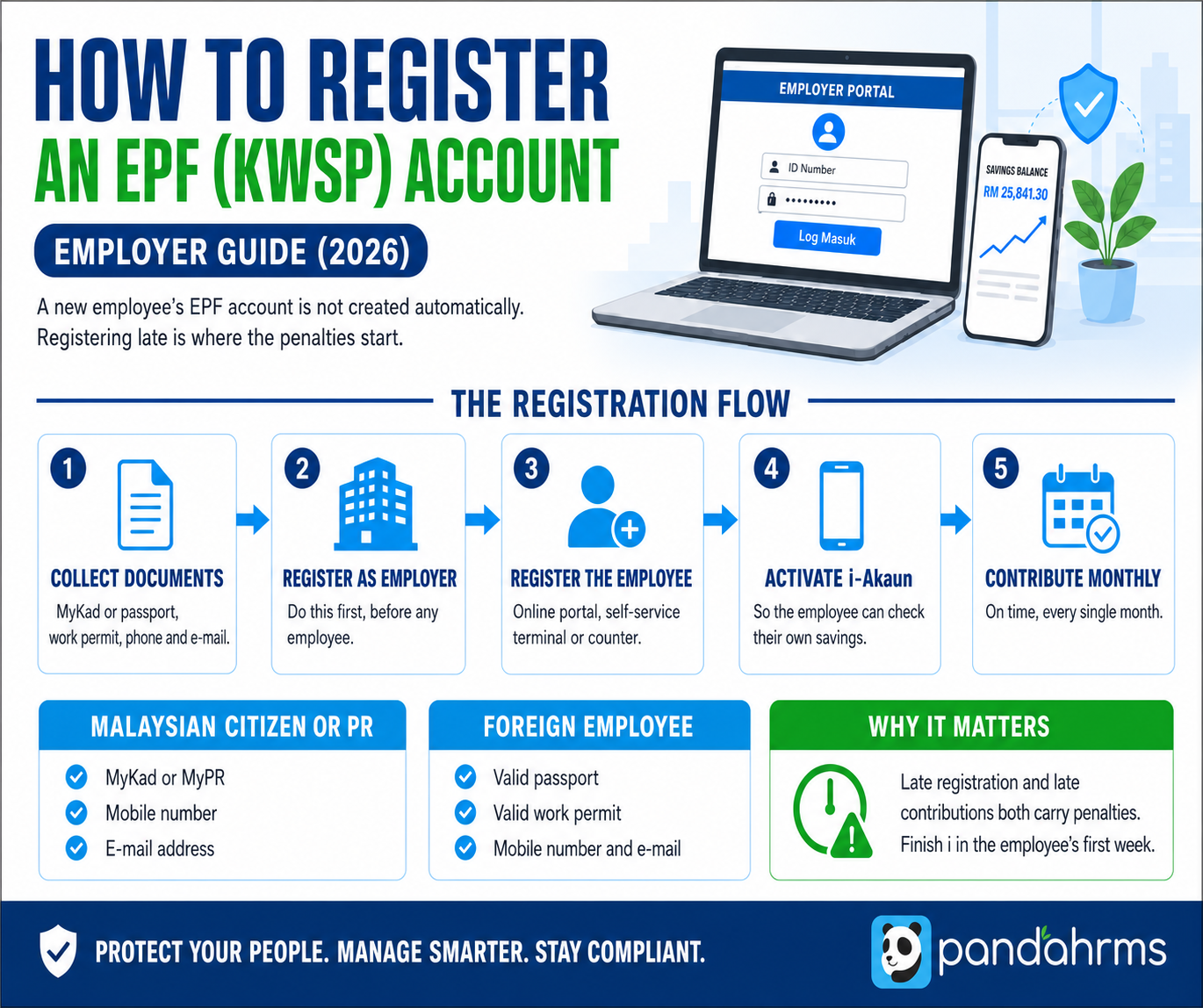
The practical sequence:
- Register the company using Form KWSP 1.
- Activate i-Akaun (Employer). The employer’s representative should do this within 30 days of registration.
- Register your employees.
- Contribute every month, on time.
If you skip step 2, you cannot do step 3 online, and you end up doing everything at a counter.
What to Collect Before You Register a New Hire
Get these on day one, in the same envelope as the signed contract:
| Malaysian citizen or PR | Foreign employee |
|---|---|
| MyKad or MyPR | Valid passport |
| Mobile number | Valid work pass or permit |
| E-mail address | Mobile number and e-mail address |
| Bank account details for salary | Bank account details for salary |
Chasing a passport copy in week six is how the six-week gap in the story above happens.
Registering a Malaysian Citizen or PR
There are a few routes, and most employers will use the first one:
- Online through i-Akaun (Employer) — once your i-Akaun is active, you can register employees directly.
- Form KWSP 3 — the member registration form, used where registration by MyKad is unsuccessful.
- Automatic registration — when an employer submits an employee’s first contribution using their identification details, EPF creates the member account after verification with the National Registration Department.
- Self-Service Terminal or an EPF counter — for cases that cannot be completed online.
Automatic registration is convenient, but do not treat it as your plan. It happens because you contributed. If the contribution is late, so is everything else.
Foreign Employees: This Changed, and It Is Now Mandatory
If your last understanding was that EPF for foreign workers is optional, that is out of date.
EPF contributions for non-Malaysian citizen employees became mandatory starting with October 2025 wages — that is, the November 2025 contribution month.
The key points for employers:
- Rate: 2% employee and 2% employer of monthly wages.
- Who it covers: legally employed non-Malaysian citizen employees holding a valid pass, such as an Employment Pass or a Visitor’s Pass (Temporary Employment).
- Who is excluded: domestic helpers.
- Registration: members holding a Visitor’s Pass (Temporary Employment) or an Employment Pass are registered automatically, without needing to attend an EPF office.
- From January 2026, non-Malaysian workers are encouraged to complete fingerprint registration at an EPF office so contributions are credited to the right member.
The rate is deliberately low at this stage, but it is not zero, and enforcement has been tightening. Two per cent of a foreign worker’s wage that you never contributed is still an arrears position with interest and penalties attached.
Because the rates and coverage for this group are still being phased, confirm the current figures on kwsp.gov.my before your next submission rather than relying on a number someone wrote down last year.
Activate i-Akaun So the Employee Can Check Their Own Savings
Registration creates the account. Activation is what lets the employee see it.
Once activated, an employee can check their own balance and confirm that your contributions actually arrived. That single fact removes a surprising amount of friction — most “did you pay my EPF?” questions are really “I have no way to check.”
Make i-Akaun activation part of your onboarding checklist, not an afterthought.
Late Registration and Late Contributions
Two separate obligations, two separate exposures.
- Late registration — you were liable from the day the employee started, regardless of when the paperwork got done.
- Late contribution — monthly contributions carry a deadline, and missing it attracts dividends and penalties on the arrears.
Neither of these is negotiated down by explaining that HR was busy. The fix is structural: register in the first week, and put the monthly contribution on a fixed date in the calendar rather than at the end of a to-do list.
Our full first-month list is here: New Employee Onboarding Compliance Checklist Malaysia 2026. For the current contribution rates, see EPF (KWSP) Contribution Rates 2026.
The First Payslip Is Where This Becomes Visible
A new hire who joins mid-month gets a part-month salary, and the statutory contributions follow the amount actually paid — which often lands them in a lower contribution band for that first month.
That is correct and expected, but it looks like an error to a new employee. Be ready to explain it.
The part-month calculation itself has its own prescribed formula: How to Calculate Salary for Incomplete Months in Malaysia: The Section 18A Formula.
A Registration Routine That Does Not Fail
- Day 1 — collect identity documents, work pass where applicable, bank details, phone and e-mail. Nothing starts without these.
- Day 1–3 — register the employee through i-Akaun (Employer).
- Week 1 — walk the employee through activating their own i-Akaun.
- First payroll run — confirm the employee appears in the submission and the contribution actually went out.
- Month 2 — check the first contribution was credited before the second one is due. Catching it here costs nothing; catching it in month six does not.
How Pandahrms Helps
Registration is a records problem wearing a compliance costume. If the employee’s data is incomplete, every downstream step fails.
With Pandahrms:
- Employee database holds identity details, pass type and expiry, join date and salary in one record, so nothing has to be chased twice.
- Payroll applies the correct EPF, SOCSO, EIS and PCB treatment for each employee, including the separate rate that applies to non-Malaysian citizen employees, and keeps a contribution history you can check against your submissions.
- Employee self-service on the mobile app for iOS and Android gives employees their payslips and their own records, which is the fastest way for them to spot a missing month.
More on payroll and employee self-service.
Conclusion
An EPF account does not create itself the moment someone joins.
The employer registers within 7 days of becoming liable using Form KWSP 1, activates i-Akaun (Employer) within 30 days, and registers each new employee — online, by Form KWSP 3, or automatically through that first contribution. For non-Malaysian citizen employees, contributions have been mandatory since October 2025 wages at 2% from each side, with domestic helpers excluded.
None of it is difficult. All of it is time-bound. Do it in the first week and it never becomes a problem.
Frequently Asked Questions (FAQ)
1. How long do I have to register as an employer with EPF?
Within 7 days from the date you become liable to contribute, which is as soon as you employ your first employee.
2. What is the difference between Form KWSP 1 and Form KWSP 3?
Form KWSP 1 is used to register the employer. Form KWSP 3 is the member registration form used for employees, including where registration by MyKad is unsuccessful.
3. Do I need to activate i-Akaun (Employer)?
Yes. The employer’s representative should activate i-Akaun (Employer) within 30 days of registration. Without it you cannot register employees or submit online.
4. Is EPF compulsory for foreign workers in Malaysia?
Yes. Mandatory contributions for non-Malaysian citizen employees started with October 2025 wages, at 2% from the employee and 2% from the employer. Domestic helpers are excluded.
5. Do foreign employees need to visit an EPF office to register?
Generally no. Members holding a Visitor’s Pass (Temporary Employment) or an Employment Pass are registered automatically. From January 2026, non-Malaysian workers are encouraged to complete fingerprint registration so contributions are credited correctly.
6. What happens if I register or contribute late?
Liability runs from the day the employee started, not from the day you got round to the paperwork. Late contributions attract dividends and penalties on the arrears.
7. Why is the first month’s contribution smaller than I expected?
A mid-month joiner is paid a part-month salary under Section 18A, and contributions are computed on the wages actually paid for that month, which often falls into a lower band.