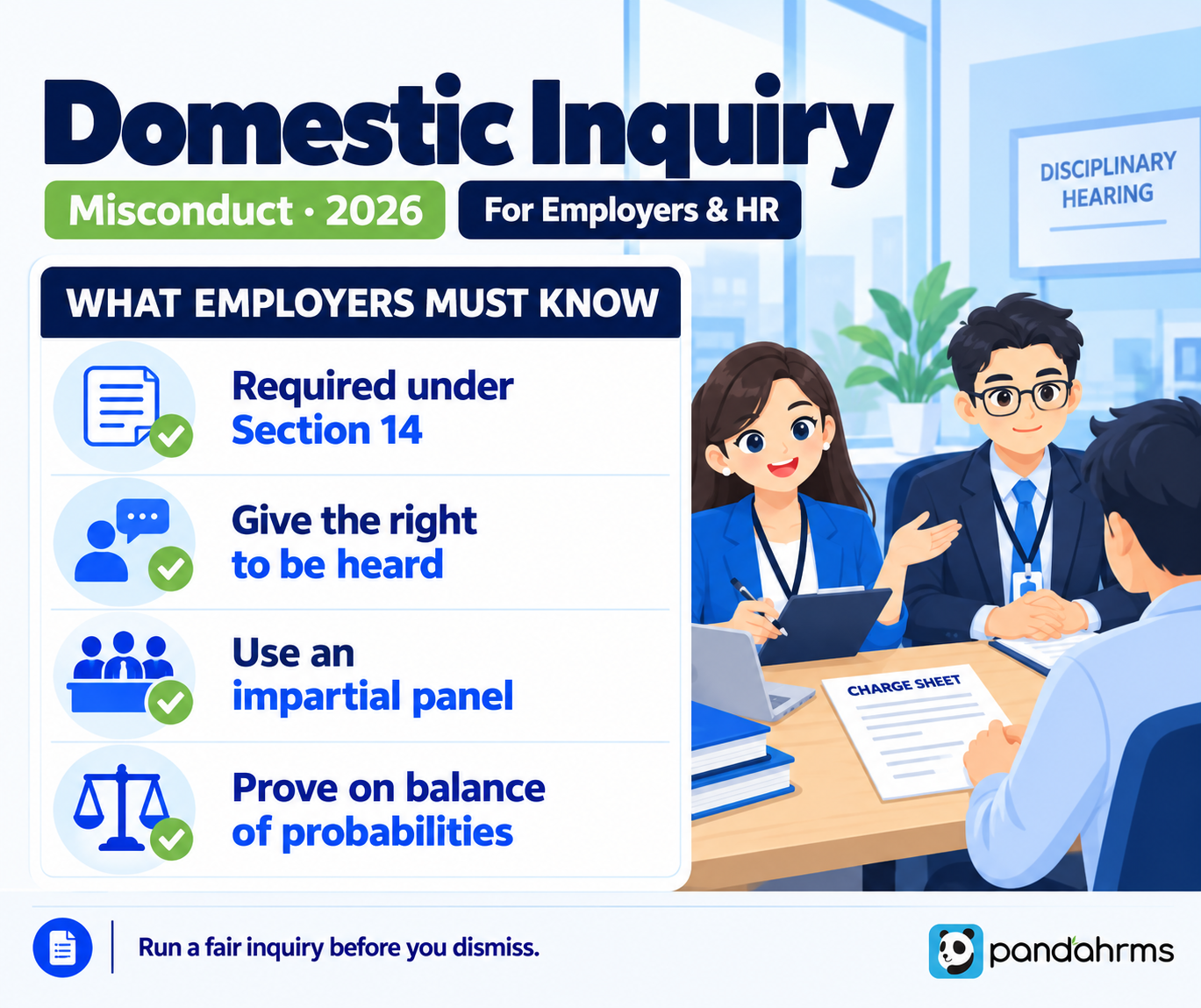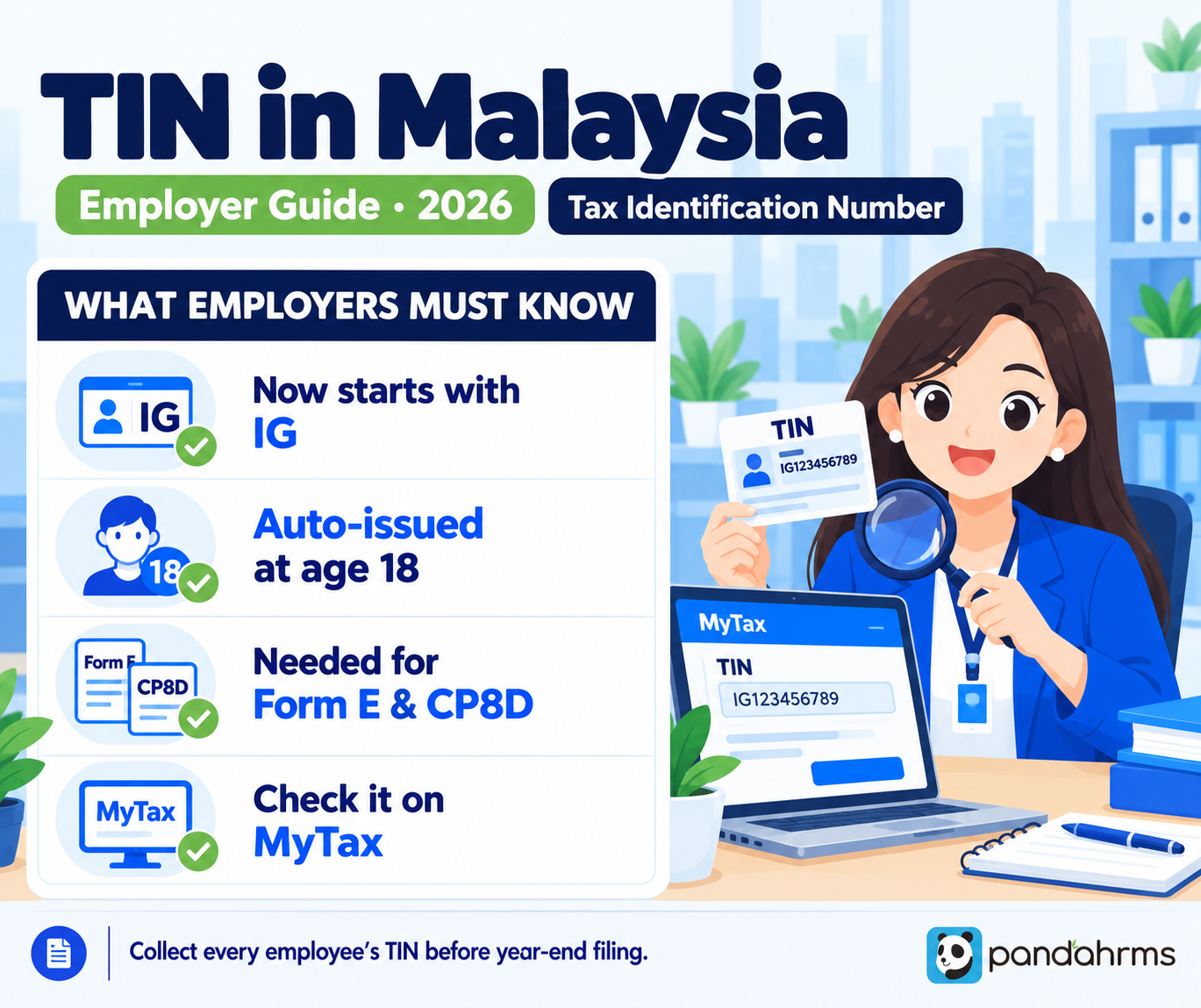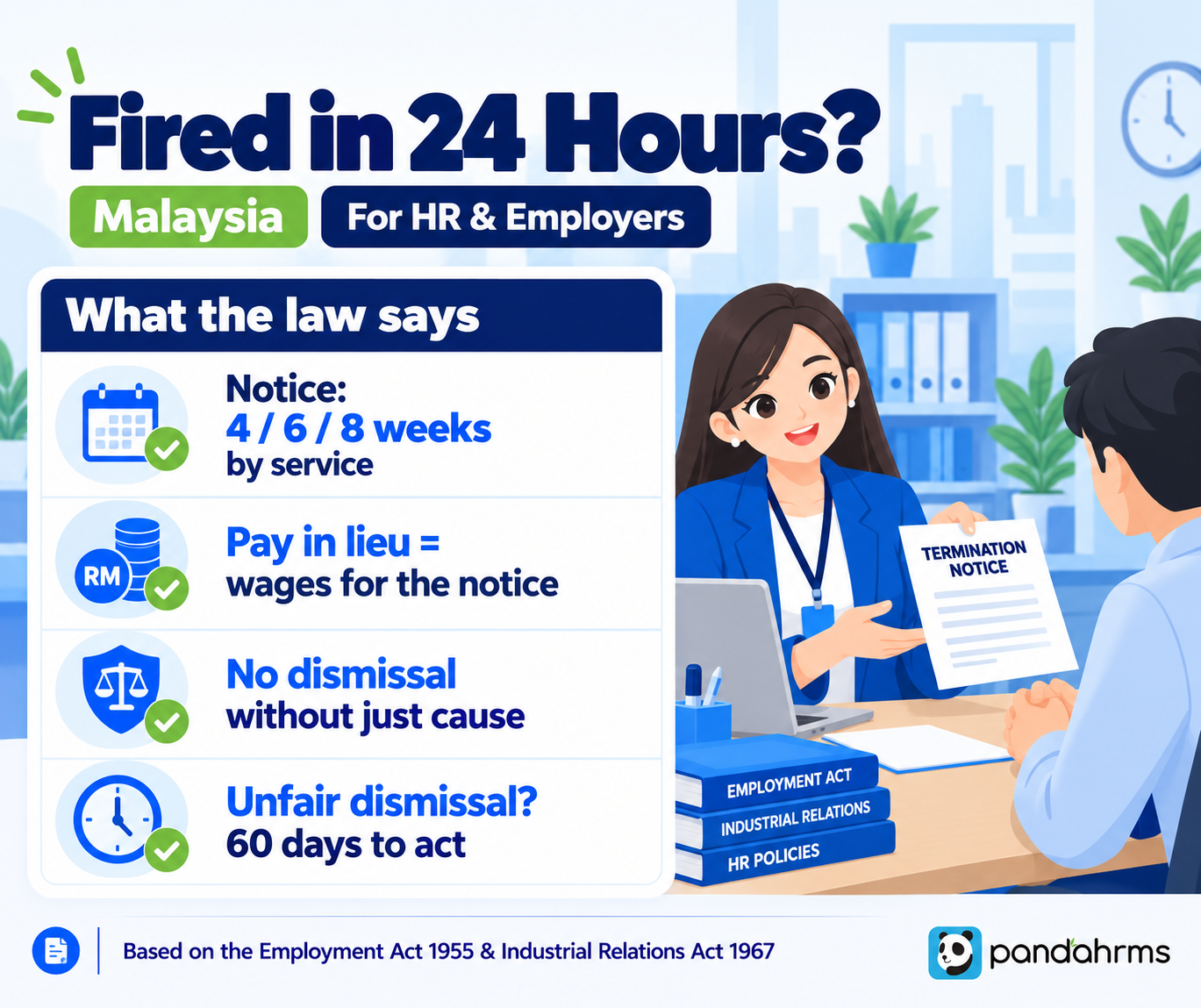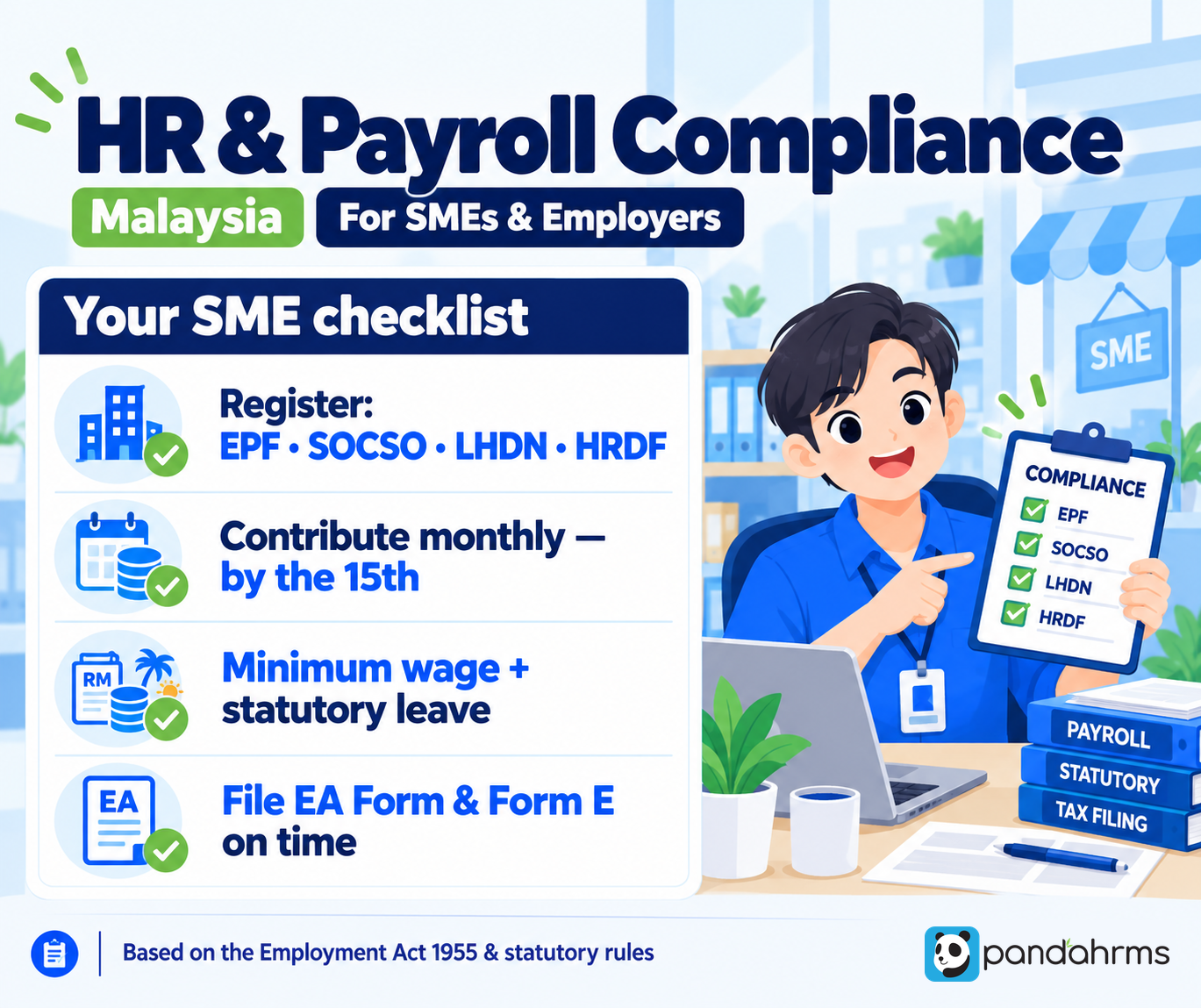
Small and medium businesses in Malaysia carry the same HR and payroll compliance duties as the big companies — just with a smaller team to handle them. Miss a registration, a contribution, or a tax form, and the penalties land on the business (and often its directors personally). This checklist walks through the essentials, from the day you hire your first employee to your annual filings, with the current 2026 figures.
Step 1: Register as an Employer
Once you employ your first staff member, you must register with the statutory bodies — there are deadlines, and they are short:
| Body | You register for | Deadline |
|---|---|---|
| EPF (KWSP) | Employer & employees’ retirement savings | Within 7 days of your first hire |
| SOCSO + EIS (PERKESO) | Work-injury & employment-insurance cover | Within 30 days of your first hire |
| LHDN | Employer tax file (E number) + notify each new hire via CP22 | CP22 within 30 days of a new employee |
| HRD Corp (HRDF) | Training levy — mandatory once you have 10+ Malaysian employees | Register when you reach the threshold |
Helpful guides: how to register an EPF account and the CP22 new-employee notification.
Step 2: Pay at Least the Minimum Wage
The national minimum wage is currently RM1,700 a month. It rises to RM2,000 from June 2027, with a temporary exemption for MSMEs below the RM50 million group turnover threshold. Pay below the floor and you are non-compliant from the first payslip. (See: Malaysia minimum wage 2027.)
Step 3: Put the Employment Terms in Writing
Under the Employment Act 1955, employment for more than one month must be covered by a written contract of service setting out the key terms — wage, hours, leave, notice and job scope. Employment contracts also need to be stamped. A clear, lawful contract and employee handbook prevent most disputes before they start. (See: what to include in an employee handbook and the contract stamping reminder.)
Step 4: Make the Monthly Statutory Contributions
Every month you deduct the employee’s share, add the employer’s share, and remit by the 15th of the following month:
| Contribution | Employer | Employee |
|---|---|---|
| EPF (KWSP) — citizen/PR under 60 | 13% (wages ≤ RM5,000) / 12% (> RM5,000) | 11% |
| EPF — foreign workers (since Oct 2025) | 2% | 2% |
| SOCSO (PERKESO) — ceiling RM6,000 | 1.75% | 0.5% |
| EIS (PERKESO) — ceiling RM6,000 | 0.2% | 0.2% |
| PCB / MTD (LHDN) | — | Per LHDN’s monthly tax schedule |
| HRDF levy (HRD Corp) | 1% of wages (0.5% optional for 5–9 staff) | — |
More detail in our guides to EPF contributions and the EIS (SIP).
Step 5: Give the Right Leave and Keep to Legal Working Hours
The Employment Act sets the minimum paid leave and the maximum working hours — 45 hours a week since the 2022 amendments took effect:
| Leave | Minimum entitlement |
|---|---|
| Annual leave | 8 / 12 / 16 days by length of service (s.60E) |
| Sick leave | 14 / 18 / 22 days; up to 60 days if hospitalised (s.60F) |
| Maternity leave | 98 days (s.37) |
| Paternity leave | 7 days (s.60FA) |
| Public holidays | 11 gazetted days, including 5 compulsory (s.60D) |
For the full breakdown, see types of leave in Malaysia and annual leave entitlement & pro-rata.
Step 6: File the Annual Tax Forms
At year-end, two forms matter — and they go to different places:
- EA Form (C.P.8A) — give one to every employee by the last day of February (28 February 2027 for YA 2026), so they can file their own tax. (See: EA Form guide.)
- Form E + CP8D — the employer’s return to LHDN, due by 31 March via MyTax e-Filing. (See: Form E & CP8D guide.)
- CP22 / CP22A — notify LHDN when an employee joins (CP22) or leaves (CP22A).
For the full year-end routine, see our year-end payroll checklist.
Step 7: Keep Proper Records
Compliance is also about being able to prove it. Keep an employee register and payroll records for at least 6 years under the Employment Act, and tax-related records for 7 years for LHDN. Issue every employee an itemised payslip each pay cycle. When an audit or a Labour Office query comes, reconciled records are the difference between a quick answer and a problem.
What Happens If You Don’t Comply
The cost of non-compliance is rarely just the shortfall. Late or unpaid EPF, SOCSO, EIS and PCB attract interest and penalties; a missed EA Form or Form E is an offence under the Income Tax Act 1967 (a fine of RM200 to RM20,000, or imprisonment, or both); and unpaid statutory contributions can make directors personally liable. For an SME, one overlooked obligation can wipe out a month’s margin.
How Pandahrms Helps
Most SME compliance failures are not deliberate — they are a small team running out of hours. Pandahrms calculates EPF, SOCSO, EIS, PCB and the HRDF levy at the correct rates (including the 2% foreign-worker EPF and the RM6,000 SOCSO/EIS ceiling), applies the statutory leave entitlements, generates payslips, EA Forms and the data for Form E, and keeps the records you need — all from one payroll run. Compliance becomes a checklist you can actually finish on time instead of a monthly scramble.
Frequently Asked Questions (FAQ)
- When must an SME register with EPF, SOCSO and LHDN?
Register with EPF within 7 days and SOCSO within 30 days of hiring your first employee, obtain an employer tax file with LHDN, and notify each new hire via CP22 within 30 days. - Does a small company have to pay the HRDF levy?
The HRDF (HRD Corp) levy is mandatory at 1% once you have 10 or more Malaysian employees. Employers with 5 to 9 Malaysian employees may register voluntarily at 0.5%. - Do I contribute EPF for foreign workers?
Yes. Since the October 2025 wage month, EPF for non-citizen employees is mandatory at 2% employer and 2% employee (domestic servants excluded). - What is the current minimum wage in Malaysia?
RM1,700 a month, rising to RM2,000 from June 2027 (with a temporary exemption for MSMEs below the RM50 million group turnover threshold). - When are the monthly statutory contributions due?
EPF, SOCSO, EIS, PCB and the HRDF levy for a given month are all due by the 15th of the following month. - How long must I keep HR and payroll records?
Keep employee and payroll records for at least 6 years under the Employment Act, and tax-related records for 7 years for LHDN.
Source: Employment Act 1955 (as amended 2022), EPF Act 1991, Employees’ Social Security Act 1969, Employment Insurance System Act 2017, Income Tax Act 1967, and guidance from KWSP, PERKESO, LHDN and HRD Corp. Rates, ceilings and deadlines are current as of 2026 and are set by the respective authorities — confirm the latest figures on the official KWSP, PERKESO, LHDN and HRD Corp sites. This article is general information, not legal or tax advice.